
- KIOST releases decade-long marine ecosystem analysis
- Food shortages and jellyfish predation threaten anchovy stocks
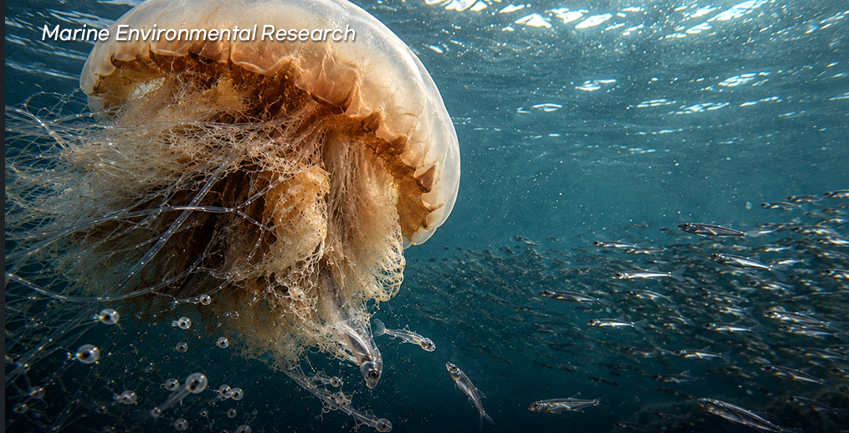
Jellyfish are appearing earlier than usual in the South Sea while the food supply for anchovies is shrinking. A new study finds that anchovy catches in the region fell about 25 percent over the past decade, as jellyfish began arriving roughly one and a half months earlier and feeding conditions for anchovies deteriorated.
The Korea Institute of Ocean Science and Technology said Thursday that a research team led by Kang Jeong-hun, director of the South Sea Research Center, reached those findings after comprehensively analyzing water temperatures, phytoplankton levels, jellyfish appearance timing and anchovy catch volumes along the South Sea coast from 2010 to 2020.
The research team divided the analysis period into three intervals — 2010 to 2013, 2014 to 2016, and 2017 to 2020 — based on changes in average sea surface temperature, then compared shifts in the marine ecosystem across each period.
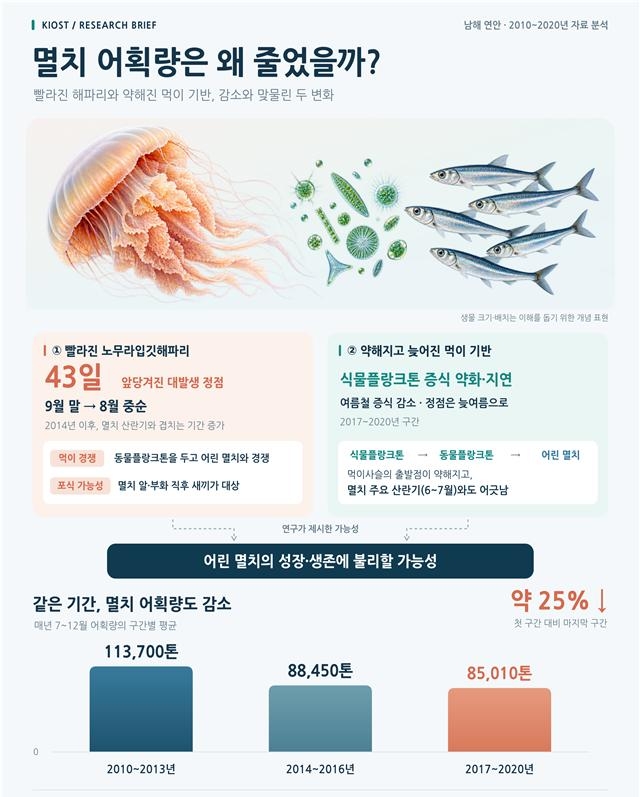
The analysis found that the peak appearance period for Nomura's jellyfish moved forward by about 43 days, from late September to mid-August. The research team said the jellyfish were reaching the South Sea coast earlier because inflow of the Tsushima Current increased during spring and summer months, from April through July.
The concern is that the earlier arrival of jellyfish has extended the overlap with the anchovy spawning season.
Juvenile anchovies and jellyfish both feed on zooplankton, so when they appear at the same time, competition for food intensifies. Jellyfish are also predators that consume anchovy eggs and newly hatched larvae.
Feeding conditions for anchovies have worsened as well. Phytoplankton — the foundation of the marine food chain — have been blooming in smaller quantities and at later times than before.
Between 2017 and 2020, the summer surge in phytoplankton slowed sharply and the bloom peak shifted to late summer, falling out of sync with the June–July period when anchovy spawning is most active.
Ultimately, juvenile anchovies are now encountering jellyfish — both competitors and predators — earlier in the season and under conditions of food scarcity.
Anchovy catch figures reflect the decline. The annual average catch from July through December fell from 113,700 metric tons in the 2010–2013 period to 88,450 metric tons in 2014–2016 and 85,010 metric tons in 2017–2020 — a drop of about 25 percent compared with the earliest period.
However, the research team said it cannot conclude that the earlier jellyfish arrival and phytoplankton changes are the direct cause of the decline, noting that anchovy catches are influenced by a range of factors including fishing activity.
The study is considered significant because it examined not only the scale of jellyfish appearances but also the timing and its effects on fishery resources. Because anchovies serve as prey for major species such as mackerel, a decline in anchovy stocks could ripple through the broader marine food chain.
"This research shows that not only the scale of jellyfish appearances but also their timing may be linked to anchovy catch levels," Kang said. "When managing fishery resources, we need to consider together the seasonal changes in jellyfish appearance, phytoplankton growth and anchovy spawning."
The findings were published in the international journal Marine Environmental Research.
nbgkoo@heraldcorp.com




