
50 companies to be selected annually in drug development, medical devices and related fields
60 billion won in investment, 90 billion won in guarantees to flow through R&D-dedicated bank
Ministries of SMEs and Health to jointly identify candidates and link clinical, commercialization support
Government says growth potential, not sales, will be the primary evaluation criterion
The government plans to nurture 200 promising small and medium-sized venture companies in the global pharmaceutical and biotech sector by 2030, selecting 50 high-potential firms each year and supporting them for up to five years — from technology development through clinical trials, commercialization and overseas expansion. To fund the initiative, the government will invest 60 billion won ($45.3 million) over three years and provide 90 billion won in commercialization guarantees.
The Ministry of SMEs and Startups and the Ministry of Health and Welfare jointly announced the plan, titled the "K-Pharma and Biotech Frontier Company Development Strategy," at a national policy coordination meeting Thursday.
The initiative was drawn up amid concerns that despite growth in the domestic pharmaceutical and biotech market, a contraction in venture investment and a decline in new startups are weakening the innovation ecosystem. The domestic pharma and biotech market expanded from 23.2 trillion won in 2020 to 31.7 trillion won in 2024. Over the same period, however, the number of new biotech venture startups fell by nearly half, from 581 in 2020 to 288 in 2023.
The government will identify promising companies across three areas: drug development; medical devices and digital health; and bio-materials and production technology. It plans to select 20 companies annually in drug development, 20 in medical devices and digital health, and 10 in bio-materials and production technology — reaching a cumulative total of 200 companies by 2030.
The two ministries will form a joint operating committee to deliberate on support categories, evaluation criteria, and the selection and deselection of companies. Each selected firm will be assigned a dedicated "growth director" on a one-to-one basis to assess its technology level and development stage and help craft a tailored growth strategy. Companies will receive R&D, clinical and commercialization support for an initial two years, after which a performance review will determine whether top performers receive an additional three years of support.
The government said it will factor in the inherent difficulty of producing visible short-term results in the biotech industry when conducting evaluations.
Park Yong-sun, director general for SME policy at the Ministry of SMEs and Startups, said at a pre-briefing held at Government Complex Seoul on Wednesday that pharmaceutical and biotech companies typically take more than 10 years to recoup their investments. "We will not use technology transfers or sales alone as performance indicators in the two-year review," Park said.
"Companies will propose their own targets based on growth potential, and we will incorporate indicators that experts agree on to decide whether to extend support," Park added. "We will apply performance metrics suited to the characteristics of each sector."
Financial support will also be expanded. The government will invest a total of 60 billion won over three years through the investment arm of an R&D-dedicated bank. The dedicated bank will also contribute 15 billion won to the Korea Technology Finance Corporation to supply a total of 90 billion won in commercialization guarantees.
Questions were raised, however, about whether the funding scale is sufficient given the enormous capital requirements of drug development. Park said financial support for pharmaceutical and biotech companies extends well beyond R&D investment alone, pointing to a range of other vehicles including AI and deep tech funds, the Ministry of Health and Welfare's mega-fund, and the National Growth Fund. "The significance lies less in the 60 billion won figure itself than in the fact that the R&D-dedicated bank is stepping in to invest directly," Park said.
The initiative focuses on linking existing funds, guarantees and R&D support programs, reflecting the capital-intensive nature of the pharmaceutical and biotech industry. Rather than distributing funds uniformly to individual companies, the approach connects each firm to the support it needs at its particular stage of development. Whether companies will ultimately be able to secure sufficient funding for clinical trials and commercialization, however, remains to be seen as the program gets under way.
The government will also strengthen support for AI-driven drug development, backing the validation and commercialization of AI drug-development models and expanding access to public medical and biotech data. To keep pace with global regulatory shifts — including the US Food and Drug Administration's moves to reduce animal testing — the government will also pursue development of animal-alternative testing technologies such as organoids and organ-on-a-chip systems.
To reduce funding gaps that arise when companies enter clinical trials, the government will expand technology validation and commercialization support that links clinical development, regulatory approval, chemistry, manufacturing and controls, and production.
Overseas expansion support is also part of the plan. The government will build networks with global pharmaceutical companies, investors and local experts, and expand international joint R&D aligned with the technology needs of foreign firms. The initiative will also leverage overseas hubs, including the Ministry of SMEs and Startups' Global Business Center in Chicago and the Ministry of Health and Welfare's presence at the Texas Medical Center.
Through the initiative, the government aims to achieve 500 new small and medium-sized enterprise startups in the pharmaceutical and biotech sector and $5.5 billion in exports by 2030.
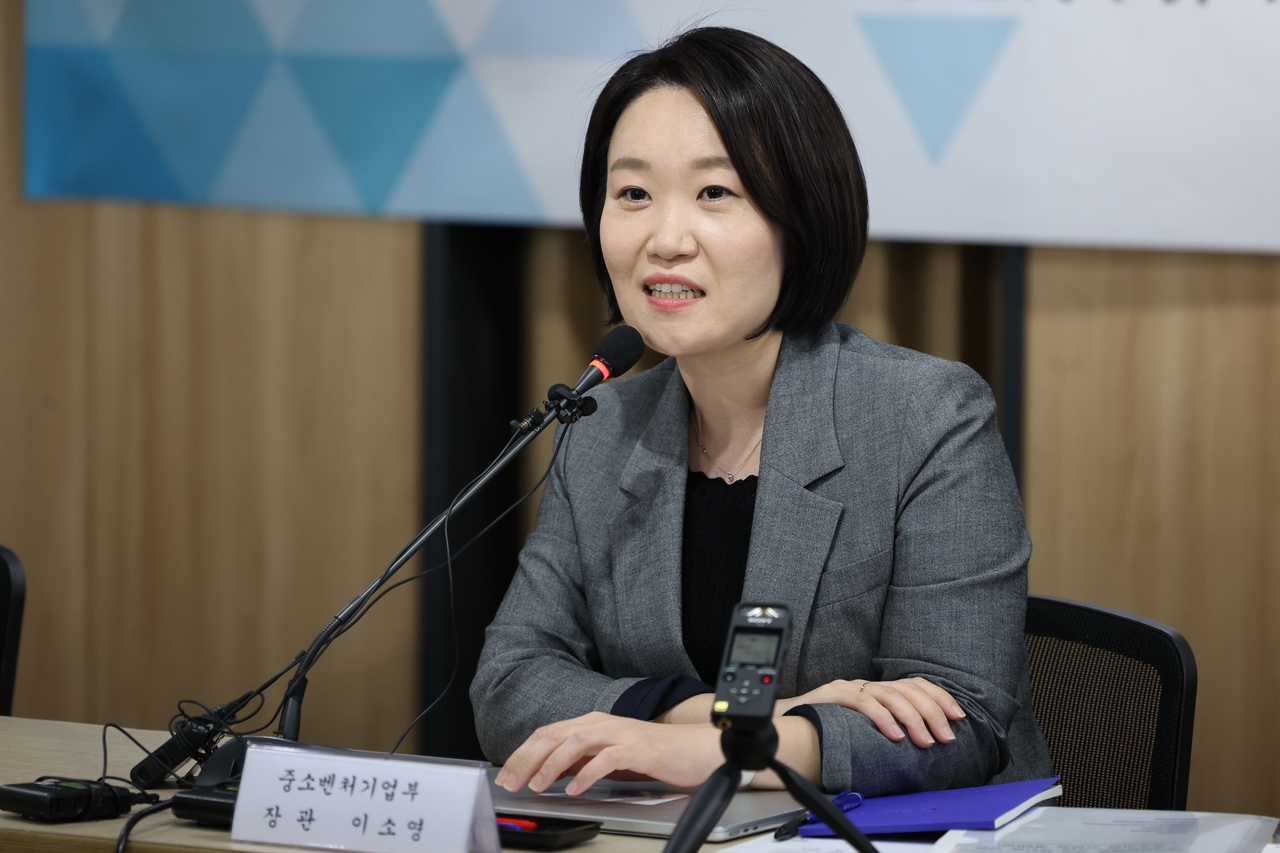
Lee So-young, minister of SMEs and Startups, said the initiative represents a new collaborative model for company development — one that moves away from support centered on individual programs and instead has the two ministries jointly identifying and selecting promising firms to cultivate as global leaders. "We will build an innovation ecosystem so that new technologies can blossom into a core engine of national growth," Lee said.
Jeong Eun-kyeong, minister of health and welfare, said systematic support across the entire process — from technology development through clinical trials, regulatory approval and commercialization — is essential for strong research outcomes in the pharmaceutical and biotech sector to translate into actual clinical applications and products. "We will closely link the Ministry of Health and Welfare's expertise in pharmaceuticals and biotech, along with its hospital and clinical infrastructure, with the Ministry of SMEs and Startups' capacity to support company growth, so that our companies can deliver results in global markets," Jeong said.
boo@heraldcorp.com




