
Korean retail investors' net purchases of US stocks in October surged more than fivefold from the previous month, hitting a record high for the year. Analysts say a stronger won has lowered the cost of buying dollar-denominated assets, while a steep drop in the domestic market has pushed investment demand overseas.
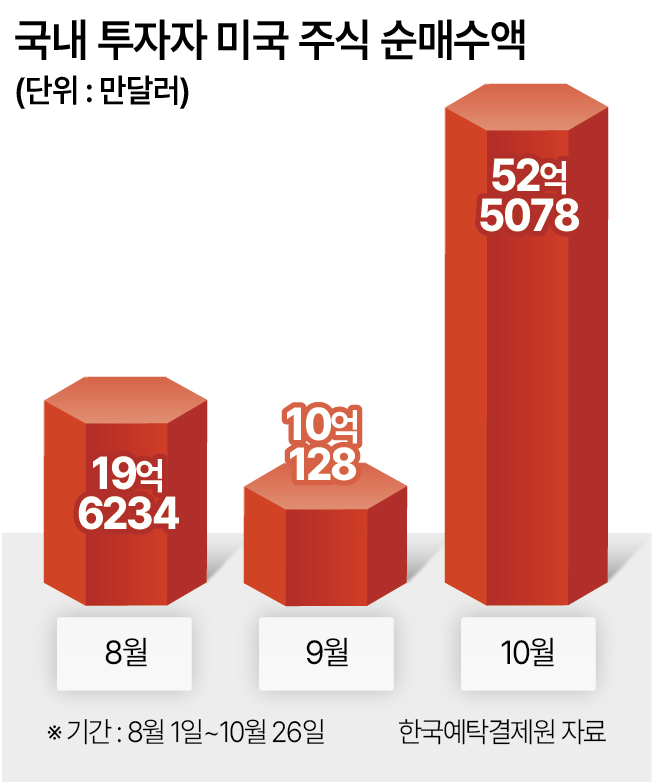
According to the Korea Securities Depository, domestic investors' net purchases of US stocks this month reached $5.25 billion as of Monday, roughly 5.2 times the $1 billion recorded in September and surpassing the $5 billion posted in January to set a new year-to-date high.
The surge in buying by Korean retail investors — known locally as "seohak gaemi," or overseas stock ants — has been driven largely by the won's appreciation. As the won-dollar exchange rate fell rapidly, reducing the cost of acquiring dollars, more investors moved to capitalize on the opportunity by putting money into US equities.
After topping 1,550 won per dollar in June, the exchange rate fell to the 1,440-won range by late July, then dropped further to the 1,360-won range in August and the 1,350-won range in September. This month it has fallen to around 1,320 won.
A sharp decline in the domestic stock market has also been cited as a factor driving funds into US equities. When the Kospi broke above the 7,000-point mark for the first time in history in May, domestic investors net sold more than $93.9 billion worth of US stocks and shifted funds into the local market.
But after the Kospi peaked near 9,000 points and turned lower, investors swung back to net buying of US stocks. As volatility in the domestic market increased, so did the scale of US stock purchases. The Kospi has since fallen below the 5,500-point level this month, tumbling more than 22 percent over the past month. Over the same period, the NASDAQ 100 and the S&P 500 declined just 4.11 percent and 0.86 percent, respectively.
Buying by retail investors has been concentrated in leveraged ETFs. Domestic investors net purchased $3.88 billion worth of the Direxion Daily Semiconductor Bull 3X Shares this month — a product that tracks three times the daily return of the Philadelphia Semiconductor Index. Another $299.5 million flowed into the Direxion Daily MSCI South Korea Bull 3X Shares ETF, a US-listed product that effectively lets investors bet on a rebound in the Korean market.
Experts caution that investors in US stocks should watch for currency losses, given the likelihood that the won will continue to strengthen. An investor who bought US stocks in June when the exchange rate stood at 1,550 won per dollar would be sitting on a currency-related loss of about 14.8 percent at the current rate of 1,320 won. Someone who converted 10 million won ($7,560) into dollars at the time would find the won-equivalent value of that investment has shrunk to about 8.52 million won today — even if the underlying share price has not moved.
Securities firms expect the won to keep strengthening. Ha Geon-hyeong, a researcher at Shinhan Securities, said the won-dollar exchange rate is likely to keep falling even amid broader dollar strength, as dollar supply remains dominant. "Export companies' dollar-selling and end-of-month dollar supply are expected to act as downward pressure on the exchange rate," he said.
Hanwha Investment & Securities projected the won-dollar exchange rate will trade in a range of 1,250 to 1,400 won in 2027. Researcher Lim Hye-yun said a favorable global manufacturing environment and strong exports led by the semiconductor sector would consistently expand dollar supply in the foreign exchange market, pulling the exchange rate lower.

moon@heraldcorp.com