- KIST develops 1-meter fiber-type zinc battery
- Retains 89.8% capacity, targets wearables and humanoid robots
Researchers have developed a battery that can be sewn into clothing like thread or wrapped around the joints of a humanoid robot. Stretching a full meter in length, it retains about 90 percent of its capacity after being bent 10,000 times.
The Korea Institute of Science and Technology announced Thursday that a research team led by Kim Nam-dong and Jung Hyun-su at KIST's Jeonbuk Branch Institute for Advanced Materials had developed a technology to continuously produce fiber-type zinc batteries at meter-scale lengths, in collaboration with Jeonbuk National University, KAIST and Kangwon National University.
Unlike conventional prismatic or cylindrical batteries, fiber-type batteries can be bent freely like thread or woven directly into fabric. They can be used in smart clothing and wearable sensors, as well as in space-constrained applications such as the joints or interior of a humanoid robot.
Zinc batteries, which use a water-based electrolyte, have drawn particular attention as a next-generation wearable power source because they carry a relatively low risk of fire or explosion.
A persistent challenge, however, has been the growth of dendrites — branching crystal formations that develop on the zinc anode surface during repeated charge-discharge cycles and degrade battery performance and lifespan. Most existing fiber-type zinc batteries have also been limited to lengths of around 10 centimeters, making them difficult to incorporate into real products.
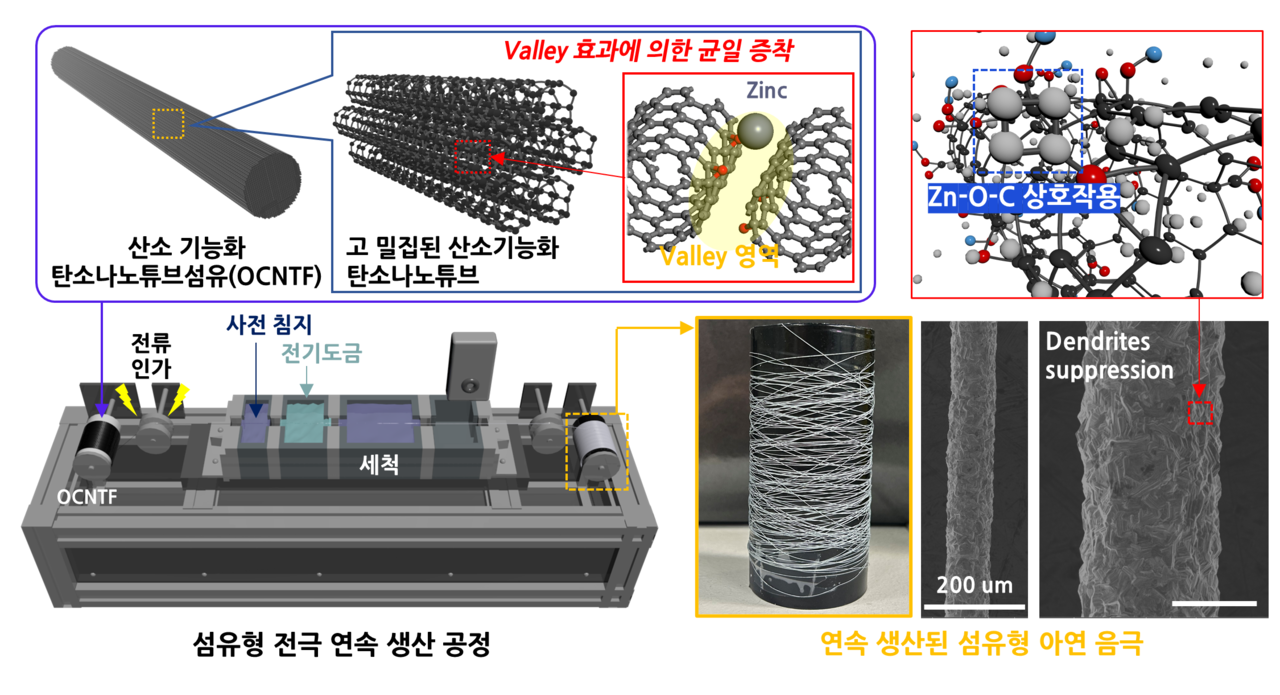
The research team addressed the problem by introducing oxygen functional groups into carbon nanotubes. By densely aligning the nanotubes and guiding zinc ions to deposit evenly across the surface, the team suppressed dendrite formation.
The approach also reduced hydrogen evolution and corrosion reactions during charging and discharging. In full-cell tests, the battery retained 85 percent of its initial capacity after 800 charge-discharge cycles.
The team also secured a key manufacturing process for mass production, developing a continuous electroplating system that automatically links every stage — from fiber feeding and zinc plating to washing, drying and winding.
Using this technology, the team successfully produced a fiber-type zinc battery measuring 1 meter in length — about 10 times longer than previous versions. The battery retained 89.8 percent of its initial capacity after 10,000 repeated bending cycles, demonstrating strong flexibility and durability.
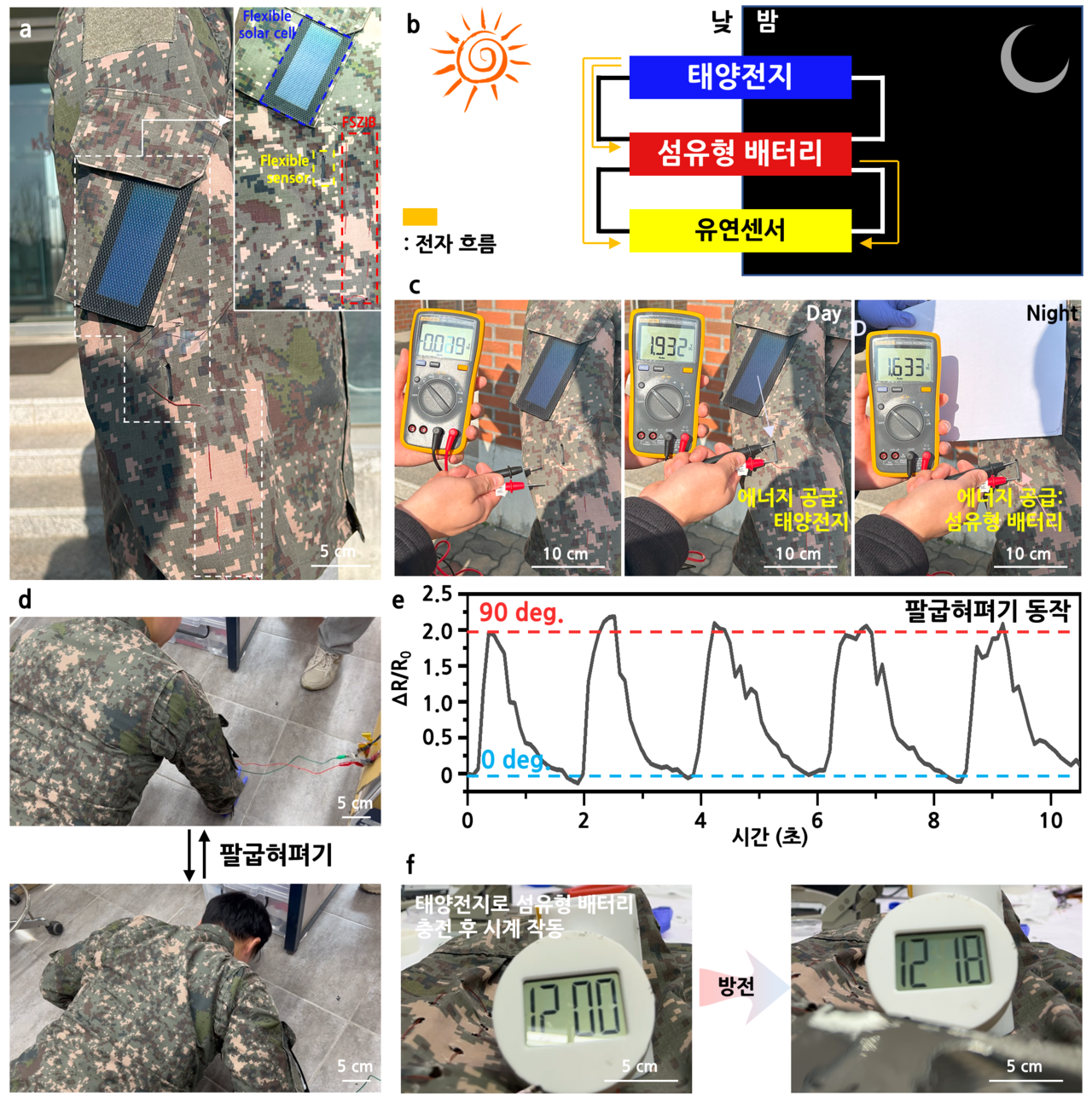
The team also verified real-world applicability by integrating the fiber battery with a flexible solar cell and a motion-detection sensor into a combat uniform. The system charged the battery with sunlight during the day and used the stored power to run the sensors at night.
Batteries produced through the continuous process can be cut to any required length or woven together with other fibers. Beyond smart clothing and electronic skin, the technology is expected to find use as a distributed power source around the joints or inside the frame of humanoid robots.
Commercialization will still require improvements in production speed, uniform plating over long electrode lengths, and verification of long-term stability under real-use conditions such as exposure to sweat and repeated washing.
"The significance lies in simultaneously solving the two core challenges of fiber-type zinc batteries — dendrite growth and length limitations — by combining materials and process technology," Kim said.
The findings were published in the international journal Advanced Energy Materials.
nbgkoo@heraldcorp.com