
- ETRI spearheads update to international standard SAE J3016
- Revised standard clarifies when drivers must monitor vehicles and intervene in emergencies
Just because a self-driving car can maintain its lane and adjust its speed does not mean the driver can take both hands off the wheel or stop watching the road. As autonomous driving technology advances rapidly, confusion over the respective roles of drivers and vehicles has grown — and Korean researchers have now led a revision of the internationally recognized six-level autonomous driving standard.
The Ministry of Science and ICT and the Electronics and Telecommunications Research Institute (ETRI) announced Thursday that Korean researchers spearheaded the revision of SAE J3016, the international standard that classifies autonomous driving technology on a scale from Level 0 to Level 5.
SAE J3016 was first established in 2014 by SAE International, a global association of automotive engineers. Automakers, parts suppliers, governments and international organizations worldwide use it as a reference for developing autonomous driving technology and related regulatory regimes.
Cha Hong-gi, director of ETRI's Intelligent Information Standards Research Laboratory, led the revision over three and a half years. The update is particularly significant because it marks the first time Korean researchers have taken the lead in revising the standard, which had previously been driven primarily by the United States. The revised edition was officially published Sept. 20.
The previous standard classified autonomous driving levels as driver assistance, partial automation, conditional automation, high automation and full automation.
However, as driver-assistance features such as lane-keeping and speed control have grown increasingly sophisticated, some users began mistaking them for full autonomous driving. Informal industry terms such as "Level 2+" also added to consumer confusion.
The core of the revision is a clearer delineation of how much of the driving the vehicle handles and when the driver must intervene.
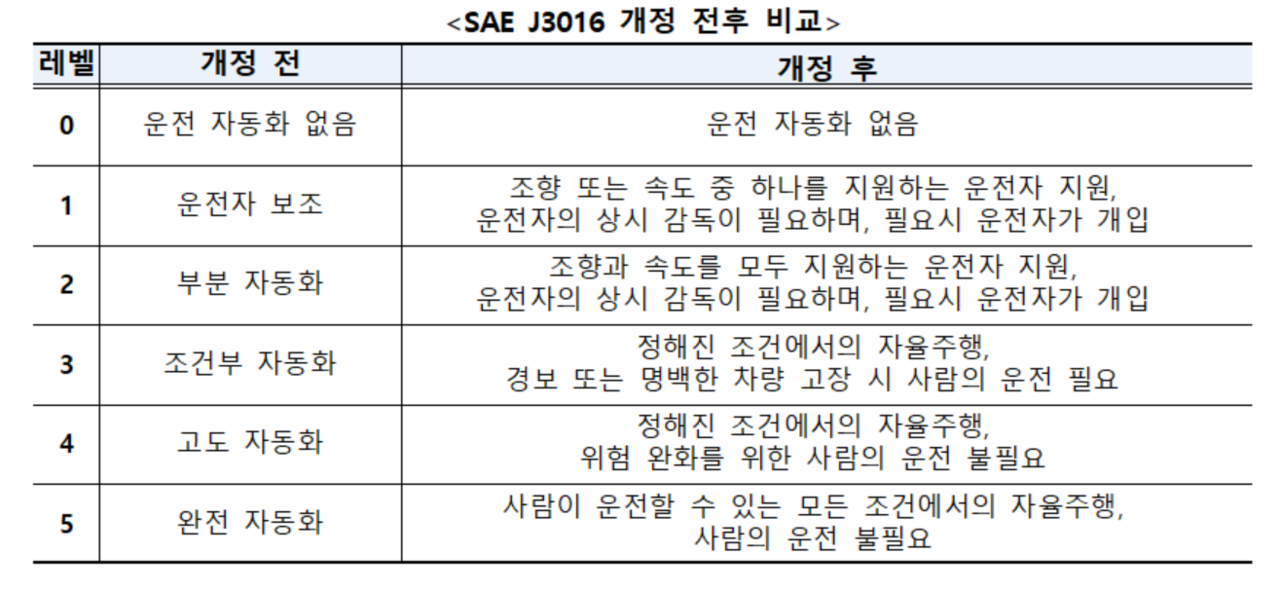
At Level 1, the vehicle assists with either steering or speed control, but not both. At Level 2, it handles both — yet at both levels, the driver must continuously monitor the vehicle and intervene when necessary.
From Level 3 onward, the vehicle performs autonomous driving under defined conditions. However, if the system issues a warning or an obvious malfunction occurs, a human must take over.
Level 4 allows fully autonomous operation within defined conditions without any human intervention. It differs from Level 3 in that a human does not need to take the wheel even in a hazardous situation.
Level 5, the highest tier, represents full autonomy — the vehicle drives itself under any condition a human driver could handle.
The revision will allow automakers and parts and software companies developing autonomous driving technology to design their systems with a clearer distinction between the roles of driver and vehicle.
Governments, regulators and the insurance industry are also expected to benefit from more concrete benchmarks when discussing liability and safety standards for autonomous driving incidents.
In particular, consumers will find it easier to tell whether a vehicle merely assists with driving or actually performs autonomous driving under specific conditions.
"As driver-assistance features become more sophisticated and autonomous driving services such as robotaxis expand, the importance of a clear, internationally accepted standard is growing," a Ministry of Science and ICT official said. "Korean researchers leading this international standard revision is a meaningful achievement, and we will actively support South Korea's continued leadership in setting global standards for autonomous driving."
nbgkoo@heraldcorp.com




