
Over 160 companies join Hunet's Injaekioom program in 4 months
Courses range from GPT basics to AI agents and workflow automation
Demand for advanced and customized training on the rise
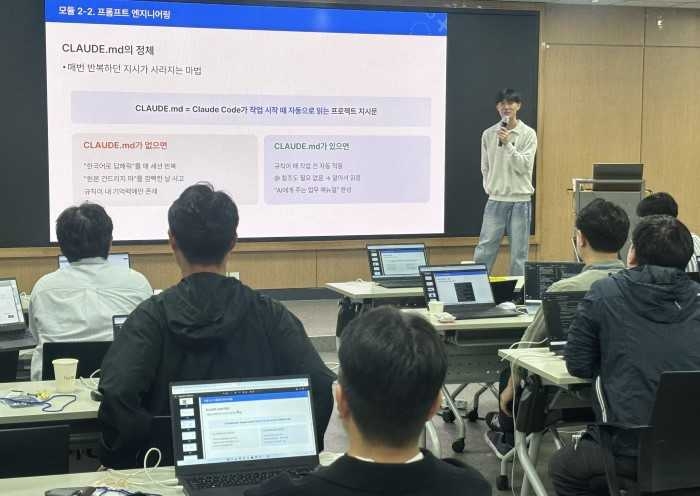
Small and medium-sized enterprises are tapping government support to build their employees' practical AI skills. A growing number of companies are looking to apply generative AI and workflow automation tools on the job while keeping training costs in check.
According to Hunet, a corporate training firm, more than 2,500 employees from over 160 companies have completed AI practical training through its SME Injaekioom premium training program within four months of the program's launch.
Injaekioom is a government-backed system under which the state covers 90 to 95 percent of training costs for employees at small and medium-sized enterprises. Companies can provide AI education tailored to their employees' specific job functions at minimal expense.
One medical device company, for instance, ran 10 rounds of AI skills training over three months for all 300-plus employees. Courses were tiered by proficiency level — from basic GPT use to Claude-based AI agents and workflow automation.
A precision machinery manufacturer also put all roughly 120 of its office staff through AI training. Employees chose between GPT application courses and "vibe coding" sessions based on their roles and interests.
Vibe coding is a development approach in which a user describes a desired function in plain language and AI writes the corresponding code. The method has drawn attention because it allows employees with little or no coding background to build their own AI-powered work tools.
An industrial equipment distributor ran a blended online and in-person program for about 400 employees spread across the country. After training all staff on Microsoft's AI tool Copilot, the company began rolling out paid accounts starting with the job functions where the tool proved most useful in practice.
These cases illustrate that AI transformation at small businesses does not have to begin with large-scale capital investment. Training existing employees to use AI for document drafting, data analysis and workflow automation is itself a viable path to AI adoption. Whether participation in training translates into measurable productivity gains, however, requires separate performance tracking.
The surge in demand is showing up in Hunet's earnings. Revenue from the Injaekioom program jumped roughly 4.7 times in August compared with the previous month, when full-scale training got underway. Sales more than doubled again in September from the month before.
"Most small and medium-sized enterprises know they need to adopt AI, but many are stuck wondering where to start or which tools to use," a Hunet official overseeing the Injaekioom program said. "Companies that learn about the Injaekioom system are highly satisfied because they can get practical AI training while significantly reducing the cost burden — and many go on to enroll in follow-up courses."
boo@heraldcorp.com




