
Four-year university dorm capacity rate stands at 21.7%
Greater Seoul area at 17.3%, lower than non-metropolitan universities
Single rooms up, rooms for four or more cut
Only 24.2% of dorms accept card payments
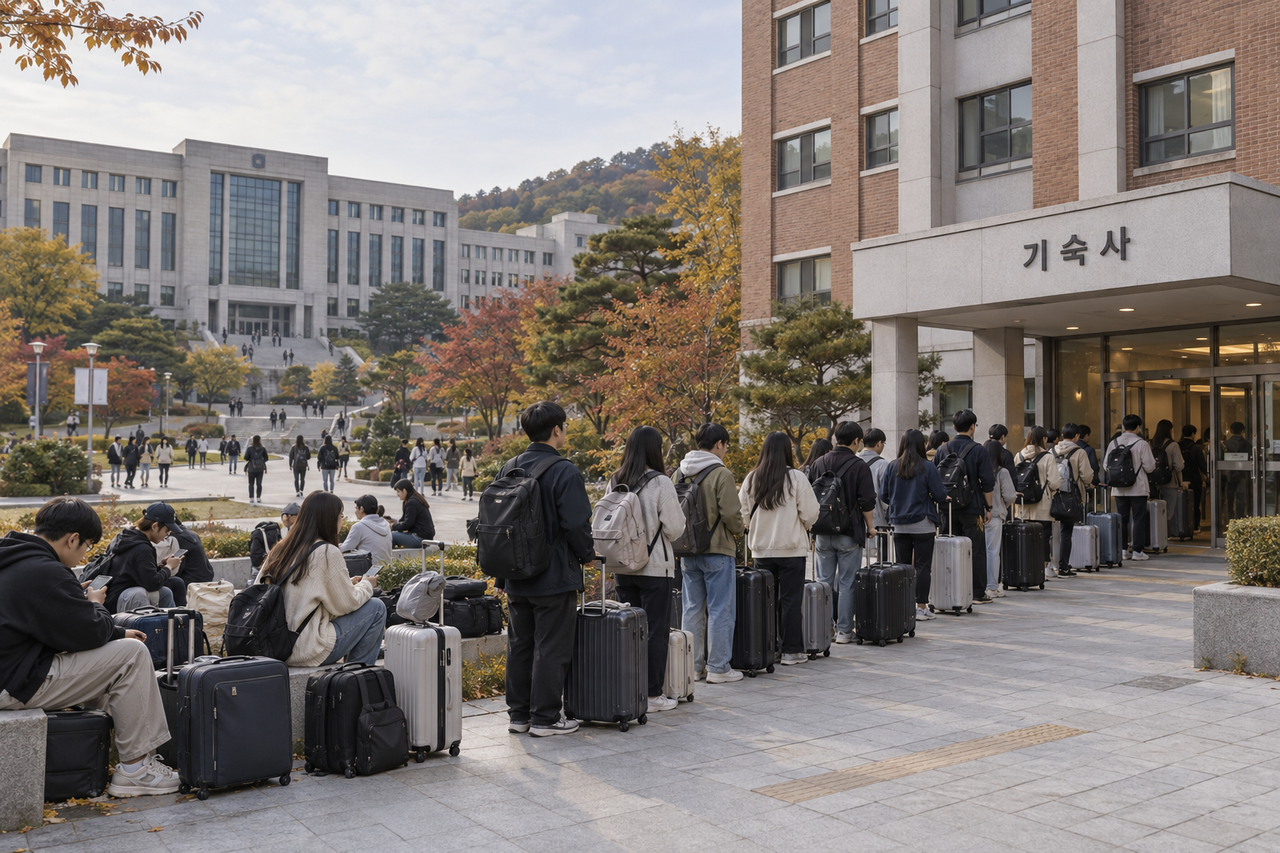
University dormitory capacity rates fell this year for the second consecutive year, with four-year universities posting a rate of 21.7% — a sign that dormitory expansion is failing to keep pace with growing enrollment. While more dormitories now accept card payments or installment plans, over half still require a lump-sum cash payment.
According to an analysis of university information disclosures for October 2026, released Friday by the Ministry of Education and the Korean Council for University Education, the dormitory capacity rate at 192 four-year general and education universities stood at 21.7% as of April 1 this year — down 0.5 percentage points from 22.2% last year. The capacity rate measures the ratio of available dormitory beds to total enrolled students.
The number of available dormitory beds rose by 2,613, from 342,117 last year to 344,730 this year. Over the same period, total enrollment climbed by 47,719 students — from about 1.54 million to about 1.59 million.
The Ministry of Education said the shift toward single rooms, driven by student preference, also contributed to the decline. Single rooms increased 6.3 percent from last year, while rooms accommodating four or more students fell 1.1 percent. The result is a structure in which adding rooms does not proportionally increase the number of available beds.
Capacity rates were even lower at universities in the Greater Seoul area. The 73 universities in the metropolitan area posted a rate of 17.3 percent, compared with 25.2 percent at the 119 non-metropolitan universities — a gap of 7.9 percentage points. Both regions fell 0.5 percentage points from last year. National and public universities saw their rate rise from 26.4 percent to 26.9 percent, while private universities saw theirs fall from 20.8 percent to 20.0 percent.
Cash payment remained the most common method for dormitory fees. Of the 252 dormitories surveyed, only 61 — or 24.2 percent — accepted card payments, up eight from last year. The number accepting cash installment payments rose by 13 to 92.
By contrast, 144 dormitories — 57.1 percent of the total — accepted only lump-sum cash payments such as bank transfers. That figure dropped by five from last year but still represents a majority. Among private university dormitories, only 15 of 183 accepted card payments, a rate of 8.2 percent. At national and public universities, 46 of 69 did so, a rate of 66.7 percent.
Capacity rates at two-year colleges also declined. The rate at 124 two-year colleges fell from 15.0 percent last year to 14.2 percent this year. The metropolitan area rate stood at 7.6 percent, while the non-metropolitan rate was 19.9 percent.
Among the 112 two-year college dormitories surveyed, 11 accepted card payments and 20 allowed cash installment payments. The remaining 87 — or 77.7 percent — accepted only lump-sum cash payments.
The dormitory payment statistics were compiled by type of operation — directly managed, privately financed and government-supported — and excluded free dormitories. Detailed information by university is available on the University Alimi website.
brunch@heraldcorp.com




