
Tokyo's retail and wholesale sales reach 251.04 trillion yen, accounting for 35.7% of national total; IT sector even more concentrated at 70.1%
Aichi Prefecture leads in manufacturing as regional industrial base offsets Tokyo dominance
Tokyo's economic dominance over the rest of Japan is sharpening, particularly in wholesale and retail trade and the information and communications sector. The capital's annual wholesale product sales accounted for 41.9% of the national total, and its share of information and communications industry sales surpassed 70%.
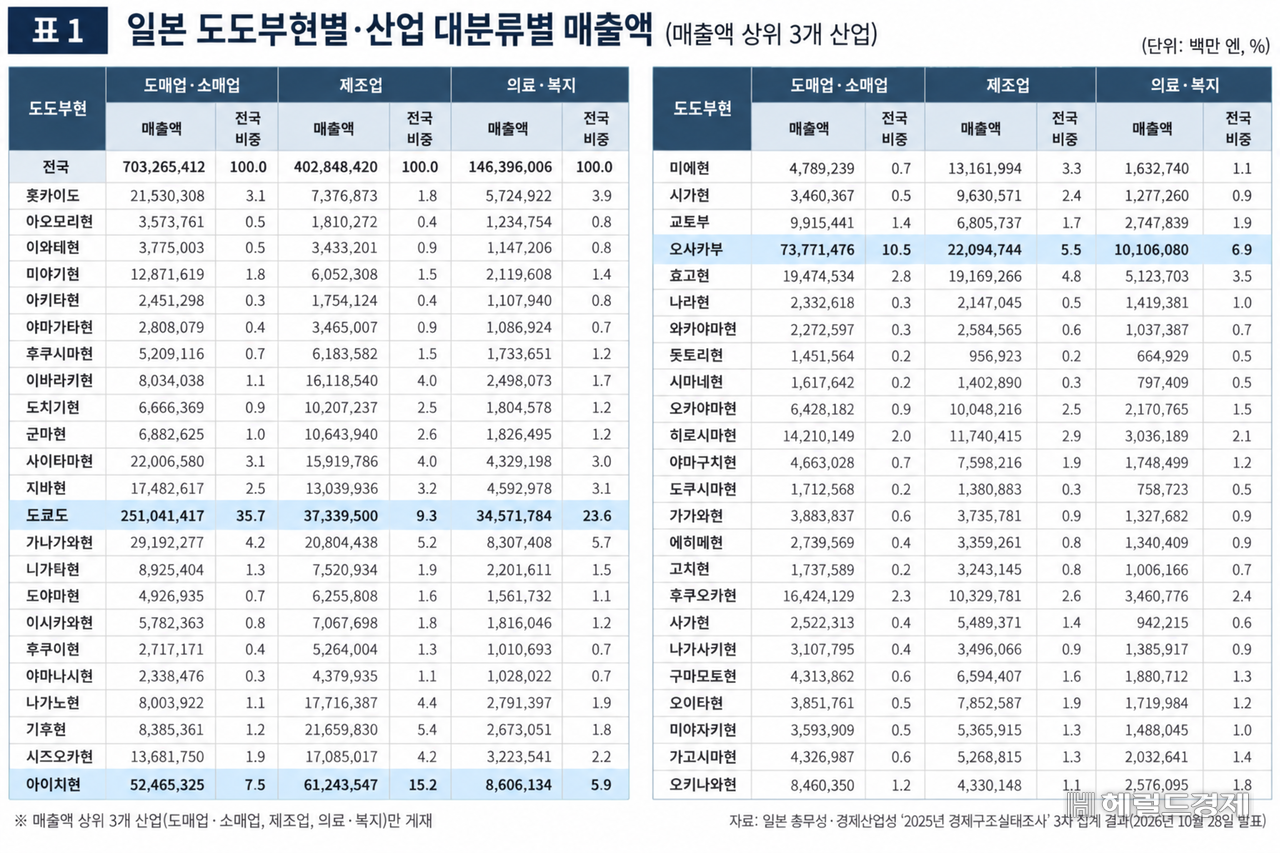
Third round of results from Japan's 2025 Economic Census for Business Activity, Ministry of Internal Affairs and Communications and Ministry of Economy, Trade and Industry
Tokyo's combined retail and wholesale sales reached 251.04 trillion yen ($1.59 trillion) in 2024, accounting for 35.7% of Japan's national total, according to the third round of results from the 2025 Economic Census for Business Activity released Wednesday by Japan's Ministry of Internal Affairs and Communications and Ministry of Economy, Trade and Industry.
That figure far outpaced second-place Osaka Prefecture at 73.77 trillion yen (10.5%) and third-place Aichi Prefecture at 52.47 trillion yen (7.5%).
The survey analyzed industry-level sales and regional economic activity across corporate establishments nationwide, with sales figures compiled from results covering January through December 2024.
Tokyo's economic weight was equally pronounced when wholesale and retail trade were broken out separately.
Tokyo's annual wholesale product sales totaled 213.1 trillion yen, representing 41.9% of the national total of 508.23 trillion yen. Osaka Prefecture followed at 59.1 trillion yen (11.6%), with Aichi Prefecture at 41.07 trillion yen (8.1%).
In retail, Tokyo accounted for 25.08 trillion yen, or 15.7% of the national total. Osaka Prefecture ranked second at 11.64 trillion yen (7.3%), followed by Kanagawa Prefecture at 10.28 trillion yen (6.4%).
The concentration was even more striking in the information and communications sector. Tokyo's sales in that industry reached 41.63 trillion yen, equal to 70.1% of the national total of 59.37 trillion yen.
In academic research and professional and technical services, Tokyo's sales reached 35.19 trillion yen, accounting for 54.8% of the national figure. In real estate and equipment leasing, Tokyo recorded 31.95 trillion yen, or 44.8% of the national total.
Manufacturing told a different story. Aichi Prefecture, the industrial heartland of central Japan, posted the highest manufacturing sales in the country.
Aichi's manufacturing sales came to 61.24 trillion yen, or 15.2% of the national total of 402.85 trillion yen. Osaka Prefecture followed at 22.09 trillion yen (5.5%), with Kanagawa Prefecture at 20.8 trillion yen (5.2%).
The data illustrate how Tokyo commands an outsized share of wholesale trade, information and communications, and professional services, while manufacturing remains comparatively dispersed across regional industrial bases led by Aichi Prefecture.
Tokyo also ranked first nationally in healthcare and welfare. Sales in that sector reached 34.57 trillion yen, accounting for 23.6% of the national total. Osaka Prefecture recorded 10.11 trillion yen (6.9%) and Kanagawa Prefecture 8.31 trillion yen (5.7%).
Breaking down product sales by industry category, food and automotive-related sectors carried the largest weight.
In wholesale trade nationwide, food and beverage wholesaling was the largest category at 62.62 trillion yen, representing 12.3% of the total. Electrical machinery and equipment wholesaling followed at 61.42 trillion yen (12.1%), with pharmaceuticals and cosmetics wholesaling at 42.89 trillion yen (8.4%).
In retail, general food retailing was the top category at 24.38 trillion yen, accounting for 15.3% of the total. Automotive retailing came in at 23.37 trillion yen (14.6%), followed by fuel retailing at 13.92 trillion yen (8.7%).
Mail-order and door-to-door retail recorded annual product sales of 9.77 trillion yen, equal to 6.1% of total retail. Drug stores accounted for 8.93 trillion yen (5.6%) and convenience stores for 5.63 trillion yen (3.5%).
Taken together, the figures show that Japan's economy has developed distinct regional concentrations by industry. Tokyo holds an overwhelming share of wholesale trade, information and communications, and professional services, while manufacturing is anchored by regional industrial bases centered on Aichi Prefecture.
The release covers regional industrial structures based on 2024 sales results and does not directly show year-on-year changes in sales or regional growth rates.
The Ministry of Internal Affairs and Communications and the Ministry of Economy, Trade and Industry plan to release the fourth round of Economic Census for Business Activity results, which will include sole proprietors, on Dec. 23.
sjkim@heraldcorp.com




