
First four-week supply price set at around 129,800 won, roughly half the cost of global rivals; Korean-specific Phase 3 trial data shows average 9.75% weight loss; drug challenges the 2 trillion won domestic obesity market
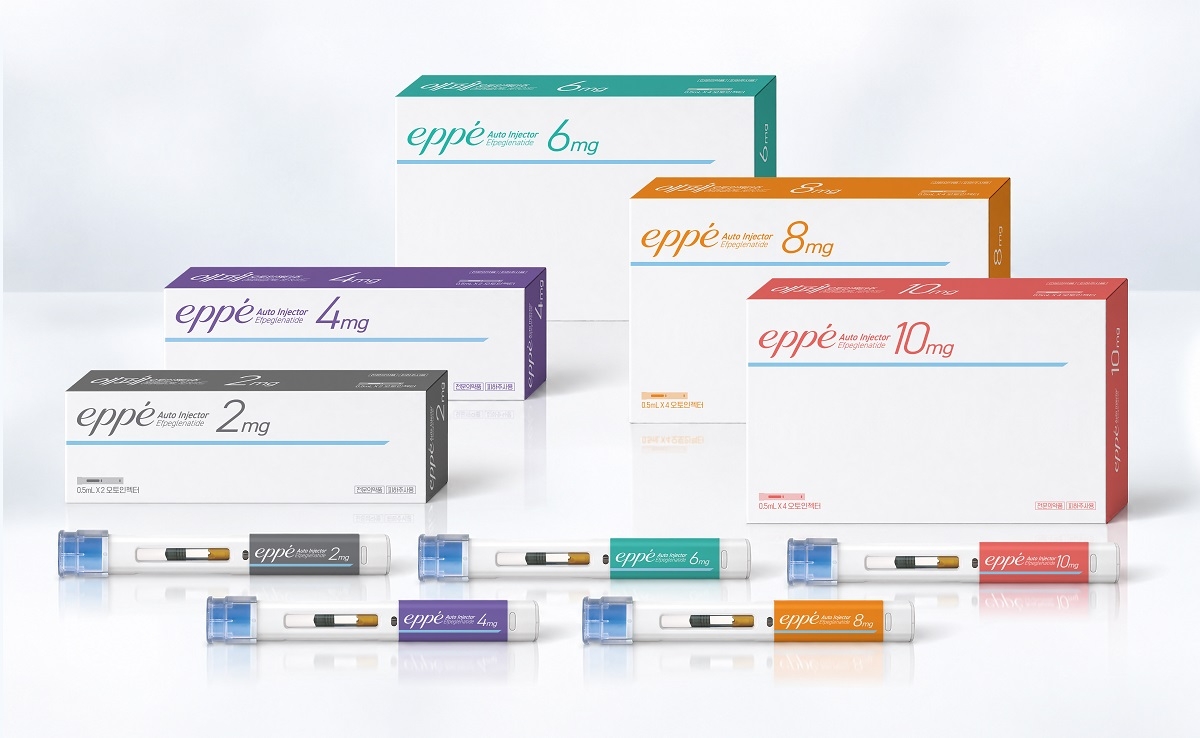
Epe, Hanmi Pharm's independently developed obesity drug and South Korea's first GLP-1 receptor agonist in its class, began reaching patients at select clinics and hospitals Thursday.
The domestic obesity treatment market has long been split between Novo Nordisk's Wegovy and Eli Lilly's Mounjaro. With a price roughly half that of existing foreign drugs and clinical data tailored to Korean patients, Epe is now poised to reshape that two-way competition into a three-way race.
According to the pharmaceutical industry, Epe — whose active ingredient is efpeglenatide — completed its first product shipment Oct. 22 and began actual patient prescriptions Thursday at select clinics and hospitals, without a formal launch event.
Epe works by binding to GLP-1 receptors in the central nervous system and gastrointestinal tract, suppressing appetite and slowing gastric emptying to induce a sense of fullness. The drug comes in five dosage levels — 2 mg, 4 mg, 6 mg, 8 mg and 10 mg — designed to be administered starting at the lowest 2 mg dose and increased gradually until reaching the maintenance dose of 10 mg.
Epe's greatest strength is its pricing advantage over competing drugs. Hanmi Pharm set the per-dose supply prices as follows: 24,200 won ($18) for 2 mg, 40,700 won for 4 mg, 57,200 won for 6 mg, 69,300 won for 8 mg and 74,800 won for 10 mg.
Based on a combined 2 mg and 4 mg regimen during the initial four-week adaptation period, the supply price comes to 129,800 won — roughly half the four-week supply price of Mounjaro at its lowest dose (about 270,000 won) and about 40 percent cheaper than Wegovy (about 210,000 won). For the maintenance phase, the four-week supply price is set at 228,800 won for weeks five through eight, 277,200 won for weeks nine through 12, and 299,200 won from week 13 onward at the 10 mg maintenance dose.
Another differentiating factor is the clinical data optimized for Korean patients, earned through an entirely in-house development process. Hanmi Pharm completed every stage independently — from candidate discovery through preclinical work, Phase 3 trials and commercialization. In a Phase 3 trial involving 448 Korean obesity patients, those who received Epe over 40 weeks achieved an average body weight reduction of 9.75 percent, with individual patients showing losses of up to 30 percent.
The market is watching closely to see whether Epe can carve out a meaningful position in South Korea's obesity drug market, which has grown rapidly to around 2 trillion won ($1.51 billion) annually. Analysts say the drug's strong cost-effectiveness and safety profile — backed by Korean-specific data with a reduced side-effect burden — could prove compelling at the point of prescription.
How quickly Hanmi Pharm can resolve early supply shortages at clinics and hospitals will be key to the drug's initial rollout, given that the first shipment volume is limited. Efpeglenatide is produced entirely in-house at the company's Pyeongtaek biotech plant, from raw materials through to finished product, giving it a stable supply chain.
"We will enhance patient access to treatment through rigorous quality control and a reasonable pricing structure so that Epe can successfully take root in the domestic market," a Hanmi Pharm official said. "We will do our utmost to contribute to healthy weight management and integrated metabolic disease care for the public, and ultimately to improve the quality of life for obesity patients."
silverpaper@heraldcorp.com




