- KAIST develops antibody candidate to ease cancer cachexia
- Grip strength improves 30% in mice; combination with anticancer drugs expected

South Korean researchers have developed an antibody drug candidate that can prevent the appetite loss and muscle wasting caused by cancer. Animal experiments confirmed the candidate restores body weight and muscle strength.
KAIST announced Thursday that a research team led by Kim Ho-min, a professor in the Department of Biological Sciences, jointly developed an antibody drug candidate called GB2Ab with a team led by Song Min-ho, a professor at KAIST's Graduate School of Medical Science and Engineering. Song also heads Thor Therapeutics, a startup founded by KAIST faculty.
Cancer cachexia is a serious complication seen in cancer patients. Unlike simple malnutrition, it involves a disruption in the body's energy metabolism that causes continuous loss of muscle and fat. Recovery is difficult even with adequate nutrition, which diminishes patients' quality of life and makes it harder to continue anticancer treatment.
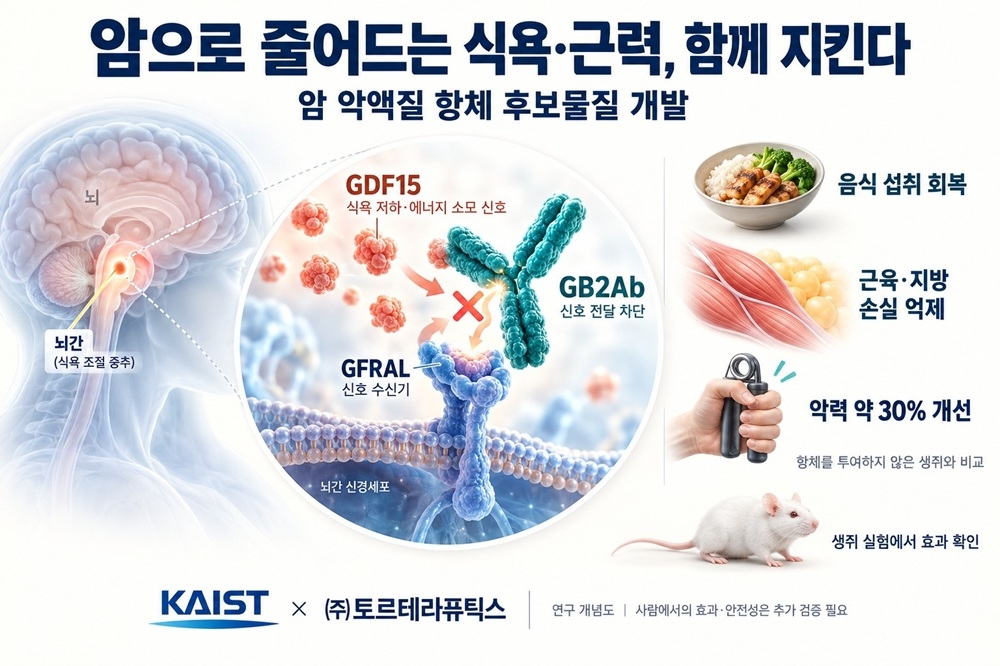
The research team focused on the GDF15-GFRAL signaling pathway, a key driver of cancer cachexia. When cancer or severe stress raises levels of the GDF15 protein in the blood, it binds to GFRAL receptors in the brainstem, suppressing appetite and affecting energy expenditure.
GB2Ab is an antibody that directly blocks the GFRAL receptor where GDF15 binds. By cutting off the signals that suppress appetite and drive excessive energy consumption, the antibody reduces muscle and fat loss.
The team also mapped the three-dimensional structure of the antibody-receptor complex and used those findings to improve the antibody's production yield and stability.
The team confirmed the treatment's efficacy as well. When the antibody was administered to mice with cancer cachexia induced by transplanted colorectal cancer cells, food intake recovered and muscle and fat loss was suppressed.
Body weight, excluding tumor mass, was about 20 percent higher in treated mice than in untreated ones. Grip strength also improved by about 30 percent, recovering to roughly 90 percent of the level seen in healthy mice.
After the antibody was administered, excessive activation of the sympathetic nervous system also decreased — suggesting the treatment may do more than restore appetite, potentially easing the abnormal energy expenditure that depletes the body.
No significant abnormalities in body weight or food intake were observed when high doses were given to healthy mice. However, additional preclinical studies and clinical trials will be needed to verify safety and efficacy before the treatment can be applied to human patients.
Unlike conventional anticancer drugs that directly attack cancer cells, the antibody focuses on preserving the physical function of patients weakened by the disease. Used alongside existing anticancer treatments, it is expected to help patients maintain body weight and muscle strength so they can continue their course of treatment.
The team has secured a humanized antibody candidate, 3D-hz-GB2Ab, and confirmed its efficacy through subcutaneous administration in animal experiments. Going forward, the researchers plan to optimize the production process, conduct repeat-dose toxicity studies and other follow-up preclinical research, and verify the antibody's effects when used in combination with immune checkpoint inhibitors.
"We will develop this into a treatment that not only restores appetite but also reduces muscle and fat loss, preserves physical function, and helps cancer patients maintain the strength to continue their treatment," Kim said.
"Building on our accumulated drug development capabilities, we will accelerate follow-up development to improve the quality of life of cancer patients and help them sustain their anticancer treatment," Song said.
The findings were published Wednesday in the international journal Science Advances.
nbgkoo@heraldcorp.com