
19th Asia-Pacific German Business Conference to be held in Seoul from Thursday to Saturday
More than 750 business and government leaders from Germany and the Asia-Pacific to attend
German Chancellor Merz, Prime Minister Han Seong-sook to deliver keynote addresses
Naver, Siemens CEOs to hold industrial AI dialogue as global executives converge on Seoul
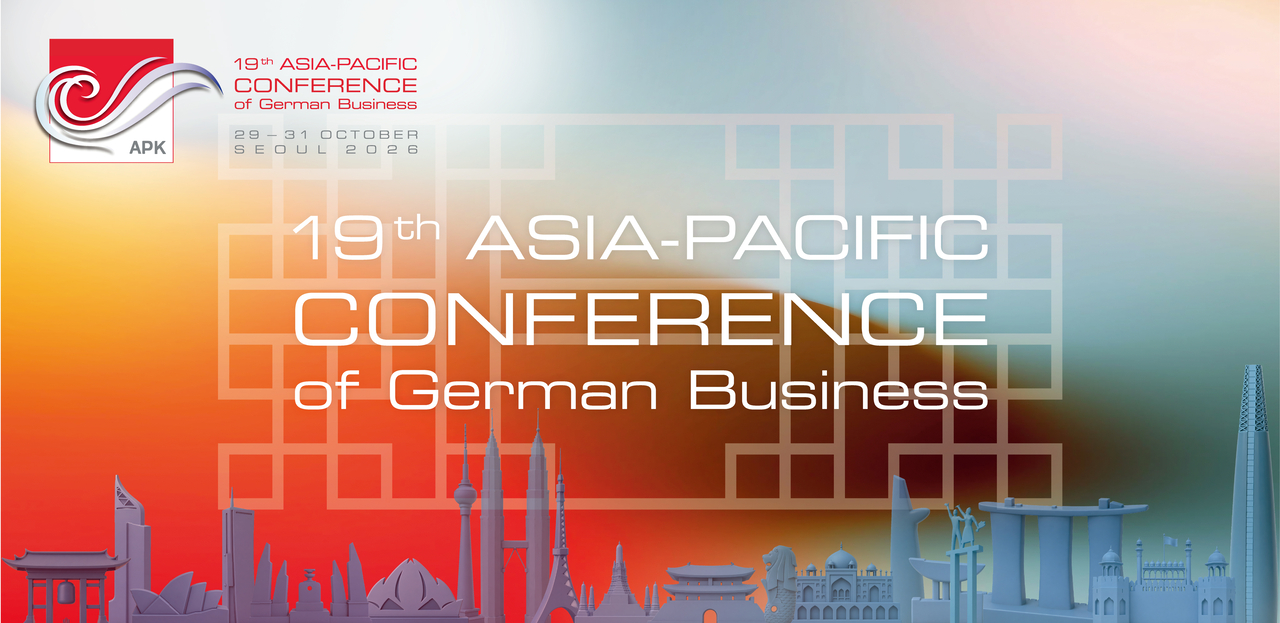
German Chancellor Friedrich Merz and the chief executives of major German companies are heading to Seoul, where they will discuss avenues for Korea-Germany cooperation on industrial AI, advanced manufacturing and the restructuring of global supply chains.
According to the Korean-German Chamber of Commerce and Industry (KGCCI), the 19th Asia-Pacific German Business Conference (APK 2026) will be held in Seoul from Thursday to Saturday. More than 750 executives, government officials and industry figures from Germany and the Asia-Pacific region are expected to attend. The event opens Thursday with a welcome reception hosted by Deutsche Bank at Hotel Shilla Seoul, followed by two days of plenary sessions and major panel discussions at the Grand InterContinental Seoul Parnas.
APK is a biennial international conference held to discuss economic cooperation between Germany and the Asia-Pacific region. It is co-organized by the Asia-Pacific Committee of German Business (APA), Germany's Federal Ministry for Economic Affairs and Energy, and the network of German chambers of commerce abroad, with the KGCCI serving as the local co-host.
This year's conference takes place amid rapid shifts in the global industrial landscape, including geopolitical uncertainty, trade tensions and advances in AI technology. The event is expected to serve as an opportunity for South Korea and Germany to deepen their cooperative ties by leveraging their respective industrial strengths.
Chancellor Merz and Prime Minister Han Seong-sook will deliver the opening keynote addresses on Friday. Roland Busch, APA chairman and Siemens president and CEO, and Kirsten Schoder-Steinmuller, deputy president of the Association of German Chambers of Commerce and Industry (DIHK), will follow with opening remarks.
Stefan Reuther, state secretary at Germany's Federal Ministry for Economic Affairs and Energy, and Minister of Trade, Industry and Energy Kim Jung-kwan will take part in the opening dialogue. The two sides are expected to discuss how shifting global power dynamics are reshaping economic ties between Germany and the Indo-Pacific region.
Senior executives from major German companies will also be in attendance. Markus Kamieth, CEO of BASF; Tobias Meyer, CEO of DHL Group; and Daniel Hager, CEO of Hager Group and president of the German Electrical and Electronic Manufacturers' Association (ZVEI), are among those set to discuss corporate strategies for navigating the changing trade environment.
Naver CEO Choi Su-yeon will hold a dialogue with Siemens Chairman Roland Busch on industrial AI. Shashank Deshpande, CEO of Boehringer Ingelheim, will examine how AI can drive innovation in manufacturing across the Asia-Pacific region.
Other participants include Peter Leibinger, president of the Federation of German Industries (BDI) and chairman of the supervisory board of Trumpf; Dirk Hoke, CEO of Voith; Taro Shimada, president and CEO of Toshiba; Anna Maria Braun, CEO of B. Braun; Miguel Angel Lopez Borrego, CEO of thyssenkrupp; and Toralf Haag, CEO of Aurubis. From South Korea, Kim Chang-bum, vice chairman of the Korea Enterprises Federation, will participate in a panel discussion on shared security interests in the Indo-Pacific region.
Industrial AI is expected to be one of the central themes of the conference. Combining South Korea's semiconductor and digital technology expertise with Germany's manufacturing know-how opens up new opportunities for joint technology development and real-world industrial application. Critical raw material security, supply chain resilience, circular economy solutions and changes to the international trade framework are also on the agenda.
South Korea and Germany maintain close economic ties centered on manufacturing. Germany is South Korea's largest trading partner among EU member states, accounting for about 13 percent of total trade between South Korea and the EU. According to Germany's Federal Foreign Office, around 540 German companies operate in South Korea, supporting an estimated 100,000 jobs.
Economic cooperation between the two countries spans a wide range of industries, including automotive manufacturing, machinery, chemicals, semiconductors and renewable energy. South Korea holds strengths in semiconductors, digital infrastructure and advanced manufacturing, while Germany brings expertise in industrial engineering, automation, special-purpose machinery and manufacturing technology. These complementary industrial capabilities give both countries a strong foundation for expanding collaboration in joint innovation, technology development and industrial transformation.
Marie Antonia von Schönburg, chief representative of the KGCCI, said APK 2026 was taking place "at an important moment in the Korea-Germany economic relationship." "As companies navigate technological change, geopolitical uncertainty and the energy transition, the value of close cooperation between our two countries is only growing," von Schönburg said.
"South Korea and Germany have complementary strengths in innovation, industrial expertise and advanced manufacturing," von Schönburg added. "We hope this event will help strengthen existing partnerships and open up new opportunities for investment and collaboration."
boo@heraldcorp.com




