Korea's payment space ceding ground to foreign players
Crypto card issuance and usage data remain a blind spot
More intermediary steps mean higher fees
Foreign firms fall outside data-request requirements
'Legal basis needed to oversee overseas operators'

The Bank of Korea has told the National Assembly that crypto cards issued abroad could be exploited as a tool to evade regulations on fund tracking and taxation, The Herald Business has confirmed.
The central bank also flagged institutional limits that prevent it from obtaining basic data on the issuance and use of such cards from foreign operators. Calls are growing for systematic regulatory reform — including mandatory data-submission requirements for overseas operators — as the second phase of the Digital Asset Basic Act moves through the legislative process.
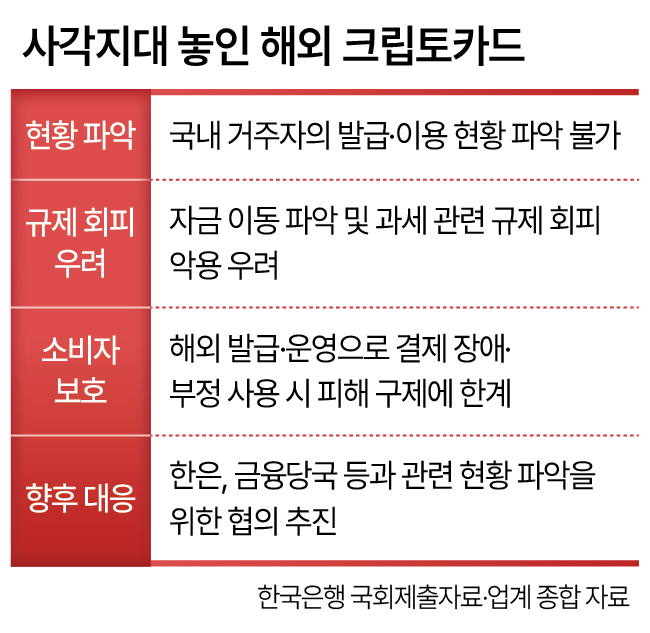
Risks flagged by the Bank of Korea: According to a document submitted by the Bank of Korea and obtained Wednesday through the office of Rep. Kim Nam-jun of the National Assembly's Finance and Economy Planning Committee, the central bank warned that "when crypto cards are used for payments in connection with virtual assets held in personal digital wallets or on overseas exchanges, they can be used to evade regulations on tracking fund movements and on taxation arising from the transfer or disposal of virtual assets." The warning elaborates on the specific regulatory-circumvention risks that Governor Shin Hyun-song raised during a national audit.
Crypto cards allow users to make payments using virtual assets they hold. They are issued by overseas fintech firms or virtual asset exchanges in partnership with global card networks such as Visa and Mastercard. Exchanges including Binance and OKX operate their own crypto cards, letting users pay with dollar-denominated stablecoins such as Tether (USDT) and USD Coin (USDC) held on those platforms.
The cards can be used at domestic merchants just like any other foreign-issued card, and fees apply to domestic transactions. Based on data the Bank of Korea has compiled, per-card fees stand at 1.2 percent for Ri.pay, 1 percent for Tria and 0.9 percent for Bybit. Domestic credit and debit cards charge consumers no fee on local transactions, whereas overseas crypto cards levy roughly 1 percent on purchases made in Korea.
Shin had previously noted that "there are various risks because all the entities behind crypto cards are based abroad and they primarily rely on dollar stablecoins." Shin also explained that "when a crypto card is used, an intermediary converts the funds back into legal tender before making the payment, which adds an extra step in the chain — and fees appear to be considerably higher than for other payment methods."
How much is being spent domestically? Nobody knows: The deeper problem is that it is difficult to determine how much domestic spending is being conducted with crypto cards issued abroad. The Bank of Korea receives quarterly data from the Credit Finance Association on the domestic card spending amounts and card counts of non-residents, broken down by foreign issuer, and publishes the figures. However, the central bank said those figures alone cannot distinguish whether a given transaction involves virtual assets.
The Bank of Korea explained that when settling domestic spending on foreign-issued cards, global card networks such as Visa and Mastercard pay merchants a lump sum that bundles crypto card transactions together with all other foreign-issued card transactions. Once virtual assets are converted into fiat currency abroad and a card payment is processed, the payment data captured domestically makes it structurally impossible to verify whether the original source of funds was a virtual asset.
The central bank also reported to the National Assembly that there is a legal gap in its ability to demand relevant data from foreign operators. The Bank of Korea said overseas crypto cards "are issued by foreign fintech firms in partnership with global card networks such as Visa and Mastercard, without the involvement of any domestic institution," adding that "those companies are not domestic virtual asset service providers subject to the Bank of Korea's data-submission requests under the Virtual Asset User Protection Act, making it difficult to track issuance and usage."
Internally, the Bank of Korea has discussed obtaining relevant data through the domestic branches of foreign card networks, but officials are uncertain whether crypto card transactions can be separated out, making that avenue appear difficult. In response, the central bank said it "will pursue consultations with foreign exchange and financial authorities to identify the current situation."
Second-phase legislation must establish oversight authority over foreign operators: Experts say systematic regulatory reform is needed as the Digital Asset Basic Act moves into its second legislative phase. They argue that the scope of virtual asset service providers' business categories and activities should be clarified to determine whether overseas payment operators can be brought under regulatory coverage. Calls have also emerged for clearer rules on the reach of data-request and inspection powers over foreign operators, and for cooperation frameworks with the overseas financial regulators that have jurisdiction over those operators in cases where direct supervision is not feasible.
Hyun Jeong-hwan, a professor in the Department of International Commerce at Dongguk University, said the Bank of Korea "should have the authority to compile data on domestic usage of overseas crypto cards, but at present, even where statistical authority exists, legal enforceability is lacking." Hyun called for "systematic regulation, including defining the permissible scope of domestic use based on the issuer's location and the currency of denomination, and imposing reporting obligations on foreign operators as well."

forest@heraldcorp.com
kyoung@heraldcorp.com