Scorecard for 17 banks made public
Relative grading by group tiers
Pilot evaluation in 2026; incentives and penalties from 2027 results
Loans to low-income borrowers and debt relief account for 70% of total score
Top-ranked banks get up to 20% reduction in Korea Inclusive Finance Agency contributions
FSC chief Lee Eok-won: 'Time for financial firms to build inclusive finance into their own structure'
The government has unveiled a scorecard to evaluate how well South Korea's 17 banks are advancing inclusive finance. The framework allocates 80 percent of the total score to services for low-income borrowers, keeping the focus on lending volume, while also assessing whether banks have embedded inclusive finance into their internal governance structures — including the size of dedicated teams.
This year's evaluation will be a pilot run, with incentives and penalties taking effect from next year's results. Under a relative grading system within each bank group, top performers will receive a 20 percent reduction in their contributions to the Korea Inclusive Finance Agency, while bottom performers will be required to pay 20 percent more.
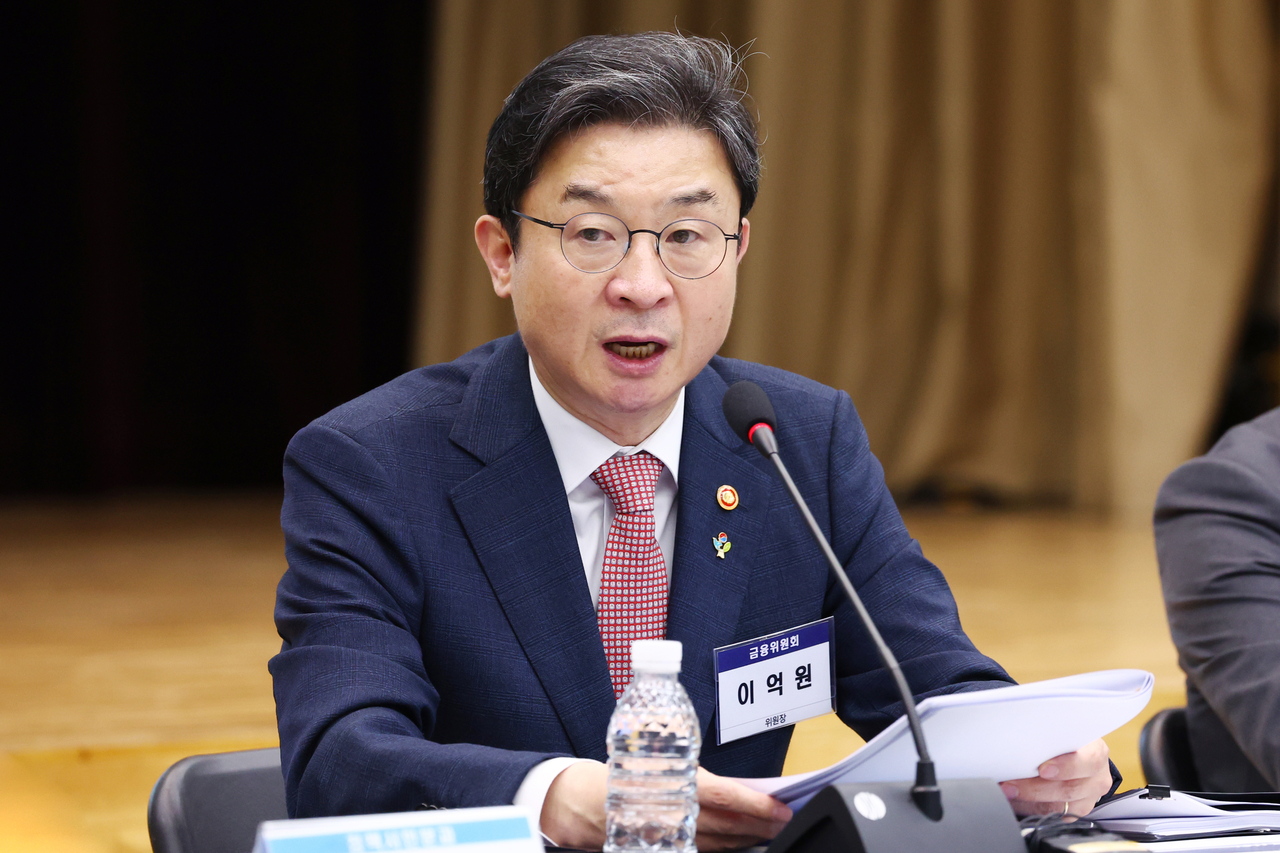
Financial Services Commission Chairman Lee Eok-won chaired the seventh Inclusive Financial Transformation Meeting on Wednesday at Kamco Yangjae Tower in Seocho-gu, Seoul, where he finalized the plan.
In his opening remarks, Lee said the financial sector had been responding to inclusive finance initiatives but that the effort had largely been reactive — driven by government requests rather than internal commitment. "It is now time to move a step further and build a structure in which financial companies take the initiative on inclusive finance themselves," he said.
Low-income loans and debt relief worth 350 points each
The Financial Services Commission on Wednesday released the comprehensive inclusive finance evaluation framework it had been developing behind the scenes — a scorecard designed to help financial companies embed inclusive finance into their management systems.
Of the 1,000 points available, 800 are allocated to the low-income finance category. Within that category, the supply of policy-backed low-income loans, "New Hope Seed" loans and mid-rate credit products accounts for 350 points. Evaluation criteria include the share of low-income financial products in a bank's total household unsecured lending and the weighted average interest rate on those products. A bank's efforts to improve borrowers' creditworthiness — such as trends in refinancing loans from non-bank lenders — are also factored in.
Debt relief within the low-income finance category also carries 350 points. Banks are assessed on how well they cooperate with debt restructuring procedures run by the Credit Counseling and Recovery Service and court-linked personal rehabilitation processes. Notably, "voluntary debt restructuring" — where a bank proactively reduces principal and interest on its own — accounts for 100 of the 350 points, the single largest sub-item. Oh Yu-jeong, head of the FSC's low-income finance division, said at a briefing at Government Complex Seoul on Wednesday that the weighting reflects how difficult each measure is to carry out. "Processes that banks run on their own initiative were given extra points," she said.
An additional 100 points within the low-income finance category cover "social consideration" measures, including support for youth asset-building and a bank's track record in accepting requests for interest rate reductions.
The remaining 200 points cover areas outside low-income finance. Governance accounts for 100 of those points, measuring how deeply inclusive finance has taken root within a bank — specifically, how well it is integrated into management strategy and whether the right organizational structures are in place to carry it out. The FSC plans to focus heavily on governance-building efforts until inclusive finance is fully embedded as a systemic practice. Oh said the assessment would not be mechanical. "We will not simply award points for having a chief inclusive finance officer and deduct them for not having one," she said. "There are concerns about infringing on management autonomy, so we intend to evaluate this with care."
Non-financial services such as financial counseling and financial education account for the remaining 100 points. Separately from these scored criteria, the financial authorities plan to award up to 100 bonus points for a bank's own proactive inclusive finance initiatives.
The framework applies to all 17 domestic banks. The financial authorities have divided them into three groups: Group A comprises KB Kookmin, Shinhan, Hana, Woori, NH and Industrial Bank of Korea; Group B includes SC First Bank, iM Bank and regional banks; and Group C covers the three internet-only banks. Grading within each group is relative — top performers receive up to a 20 percent reduction in their Korea Inclusive Finance Agency contributions, while bottom performers face a surcharge of up to 20 percent.
The 2026 evaluation will be run as a pilot. Only top-performing institutions will be announced, and no other incentives or penalties will apply. Incentives and penalties will take effect from the 2027 results, to be announced in 2028. Asked about concerns that relative grading is difficult to apply to Group C — which has only three internet banks — Oh said the authorities would use the pilot to check whether the approach works in practice.
The Financial Supervisory Service will conduct the initial assessment, with results reviewed by a five-member evaluation committee. The committee chair will be drawn from the private sector, with the FSC's financial consumer bureau director, the FSS's deputy governor for the banking sector, the Korea Inclusive Finance Agency's deputy president and the Credit Counseling and Recovery Service's secretary general serving as ex officio members.
Inclusive finance has been a consistent priority for President Lee Jae-myung. At a Cabinet meeting on Tuesday, Lee stressed the need to eradicate illegal private lending while also calling for solutions to the cash crunch facing ordinary citizens. "What do we do about people who say they need to borrow even at 30 percent interest?" he said. "We are blocking that channel through regulation, so we have a responsibility to provide an alternative."
hyuk@heraldcorp.com