Park Hyun-joo: apartment prices likely to fall
LH chief 'certain' housing prices will drop
Seoul apartment listings hit 7-month high
Mirae Asset Group Chairman Park Hyun-joo has joined Korea Land and Housing Corporation President Lee Sung-hoon in warning that housing prices could fall. With Seoul apartment listings approaching 80,000 and price gains slowing, attention is turning to where the real estate market is headed.
Park: 'Be careful with apartments — they're very likely to fall'

Speaking Tuesday at an insight forum marking the 60th anniversary of Kyung Hee University's Graduate School of Business, Park said real estate regulations are fueling apartment price increases and called for a shift in how housing supply is approached.
"Regulations are what's driving up real estate in Korea," Park said. "Be careful with apartments. They're very likely to fall."
He acknowledged he is not a real estate expert and framed his remarks as a matter of perspective, but said existing housing supply methods and land-use regulations need to change.
Park also proposed using office buildings and golf course sites in central Seoul to boost housing supply. He argued that high-density mixed-use redevelopment of office buildings could raise land utilization in the city center, while golf course sites could be used for rental housing.
"You can have offices up to the 20th floor and build apartments above that," he said, adding that Korea rigidly separates apartments, condominiums and residential facilities into distinct categories. His point was that changing existing supply methods and land-use regulations could expand supply and alter the price trajectory of the real estate market.
LH chief: 'Full supply kicks in within 3 years — prices will crash'

Park's remarks are drawing attention alongside the "crash" warning already issued by LH President Lee Sung-hoon.
At a comprehensive national audit of the National Assembly's Land and Transportation Committee on Friday, Lee answered "yes" when People Power Party lawmaker Kim Eun-hye asked whether he was certain housing prices would fall.
Lee said that during the previous administration's three years, housing construction starts in the greater Seoul area fell to half or one-third of normal levels, leading to the current shortage of move-in and completed units.
"Supply will ramp up in full over the next three years under this administration," he said. "Prices will crash at that point, and if the market recognizes this first, stabilization will be inevitable."
It was not the first time Lee had raised the possibility of a sharp price drop.
At the LH national audit on Oct. 12, Lee also cited expanding supply and rising interest rates as grounds for his view that "housing prices could fall sharply going forward." He added that "if prices stabilize, not buying a home right now will not mean taking a loss."
Seoul apartment listings hit 7-month high — Seongbuk-gu up 56%
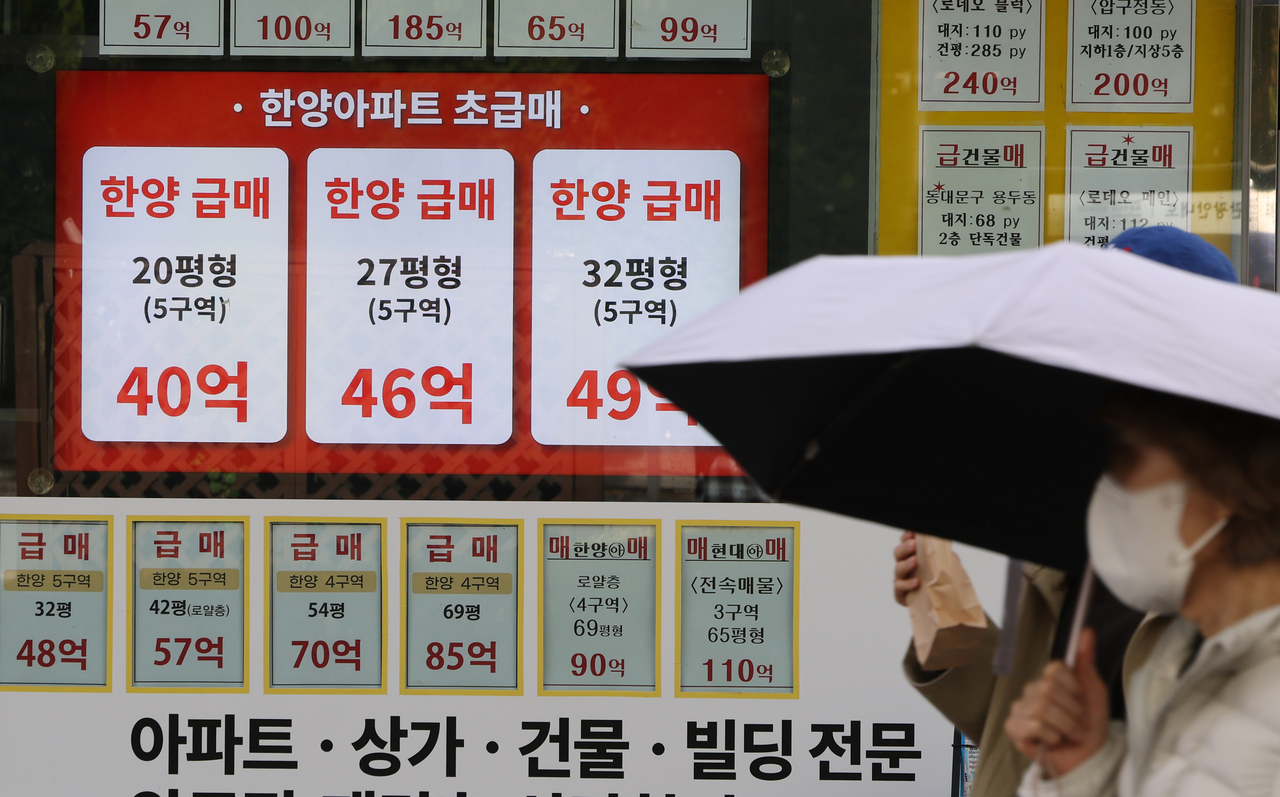
The warnings are being borne out in the Seoul apartment market, where listings have been rising.
According to real estate big data firm Asil, the number of Seoul apartments listed for sale stood at 78,323 as of Sunday — the highest since March 29, when listings reached 78,739, roughly seven months ago.
Listings totaled 60,409 when the government announced its tax reform plan on Aug. 3, meaning the count has grown by 17,914, or 29.7 percent, in about three months.
The increase is spreading beyond Gangnam into non-Gangnam areas. Seongbuk-gu saw the sharpest rise among Seoul's 25 autonomous districts over the same period, with listings climbing 55.8 percent from 1,474 to 2,297.
Gangdong-gu rose 39.8 percent from 3,193 to 4,465, and Dongjak-gu climbed 38.8 percent from 1,666 to 2,314. Seongdong-gu and Mapo-gu posted increases of 38.5 percent and 37.4 percent, respectively.
All five districts with the highest listing growth rates are outside Gangnam, suggesting that the wait-and-see mood that had centered on Gangnam is spreading to other parts of Seoul. Analysts attribute the trend to a rise in sellers in areas where prices surged sharply in a short period, combined with buyers growing more cautious about chasing prices amid tighter lending regulations and higher borrowing costs.
Gangnam decline continues as Seoul overall posts 89th straight week of gains
Price data also show Seoul apartment gains losing momentum.
According to the Korea Real Estate Board's weekly apartment price trend for the third week of October (based on Oct. 19), Seoul apartment sale prices rose 0.13 percent from the previous week. The city extended its streak to 89 consecutive weeks of gains, but the pace slowed from 0.16 percent the prior week to 0.13 percent, a contraction of 0.03 percentage points.
Declines continued across the three main Gangnam districts. Seocho-gu's drop widened from minus 0.27 percent to minus 0.32 percent, while Gangnam-gu's fall narrowed from minus 0.35 percent to minus 0.31 percent and Songpa-gu's from minus 0.21 percent to minus 0.13 percent. Gangnam-gu and Seocho-gu have now fallen for 11 consecutive weeks, and Songpa-gu for seven.
Gains also shrank in northern Seoul and outlying areas. Jungnang-gu's increase eased from 0.42 percent to 0.31 percent, Seongbuk-gu's from 0.41 percent to 0.36 percent, and Nowon-gu's from 0.37 percent to 0.26 percent.
Nam Hyeok-woo, a researcher at Woori Bank's real estate research institute, said transactions in Gangnam-gu and Songpa-gu are picking up around distressed reconstruction apartments discounted by more than 20 percent, gradually clearing out lower-priced listings. "However, policy uncertainty remains and macro variables such as interest rate increases are still in play, so a slowdown in transactions and a trend of price weakness are likely to continue for now," he said.
The borrowing burden from rising interest rates is also growing. Last month, the average rate on new home mortgage loans at the five major commercial banks rose 0.28 percentage points from the previous month to 4.936 percent. The COFIX rate for September — the benchmark for variable-rate mortgages — also climbed 0.25 percentage points to 3.43 percent.
Some analysts, however, say a shortage of listings for both sale and jeonse and monthly rent could limit any price decline. "Listings for sale and jeonse and monthly rent remain relatively scarce, so any drop in asking prices is very limited," Nam said.
bbo@heraldcorp.com