Move aims to eliminate collision and fall risks for electric scooter users
Pilot to launch at Goyang complex before nationwide rollout next year
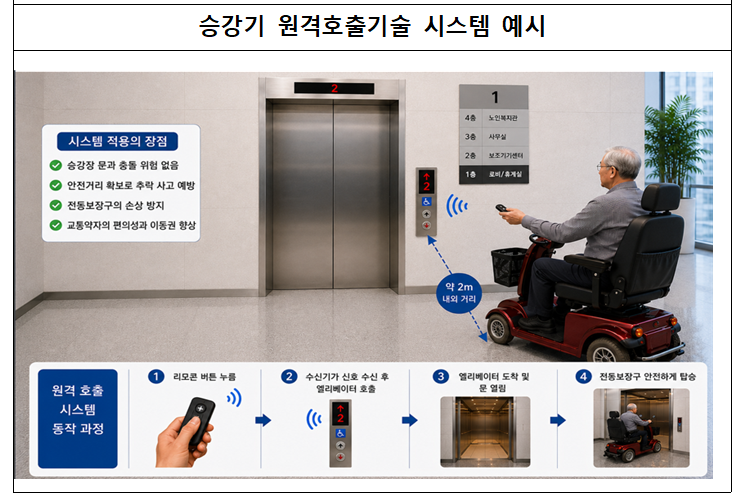
The Korea Land and Housing Corporation announced Wednesday it will introduce remote elevator call technology in its rental housing units to fundamentally prevent collision and fall accidents involving elderly residents and people with disabilities who use electric scooters.
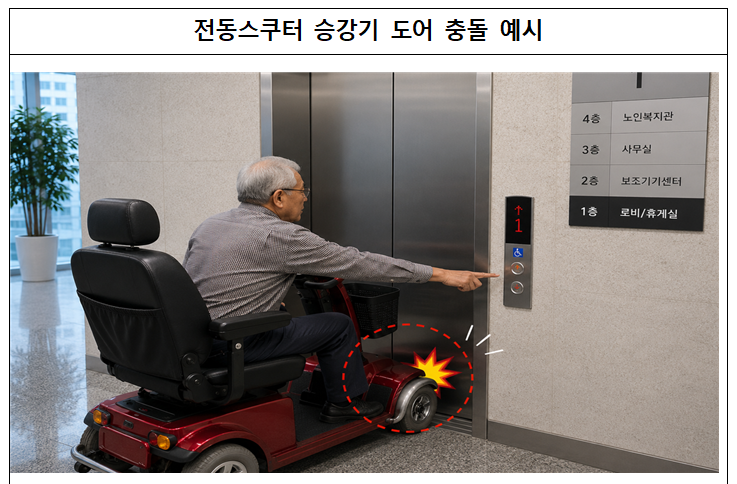
Until now, residents using electric scooters had to approach close to elevator landing doors to press the call button, raising concerns that the scooters could collide with the doors and fall into the elevator shaft.
In response, LH has since 2025 raised the door-displacement resistance standard for first-floor elevator landings from 450 joules to 1,000 joules and conducted safety education for residents, in an effort to strengthen collision safety at landing doors. While the legal standard under the Elevator Safety Management Act stands at 450 joules, an electric scooter collision generates roughly 1,000 joules of impact force. Even so, those measures fell short of eliminating the collision risk that arises during the button-pressing process itself.
To address the problem, LH will this month begin rolling out remote elevator call technology across its rental housing stock. Developed by the Korea Elevator Safety Agency, the system uses a receiver attached to the landing call button, allowing residents to summon an elevator from about two to three meters away using a handheld remote control.
Because electric scooter users no longer need to pull up close to the landing door to call the elevator, LH expects the technology to eliminate the risk of door collisions and improve elevator accessibility for mobility-impaired residents.
The pilot site is Goyang Wonheung Village Complex 12, a public rental housing development in Goyang, Gyeonggi Province, comprising 1,372 units across eight buildings. The complex had already seen proactive safety upgrades, including the installation of courtesy seats inside elevators and the tightening of door-displacement resistance standards. LH expects that adding the remote call system will create a synergistic effect with those existing safety and accessibility features for mobility-impaired residents.
LH plans to use the pilot to verify the technology's performance and ease of use, gather resident satisfaction data to identify areas for improvement, and then roll the system out gradually to rental housing complexes nationwide starting next year.
To that end, LH signed a memorandum of understanding with the Korea Elevator Safety Agency on Tuesday at the agency's headquarters in Jinju, South Gyeongsang Province, covering elevator accident prevention and the creation of a safe elevator environment for mobility-impaired residents.
The agreement was drawn up to ensure the stable on-site deployment of the remote call technology and to build a safer, more convenient elevator environment in rental housing. Under the MOU, LH will provide the pilot complex site and cover installation costs, while the Korea Elevator Safety Agency will handle technology development and certification, with both parties committing to active cooperation.
"Introducing this remote call technology is a measure to fundamentally prevent safety accidents that mobility-impaired residents may encounter while using elevators," said Yoo Byung-yong, head of LH's residential welfare division. "We will continue to carefully consider the diverse living conditions of our residents and create a residential environment where everyone can live with peace of mind."
hss@heraldcorp.com