'Slow down on black ice and frost-prone sections,' corporation urges
The Korea Expressway Corporation launched its winter highway snow-removal program Sunday, running through March 15 next year, to keep expressways safe and traffic flowing during the four-month winter season, the corporation announced Monday.
The Korea Meteorological Administration's three-month outlook projects snowfall this winter at or above normal levels. Analysis of weather patterns over the past five years has also shown a tendency for snowfall to concentrate in specific regions, prompting the corporation to build a proactive response system — securing snow-removal materials and personnel, tightening pre-treatment standards and strengthening traffic information services.
The corporation has stockpiled 340,000 tons of snow-removal materials, equivalent to 120 percent of the average reserves held over the past three years, and will deploy 2,604 dedicated personnel and 1,210 pieces of equipment.
A rapid snow-response team supporting large-scale removal operations will also run for four months starting Sunday. The corporation has distributed 43 snow-removal vehicles and machines across five regional zones — Seoul-Gyeonggi Province, Gangwon Province, North Chungcheong Province, North Jeolla Province and Daegu-North Gyeongsang Province — with additional equipment to be deployed to vulnerable sections when a heavy-snow advisory is issued.
The corporation will also coordinate with 341 related agencies, including the Ministry of Interior and Safety, the Ministry of Land, Infrastructure and Transport, the Korean National Police Agency, fire departments and military units, and has stationed additional snow-removal equipment along key connector roads in the Greater Seoul area, which are particularly prone to difficult conditions.
Using black-ice risk data from the Korea Meteorological Administration's disaster weather platform and the road weather information system, the corporation will begin pre-treatment immediately whenever the alert level reaches "Caution" or higher. On connector roads in the Greater Seoul area — which are especially vulnerable — pre-treatment application rates will be raised to full-treatment levels even during the preliminary stage. Pre-treatment application is set at 14.3 grams per square meter, while full treatment rises to 27.2 grams per square meter.
During heavy snowfall or traffic control situations, conditions will be communicated through variable message signs and monitors at rest facilities. The corporation also plans to send public location-based text alerts to drivers within 10 kilometers behind the start of congestion or hazard-prone sections to encourage safe driving.
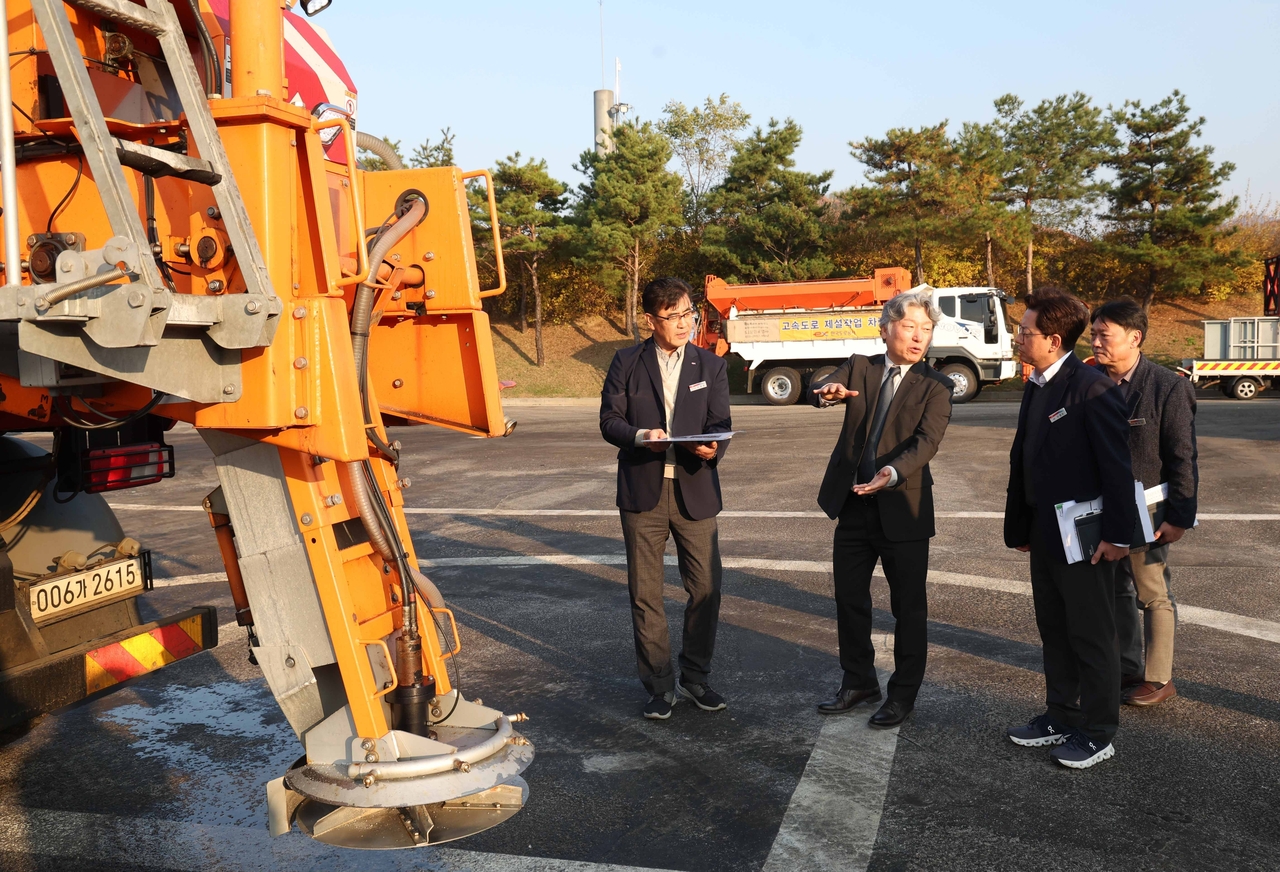
Korea Expressway Corporation President Yu Jeong-hun has been visiting key regional offices in person since Tuesday to inspect snow-removal readiness and encourage field staff ahead of the winter season.
"Put public safety first, thoroughly check past accident sites and frost-prone sections, and give everything to a proactive snow-removal response that leaves no gaps," Yu said.
A corporation official urged drivers to reduce speed to 50 percent of the posted limit in areas of snowfall or sudden temperature drops, and to maintain at least twice the normal following distance. "It also helps to prepare winter driving equipment before setting out and to refer to icy-road alerts provided by navigation services," the official said.
hss@heraldcorp.com