CPTPP members account for 25% of South Korea's trade; joining could generate up to 6.7 trillion won in annual manufacturing output effects
Mexico market access and cumulative rules of origin offer supply chain gains; delay risks widening competitive gap
Nearly half of South Korea's export items have lost competitiveness within the bloc since it took effect
Agriculture and fisheries face projected annual output losses of 852.3 billion won; compensation terms will determine the pace of accession
Is South Korea's membership in the Comprehensive and Progressive Agreement for Trans-Pacific Partnership worth the backlash from the farming and fishing industries? Joining the pact could generate up to 6.7 trillion won ($5.07 billion) in annual manufacturing output effects, but it would also reduce agricultural and fisheries production by an estimated 852.3 billion won per year. The government has slowed its push amid opposition from the farming and fishing sectors, yet analysts say CPTPP accession is not a decision South Korea can afford to keep deferring.
For an economy heavily dependent on exports, expanding into markets beyond the United States and China and securing a foothold in regional supply chains is an increasingly urgent task. South Korea's trade with CPTPP member states already accounts for 25 percent of its total goods trade. The longer accession is delayed, the greater the risk that South Korea loses ground to competitors within the bloc. The central question is how to maximize the economic benefits of membership while minimizing and compensating for the losses.
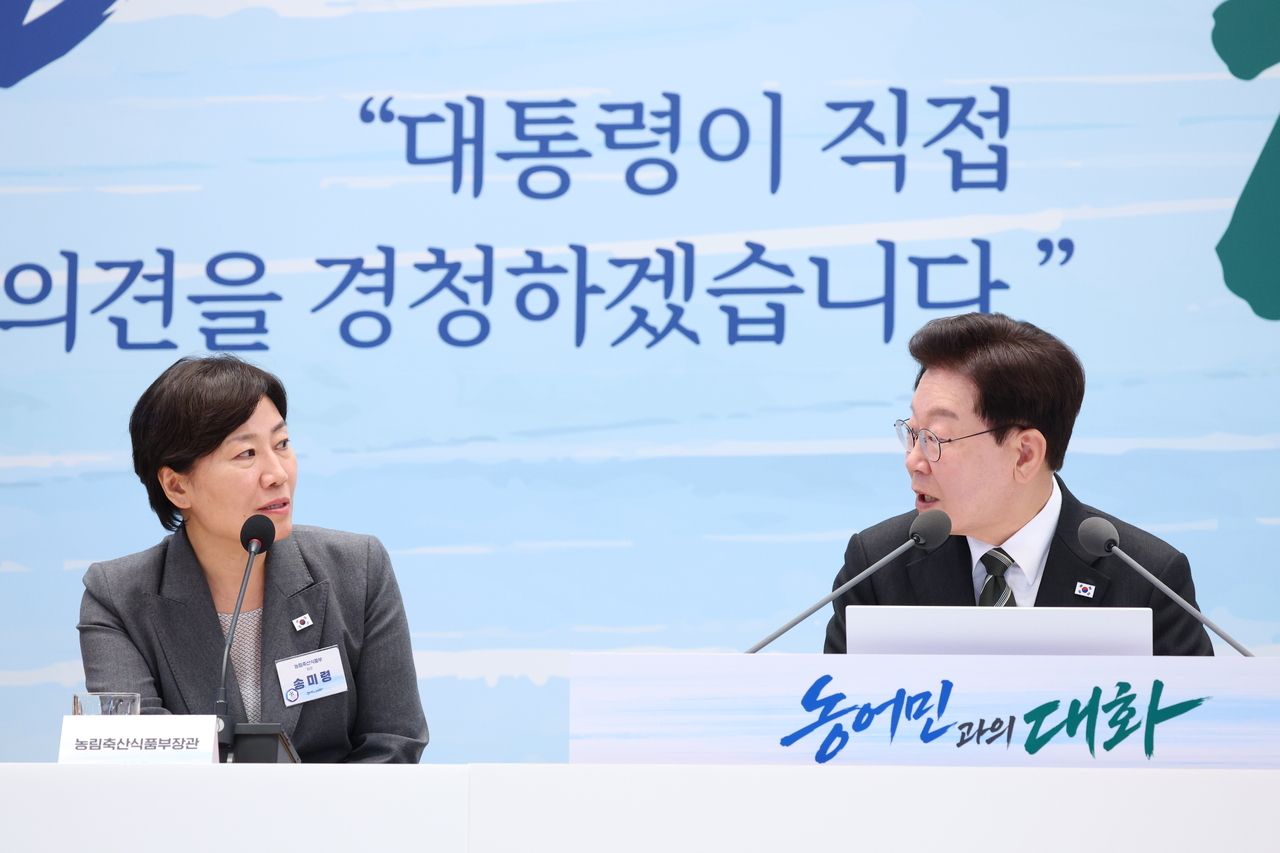
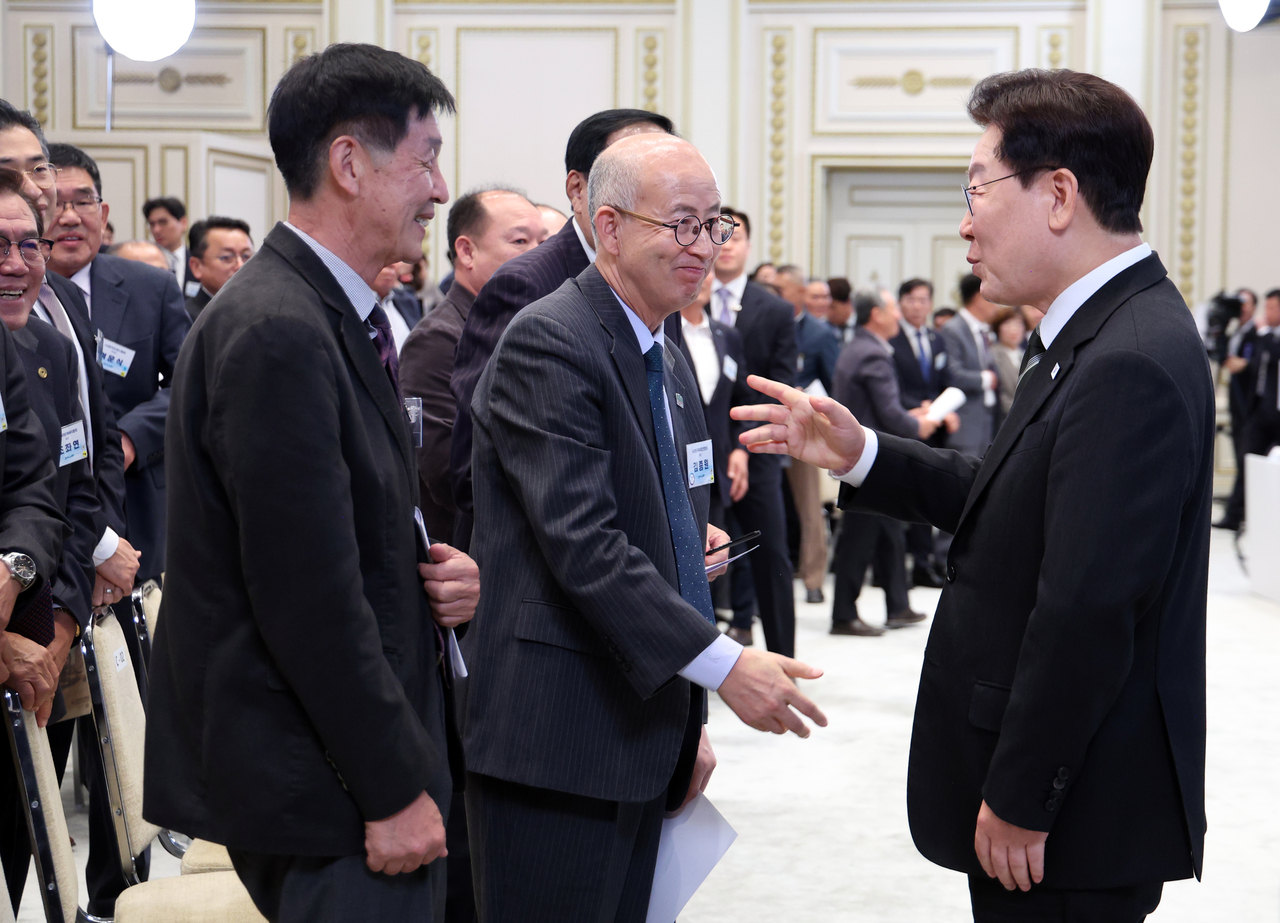
President Lee Jae Myung, speaking at a dialogue with farmers and fishers held at Cheong Wa Dae, called CPTPP membership "something that cannot be avoided, however frustrating," adding that "it is something that must be done for the country as a whole." He acknowledged that the politically comfortable choice would be to forgo membership, but said that "even if there is criticism, it must be done for the sake of the Republic of Korea as a whole, so that we can move to the next stage."
However, Lee said the chances that a final deal would be concluded within his term were "far greater" that it would not, signaling that negotiations would take considerable time. The government has decided not to submit a membership application this year, opting instead to consult fully with the farming and fishing communities before determining the direction forward.
CPTPP members account for 25% of South Korea's trade — diversifying beyond the US and China
CPTPP is a multilateral free trade agreement involving 12 countries, including Japan, Australia, Canada, Vietnam and the United Kingdom. The bloc represents about 14 percent of global GDP and applies high levels of tariff elimination along with common trade rules.
South Korea's trade with CPTPP member states is already substantial. According to a report published last month by the Korea Economic Research Institute titled "Open Plurilateral Cooperation: The Future of CPTPP and South Korea's Choice," South Korea's goods trade with the 12 CPTPP members totaled about $341 billion last year, accounting for 25 percent of its total goods trade — more than its trade with China ($273 billion, 20 percent) and the United States ($196 billion, 15 percent), its two largest trading partners.
Given how heavily South Korea depends on trade with China and the United States, diversifying its trading partners is essential to reducing exposure to shifts in the trade environment. Both countries have free trade agreements with South Korea, but tariffs, export controls and other trade issues are growing more complex, prompting calls for a broader network of cooperation beyond existing trade ties.
Consolidating South Korea's existing trade relationships with CPTPP members under a single set of rules is also cited as a benefit of joining. South Korea has bilateral or multilateral agreements with 10 of the 12 CPTPP members, but the scope and level of market opening differ across those agreements. It has no separate bilateral FTA with Japan or Mexico.
Jeffrey Schott, a senior fellow at the Peterson Institute for International Economics, said at an international seminar jointly hosted by the Korea Institute for International Economic Policy and the Federation of Korean Industries on Aug. 31 that the value of CPTPP membership lies in managing existing trade relationships under common rules. He also said membership would allow South Korea to participate in shaping new trade norms covering data, labor and the environment, beyond tariff reductions alone.
South Korea also relies on CPTPP member states for a significant share of its imports. According to the Korea Economic Research Institute report, 67 percent of South Korea's mineral product imports, 42 percent of stone and glass imports, 34 percent of machinery imports and 25 percent of electronics and electrical machinery imports come from CPTPP members.
The report said the priority should be managing supply chain risks through predictable rules and dispute resolution procedures, rather than eliminating dependence on member states altogether.
CPTPP membership alone would not eliminate all risks from disruptions to key raw material supplies or economic coercion. The report noted that the current agreement lacks sufficient institutional mechanisms for coordinating industrial policy and responding jointly to supply chain crises. South Korea must therefore weigh not only the direct tariff benefits of joining but also the strategic value of participating in the formation of future trade norms.
Why join when FTAs already exist? Mexico market access and cumulative rules of origin
Mexico is the market where CPTPP membership would deliver the most direct economic benefits. Since January this year, Mexico has raised tariffs on 1,463 product categories — including automobiles and steel — by up to 50 percent for countries without a free trade agreement.
Japan can access tariff benefits through its Economic Partnership Agreement with Mexico and through CPTPP, but South Korea has no FTA with Mexico and must bear the higher tariffs. Korean automakers with local factories that source parts from South Korea may also face increased costs.
If South Korea joins CPTPP and the agreement enters into force, there would be room to reduce the tariff burden in the Mexican market. The actual benefits will depend on the outcome of accession negotiations, the date the agreement takes effect, and the tariff elimination schedules and rules of origin for individual product categories.
Another advantage is the ability to treat production processes spanning multiple member states as a single supply chain. CPTPP's cumulative rules of origin allow parts and materials produced in member countries to be counted together as originating within the bloc when determining origin status.
For example, if a South Korean company uses Japanese parts and Vietnamese materials to manufacture a product domestically and then exports it to Canada, those parts and materials could qualify as CPTPP-originating — provided the product meets the applicable origin criteria for its category.
Under existing bilateral FTAs, different rules of origin apply for each agreement. Under CPTPP, production processes spanning multiple member states can be managed under a common set of rules. This could benefit manufacturers that source components from multiple countries and operate production processes across several nations.
According to preliminary results of an economic impact analysis released by the government in September, South Korea's real GDP would be 0.38 percentage points higher 10 years after the agreement enters into force than it would be without membership.
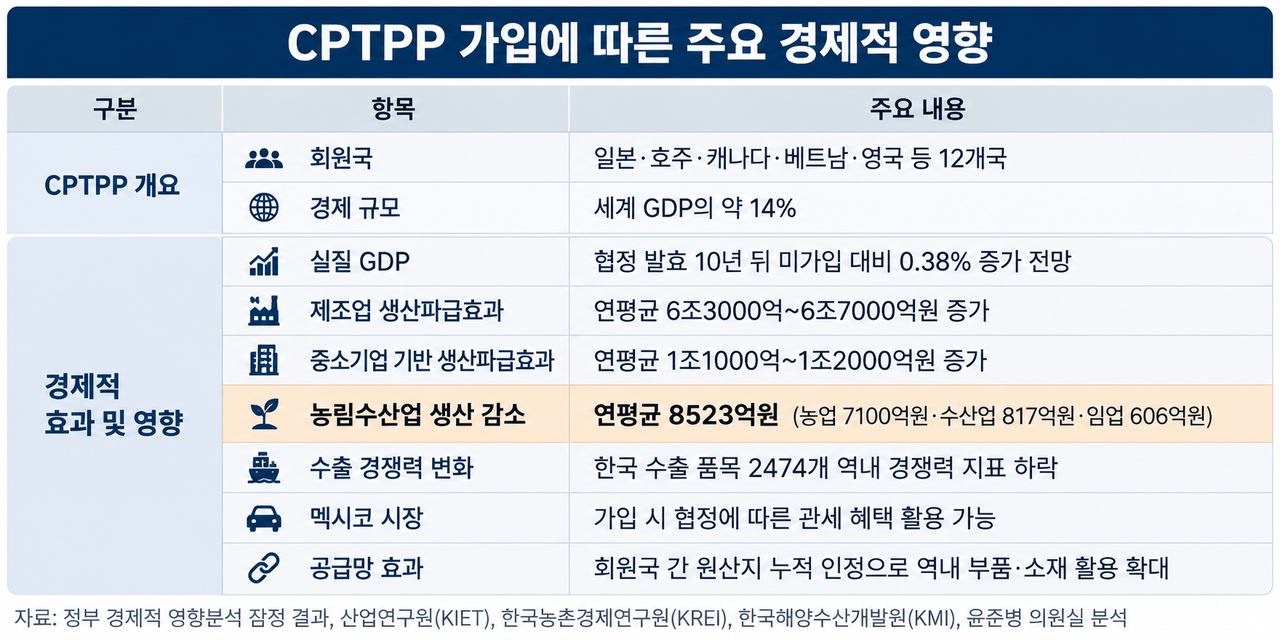
The Korea Institute for Industrial Economics and Trade estimated that production ripple effects across manufacturing and related upstream and downstream industries would increase by an annual average of 6.3 trillion to 6.7 trillion won over the 15 years following the agreement's entry into force. Production ripple effects for small and medium-sized enterprise-based industries were projected at an annual average of 1.1 trillion to 1.2 trillion won.
The figure of up to 6.7 trillion won does not represent export revenue growth or corporate net profit. It includes not only finished goods but also production induced across related industries such as parts and materials. Actual corporate gains will vary depending on tariff rates by product category, rules of origin and supply chain structure.
Competitiveness index falls for 47.7% of export items — the opportunity cost of delayed accession
Beyond the gains from joining CPTPP, South Korea also needs to weigh the opportunity cost of staying out.
A report released by the Korea Institute for Industrial Economics and Trade on Oct. 14, titled "Analysis of South Korea's Competitiveness Before and After CPTPP's Entry into Force," compared competitiveness indicators for 5,185 South Korean export items in the pre-agreement period of 2012–2018 and the post-agreement period of 2021–2024. The index fell for 2,474 items, or 47.7 percent of the total.
The analysis used the Revealed Symmetric Comparative Advantage index, which measures the relative export competitiveness of specific product categories. A decline in the index means relative competitiveness in that market has weakened.
Notably, 796 of the items that saw a decline within the CPTPP region maintained or improved their competitiveness in markets outside the bloc — meaning the same South Korean products showed divergent competitiveness trends inside and outside the region.
Across 15 manufacturing sectors — including shipbuilding, displays and automobiles — every sector where South Korea's index fell also saw CPTPP member states' index rise.
In shipbuilding, South Korea's intra-regional competitiveness index fell by 0.262 while CPTPP members' rose by 0.125, the widest gap among the 15 sectors. In automobiles, South Korea's index fell by 0.199 while member states' rose by 0.047, with Mexico's performance identified as a major driver of the member-state gain.
The institute cautioned that factors beyond CPTPP were reflected in the data, making it difficult to establish a direct causal relationship. Multiple factors — including shifts in global demand and the competitive landscape of individual industries — were at play during the analysis period. The index did not fall for 52.3 percent of all items analyzed.
The institute said CPTPP accession should be approached not simply as a matter of gaining additional benefits, but as a question of survival — one in which South Korea risks losing its footing in regional markets. While member states use the agreement to strengthen market access and supply chains, South Korean companies may be left without the same advantages.
Timing is also a strategic variable. China applied for CPTPP membership in 2021 but has not yet joined. The Korea Economic Research Institute report said that if South Korea joins first, it could participate in discussions over the terms of China's eventual accession, but if China joins first, Beijing would become a member with veto power over South Korea's own accession process.
CPTPP accession is not decided on a first-come, first-served basis. After an application is submitted, existing members must reach consensus before an accession working group is established and negotiations begin. China's own accession prospects remain uncertain in the near term, given unresolved issues involving state-owned enterprises, labor and data transfers.
The Ministry of Trade, Industry and Energy views CPTPP membership as a strategic choice for diversifying export markets, stabilizing supply chains and expanding trade cooperation. Trade Minister Kim Jung-kwan told the National Assembly's industry and trade committee during a national audit on Thursday that he would "make sure South Korea joins CPTPP" in his capacity as the minister responsible for trade. On the president's decision to hold off on submitting an application this year, Kim said the ministry's position and the president's were "essentially the same in broad terms," reaffirming the government's commitment to pursuing accession.
Agriculture and fisheries output to fall 852.3 billion won annually — concerns over underestimated losses
Unlike the expected gains for manufacturing, CPTPP membership is projected to reduce output in agriculture and fisheries as markets open.
An analysis of data submitted to Democratic Party of Korea lawmaker Yun Jun-byeong of the National Assembly's agriculture and fisheries committee by the Ministry of Agriculture, Food and Rural Affairs and the Ministry of Oceans and Fisheries found that the total projected decline in agricultural and fisheries production over 15 years could reach as much as 11.88 trillion won.
Based on analyses by the Korea Rural Economic Institute and the Korea Maritime Institute, agriculture is projected to see output fall by up to 10.65 trillion won over 15 years, while fisheries could see a decline of up to 1.23 trillion won. On an annual basis, the figures are 710 billion won for agriculture and 81.7 billion won for fisheries.
The combined annual average output loss for agriculture and fisheries is 791.7 billion won, up 279.3 billion won, or 54.5 percent, from a previous estimate of 512.4 billion won. Adding the projected annual average forestry output loss of 60.6 billion won brings the total annual average decline across agriculture, forestry and fisheries to 852.3 billion won.
These figures represent projected output declines, not a comprehensive tally of income losses for farmers and fishers or damage to regional economies. The farming and fishing industries have raised concerns that the actual losses may be higher than the government's estimates. The government's figures are output projections derived under specific assumptions and do not capture income losses for farmers and fishers, the contraction of regional economies, the risk of rural and coastal community decline, or the impact on food security. The government said it would incorporate field-level input on impacts that are difficult to quantify into its review process.
The level of market opening also poses a burden. According to data from lawmaker Yun's office, CPTPP member states have opened an average of 95.9 percent of agricultural product categories and 99.4 percent of fisheries product categories. These figures reflect the averages for existing members, however; South Korea's actual scope of market opening and the scale of losses will depend on the terms negotiated during accession talks.
The Korea Economic Research Institute report also outlined negotiating strategies that account for the sensitivity of the agricultural sector. Japan used tariff-rate quotas and similar tools for sensitive items such as rice, beef and dairy to keep its agricultural liberalization rate at around 78 percent. The United Kingdom maintained its existing sanitary and phytosanitary standards and applied permanent tariff-rate quotas, phased tariff reductions and transitional safeguards to sensitive products.
South Korea cannot assume it will secure the same terms. Japan helped shape the original agreement, whereas South Korea would be applying to join a pact that is already in place. Analysts say South Korea must develop compensation measures that the farming and fishing communities can trust, alongside negotiations to limit the scope of market opening.
Concerns from the farming and fishing sectors continued at Monday's dialogue. An apple farmer said CPTPP membership could cause serious damage to the apple industry, emphasizing the burdens farmers have borne in pursuit of export growth and the importance of food security.
Lee Tae-yong, chairman of the Korea Fisheries Business Managers' Central Federation, called for a precise assessment of the ripple effects of CPTPP membership — including deteriorating business conditions and the decline of fishing communities — and asked that the survival of fishers and food security be given priority.
Jeon Min-gyeong, head of external affairs at the National Federation of Fishermen's Associations, warned that an unchecked influx of Japanese fisheries products could undermine the domestic aquaculture industry, including yellowtail and sea bream farming. She called on the government to publicly commit to maintaining the import ban on seafood from Fukushima and seven other Japanese prefectures even after CPTPP accession.
President Lee said the mention of Japanese seafood "suddenly made it hard to breathe," calling it "a very significant practical obstacle." He directed the Ministry of Oceans and Fisheries to look into minimizing damage to the fisheries sector and reviewing compensation measures.
CPTPP membership would not automatically mean lifting import restrictions on Japanese seafood. Given strong public concern over import regulations and food safety, however, the issue is likely to become a sensitive point in future accession negotiations.
Minister of Agriculture, Food and Rural Affairs Song Mi-ryung told the National Assembly's national audit on Oct. 7 that she would review CPTPP accession discussions from scratch. On whether South Korea would join, she said "nothing has been decided," emphasizing that the decision must be guided by the national interest and public opinion.
The case for joining grows stronger — but compensation terms will set the pace
At Monday's dialogue, President Lee also said it would be wrong to treat the farming and fishing communities' sacrifices as a given in the pursuit of trade gains.
"Until now, the basic approach when implementing a policy has been that if the majority benefits greatly, the minority must accept the losses — but I do not think that is right," he said. "We cannot force one-sided losses on people simply because they lack power or because their numbers are small."
He added that "there will be no case where you suffer unexpected harm," and pledged to ensure that the agriculture, livestock, fisheries and forestry sectors would not be damaged or weakened.
Proposed compensation measures include expanding direct support for farm households, introducing a basic income for rural and fishing communities, and raising public interest direct payments. The president also floated the idea of levying a contribution from export industries that would benefit from CPTPP membership. The scale of support and the means of financing have yet to be specified, and the export industry levy remains at the stage of a mentioned possibility rather than confirmed policy.
The manufacturing output effects and the agricultural and fisheries output losses cannot simply be subtracted from each other to calculate a net benefit from joining. The two figures use different analytical frameworks and methodologies. While the expected gains for manufacturing would be distributed across many companies and industries, the losses for agriculture and fisheries could be concentrated among specific product categories and producers.
CPTPP membership offers South Korea an opportunity to diversify its export markets, leverage regional supply chains and participate in shaping new trade norms. Neither insisting on the necessity of joining nor deferring the discussion because of opposition from the farming and fishing sectors will resolve the issue on its own. The benefits and costs of membership must be assessed concretely, and compensation measures that the affected communities can accept must be put in place. Whether the economic gains from membership can be realized while managing the social costs will determine how quickly South Korea moves forward.
Hong Ki-yong, a professor at Incheon National University, said that while President Lee had set adequate compensation as a precondition, "raising the policy acceptability among the farming and fishing communities is crucial." He said that "specifying the scale of support and the financing plan for individual product categories such as rice and beef, and using that to persuade farmers and fishers, will be the core challenge in advancing accession."
adastra@heraldcorp.com