Surprise growth masks hollow economy
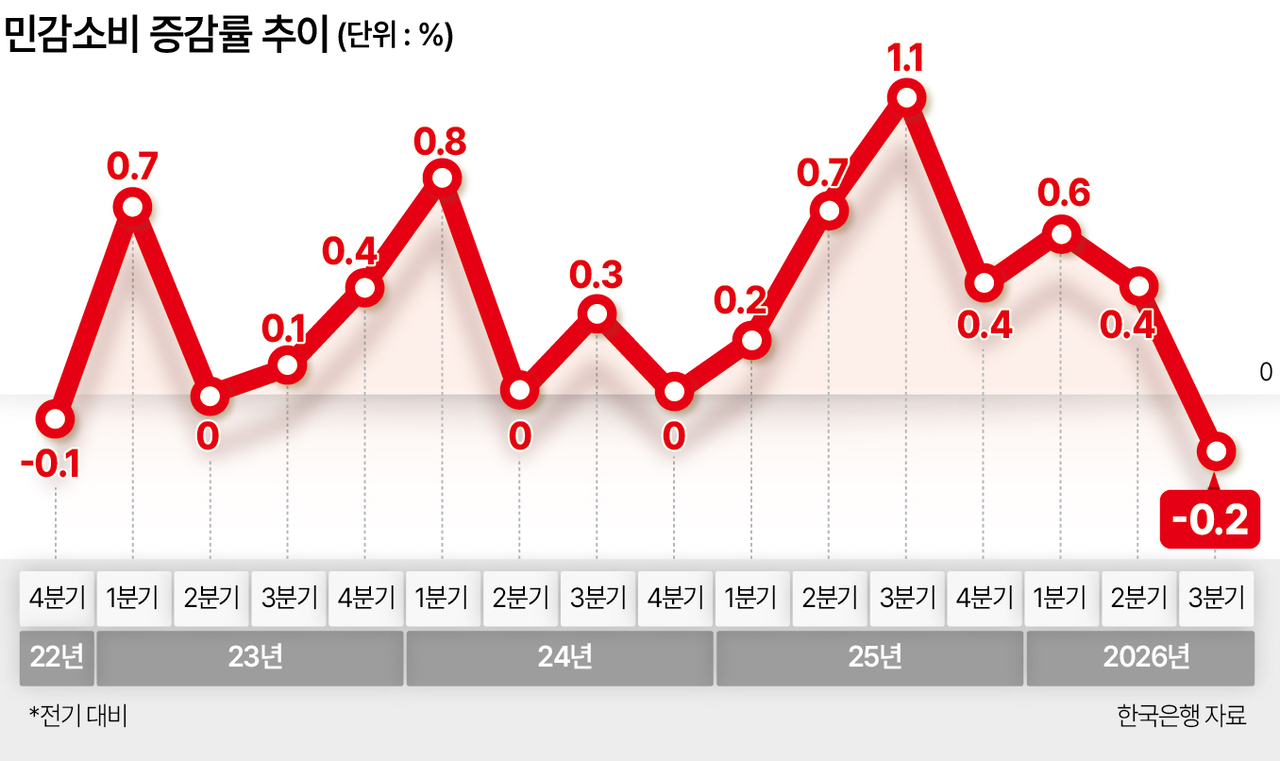
Private consumption down 0.2% for first time in 15 quarters
Stock market correction, automaker strikes weigh on spending
Without one-off factors, consumption would have risen 0.4%
Government's growth contribution four times that of private sector
Bank of Korea sees consumption recovery from Q4

South Korea's economy grew faster than expected in the third quarter, driven by semiconductor exports and government spending, but private consumption fell for the first time in roughly four years. Semiconductor facility investment and government outlays lifted overall growth, yet the gains have failed to reach household spending, weighed down by a stock market correction and strikes at major automakers.
According to the Bank of Korea, third-quarter real GDP expanded 1 percent — more than three times the central bank's August forecast of 0.3 percent — as facility investment led by semiconductors and government expenditure both rose sharply.
Lee Dong-won, director general of the Bank of Korea's Economic Statistics Department 2, told a briefing on the advance third-quarter GDP estimate Tuesday morning that strong exports and investment continued into the third quarter, extending a growth trajectory that had already outpaced initial projections in the first half of the year.
Private consumption fell 0.2 percent from the previous quarter, with both goods — including passenger cars and home appliances — and services such as finance and food declining. It was the first quarterly contraction since the fourth quarter of 2022, when consumption edged down 0.1 percent, and the steepest drop since the first quarter of 2022, when it fell 1.0 percent. Year-on-year growth also slowed to 1.1 percent, less than half the 2.4 percent recorded in the second quarter.
Within the services sector, wholesale and retail trade and accommodation and food services fell 0.4 percent, financial and insurance services dropped 4.3 percent, and real estate declined 0.2 percent — all reflecting the weakness in private consumption. Lee said the contraction in services was a direct consequence of the drop in private spending.
The Bank of Korea attributed the decline in third-quarter private consumption primarily to a drop in financial services tied to the stock market correction and to delivery delays caused by strikes at passenger car manufacturers.
Lee explained that stock trading volumes, which had been rising since last year, began falling in July as the market pulled back, dragging down financial services activity. He added that a full-scale strike at passenger car manufacturers — the first in a decade — delayed vehicle deliveries and suppressed consumption. "Had these one-off factors not occurred, private consumption is estimated to have grown 0.4 percent," he said.
Even so, Lee cautioned that it would be difficult to describe the improvement in private consumption as strong, citing structural headwinds including high household debt and an aging population.
Monthly consumption indicators tell the same story. Retail sales fell 2.4 percent in July, while passenger car sales dropped 11.1 percent — the sharpest decline since January 2024. Retail sales slid a further 1.8 percent in August from the previous month, marking two consecutive months of decline.
The ripple effects of the stock market correction have persisted into recent months. The Consumer Composite Sentiment Index, which tracks the public's economic outlook, fell 1.2 points in October from the previous month, pulling back within a month on the back of falling share prices. Kim Se-yong, a senior official at the Bank of Korea's Economic Sentiment Survey team, said the index edged down as pessimism about the economic outlook grew slightly, driven by the domestic stock market correction and the ongoing conflict in the Middle East.
The gap between income and consumption has also widened. Real gross domestic income, which measures the total income earned by all producers in the economy, surged 18.8 percent year-on-year — the largest increase in about 49 years — yet private consumption grew just 1.1 percent over the same period. Improved terms of trade driven by higher semiconductor prices have boosted the nation's overall purchasing power, but that income has yet to flow through to households via wages and dividends.
The engine of growth has also shifted. Of the 1 percent third-quarter GDP growth, the government accounted for 0.8 percentage points while the private sector contributed just 0.2 percentage points. This stands in sharp contrast to the second quarter, when the private sector drove growth with a 1.1-percentage-point contribution while the government subtracted 0.5 percentage points. It was the first time since the fourth quarter of 2025 — three quarters ago — that the government's contribution exceeded the private sector's. GDP growth in that quarter was minus 0.1 percent, with the private sector contributing minus 0.2 percentage points and the government contributing zero.
Lee said the government's outsized 0.8-percentage-point contribution in the third quarter was largely because the outbreak and prolonged duration of the Middle East war in the second quarter had prompted authorities to hold back first-half budget spending as a precaution. The government then deployed those funds in the third quarter on large-scale construction projects and facility investment, he said.
The Bank of Korea expects consumption to gradually recover from the fourth quarter. In a recent report reviewing conditions for a private consumption recovery, the central bank projected that the benefits of the semiconductor boom would increasingly filter through to households next year, broadening the consumption recovery.
The outlook is supported by plans for special performance bonuses at major companies worth 60 trillion to 70 trillion won ($52.9 billion), as well as expectations that large dividend payouts by chipmakers from the fourth quarter onward and higher corporate tax revenues will expand government transfers to households, boosting their spending capacity. The bank also estimated that a 10 percent decline in the won-dollar exchange rate would improve households' real purchasing power by about 0.35 percent.
Bank of Korea Governor Shin Hyun-song, speaking at a monetary policy press conference Thursday morning, acknowledged that the recent sharp stock market correction was affecting the real economy, but said that over the longer term, income conditions continued to improve through exports and investment, and that consumption was broadly on a solid trajectory.
With growth and consumption moving in opposite directions, the Bank of Korea will set its benchmark interest rate at its final Monetary Policy Board meeting of the year on Nov. 26. After raising the rate in two consecutive meetings in July and August, the board held it steady this month in a pause. Shin said at the press conference that the board would weigh October consumer price inflation alongside the third-quarter GDP data before deciding whether to adjust the benchmark rate in November.
kimstar@heraldcorp.com