Pharmacokinetic equivalence and similar safety and efficacy confirmed in lung cancer patients
Biosimilar of world's top-selling drug — a 46 trillion won blockbuster — could become company's biggest revenue driver
Samsung Bioepis pushes for commercialization ahead of 2028 patent expiry, expanding oncology portfolio
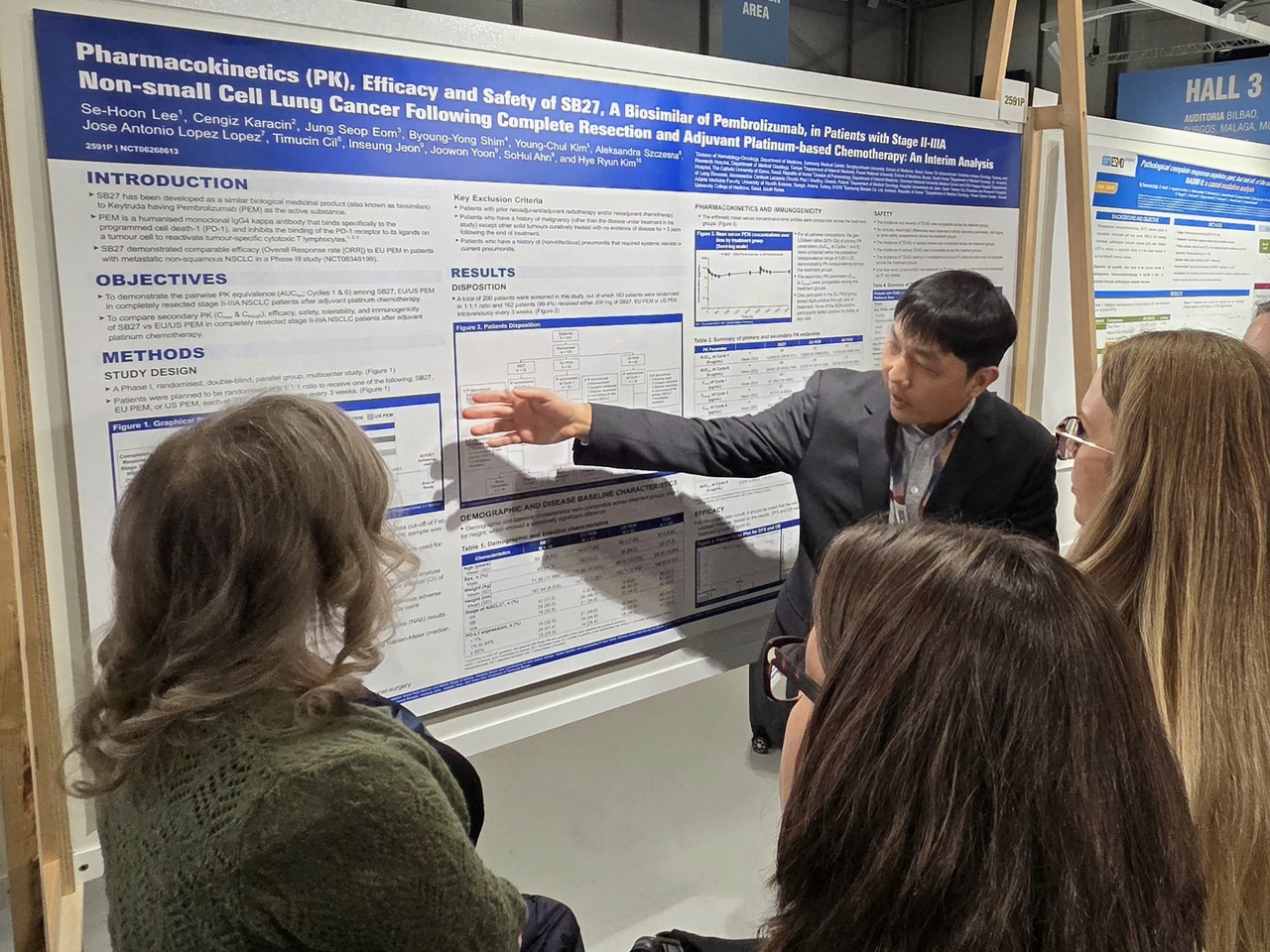
Samsung Bioepis is accelerating development of SB27 (pembrolizumab), its biosimilar candidate for Keytruda — the world's best-selling cancer immunotherapy — after demonstrating equivalence with the original drug in a Phase 1 trial.
The company announced Tuesday that it had presented the Phase 1 trial results for SB27 in a poster session at the European Society for Medical Oncology congress (ESMO 2026), held in hybrid format in Madrid, Spain, from Friday through Tuesday.
Keytruda, developed by US pharmaceutical company MSD, is the world's top-selling drug, recording global sales of approximately 46 trillion won ($31.7 billion) last year.
The drug works by binding to PD-1, an immune checkpoint receptor, to block cancer cells from evading the immune system and help the body's own defenses attack tumors. It holds approvals across a broad range of cancer types.
Samsung Bioepis has been conducting the Phase 1 trial of SB27 since 2024, enrolling 163 patients with non-small cell lung cancer across four countries, including South Korea. Patients were randomly assigned to receive either SB27 or the US- or EU-approved original Keytruda, with researchers comparing pharmacokinetic profiles, efficacy and safety.
The analysis confirmed pharmacokinetic equivalence with the original drug on the primary endpoint — the area under the concentration-time curve (AUC) at a pre-specified time point. Efficacy and safety were also found to be similar to the original drug, with no clinically meaningful differences.
"Through the Phase 1 trial of SB27, we confirmed pharmacokinetic equivalence and similar efficacy and safety compared with the original drug," said Shin Dong-hoon, executive vice president and head of clinical medicine at Samsung Bioepis. "Based on rigorous analysis and clinical standards, we will continue developing oncology biosimilars that patients and healthcare providers can trust."
With Keytruda's key patents set to expire in 2028, competition among global pharmaceutical companies to develop biosimilars has intensified. Should Samsung Bioepis succeed in commercializing SB27, analysts expect it to become the single largest source of sales growth in the company's history.
silverpaper@heraldcorp.com