- Chip implanted in miniature pig traces acetylcholine changes after drug administration
- Technology expected to advance dementia drug development and personalized brain-disease treatment
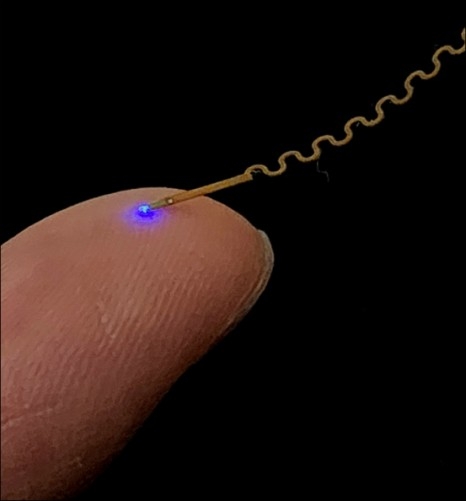
South Korean researchers have developed a technology that can monitor in real time the chemical changes occurring in the brain after an Alzheimer's disease drug is administered. The technology is expected to aid in developing new dementia treatments and precision therapies tailored to individual patients' brain conditions.
KAIST announced Tuesday that a research team led by Professor Jang Kyung-in of the mechanical engineering department had jointly developed an implantable wireless neural chip with the Daegu Gyeongbuk Institute of Science and Technology (DGIST), the Korea Brain Research Institute (KBRI) and the Korea Research Institute of Bioscience and Biotechnology (KRIBB). The chip can detect neurotransmitters in the brain in real time and stimulate neurons using light.
The key advance is the ability to wirelessly monitor changes in acetylcholine — a neurotransmitter in the brain — from outside the body.
Acetylcholine transmits information between neurons and plays a critical role in cognitive functions including memory, learning and attention. Donepezil, an Alzheimer's disease drug, inhibits the enzyme that breaks down acetylcholine, allowing the substance to remain active in the brain longer.
The research team implanted the neural chip into the prefrontal cortex of a miniature pig and then administered donepezil. The prefrontal cortex is the brain region responsible for higher-order cognitive functions such as judgment, attention and memory.
The experiment showed that acetylcholine signals rose after the drug was administered and then gradually returned to baseline — a process observed continuously in real time. This marked an advance beyond conventional electrical brain-signal measurement, enabling the team to track the chemical changes a drug induces in actual brain tissue on a continuous basis.
The neural chip does more than detect changes in the brain — it is also equipped to stimulate neurons using light.
In a separate mouse experiment, the research team confirmed that applying light stimulation through a miniature LED embedded in the chip caused acetylcholine signals to increase.
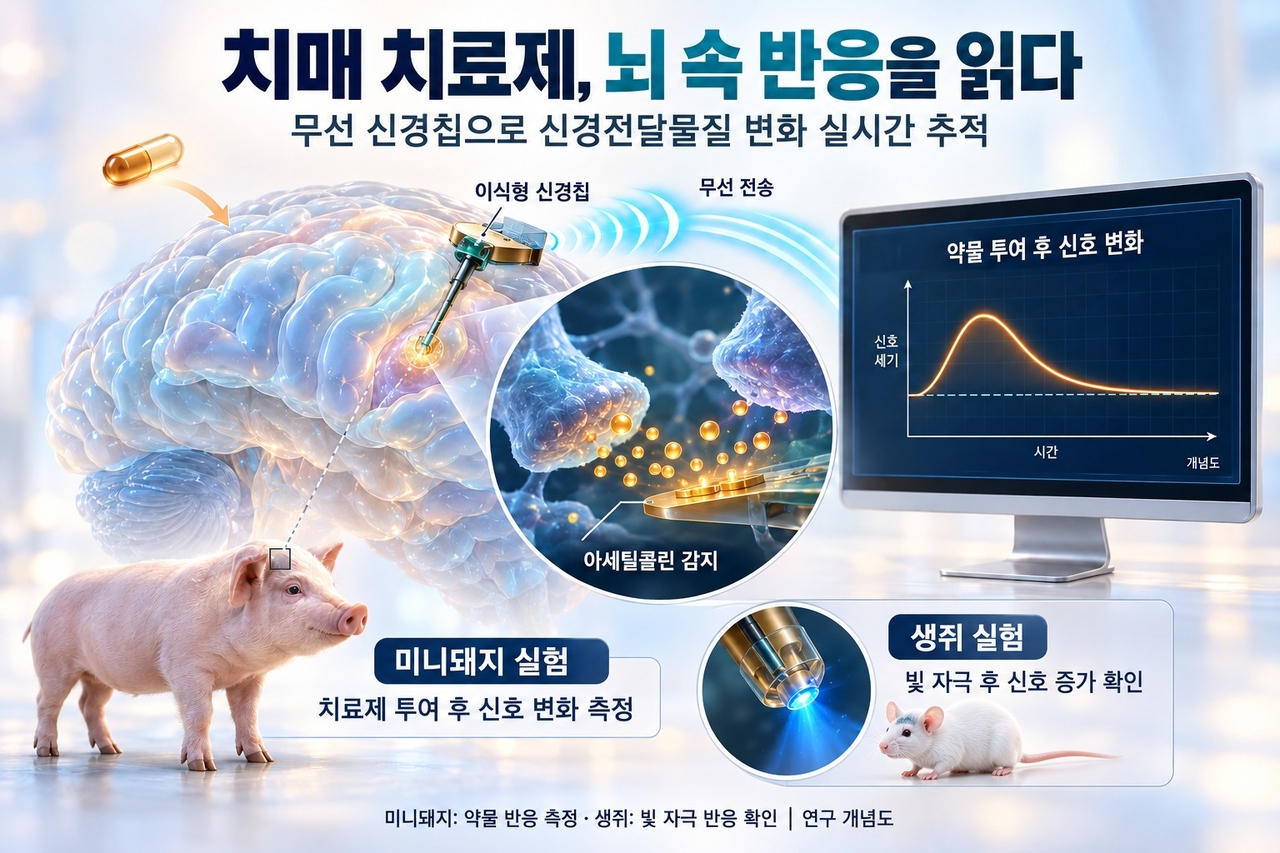
The technology could be applied to developing a "closed-loop neural interface" — a system that measures brain states and adjusts stimulation based on the results.
Conventional brain-computer interfaces (BCI) have primarily analyzed the electrical signals of neurons. This technology sets itself apart by also measuring chemical information in the form of neurotransmitters.
Beyond Alzheimer's disease, the technology is expected to find use in research on a range of neurological conditions linked to neurotransmitter abnormalities, including Parkinson's disease, depression and epilepsy.
The technology also holds strong potential in drug development. At the preclinical stage, it can directly confirm whether a candidate compound is acting on its intended target in the brain and how neurotransmitter responses vary depending on dosage and administration intervals.

The study measured neurotransmitter changes in response to a drug in animal experiments and did not demonstrate actual therapeutic effects on Alzheimer's disease or improvements in memory. Further verification of long-term implant safety and measurement stability will be required before the technology can be applied to humans.
The research team is also pursuing commercialization through Encide Co., a company founded by Professor Jang. Drawing on its experience developing invasive BCI electrodes and implantable devices, Encide plans to seek regulatory approval for medical devices and pursue the clinical validation needed for human application in a phased approach.
"This research has laid the groundwork for advancing toward a technology that reads changes in the brain and adjusts stimulation in response," Jang said. "We expect it to be used to confirm how brain-disease treatments actually work in the brain and to find stimulation methods suited to each patient's brain condition."
nbgkoo@heraldcorp.com