'No mortgage, no viewing' — how Banpo buyers are changing the rules
Loans of 500 million to 1 billion won, 5% annual interest, six-month terms becoming common
Sellers assess repayment ability directly, favoring high earners

A unit at Banpo Riche in Banpo-dong, Seocho-gu, Seoul, with an exclusive use area of 59 square meters sold for 3.15 billion won in September. A collateral mortgage of up to 720 million won was registered on the property, with the seller named as the mortgagee.
As the government maintains tight mortgage lending restrictions, a practice known as seller financing — in which property owners lend buyers a portion of the purchase price directly — has begun appearing in Seoul's high-end apartment market, particularly in the Gangnam area. With buyers finding it increasingly difficult to secure funds through financial institutions, and sellers eager to offload properties, the convergence of their interests has turned private lending into a new avenue for closing deals.
According to real estate industry sources, cases have recently been confirmed in Seoul's three Gangnam-area districts — Gangnam-gu, Seocho-gu and Songpa-gu — in which sellers lend buyers hundreds of millions of won toward the purchase price, secured by a collateral mortgage registered on the property.
The trend traces back to the Oct. 15 real estate measures introduced last year, which tightened mortgage loan limits in the Greater Seoul area and designated regulatory zones. Compounding the pressure, the suspension of the capital gains tax surcharge exemption for multi-home owners ended in May, and proposed property tax increases on high-value homes under the August tax reform package added further strain. The result has been a meeting of minds between buyers struggling to raise funds under tighter lending rules and sellers looking to dispose of properties amid mounting tax burdens — giving rise to seller financing as a deal-making tool.
The head of a real estate agency in Banpo-dong, identified as Agency A, said the office recently brokered a transaction involving an apartment priced at around 5 billion won ($3.78 million) in which the seller lent the buyer about 400 million won. "The interest rate was set at 5 percent per year, with a six-month term," the agent said.
"In the past, a deal where the buyer borrowed money directly from the seller was so rare it might happen once in every 30 or 40 transactions," the agent said. "Recently, it feels more like one or two out of every 10. When you consider there are somewhere between 100 and 200 real estate agencies in Banpo alone, even one or two deals per office adds up to a significant volume."
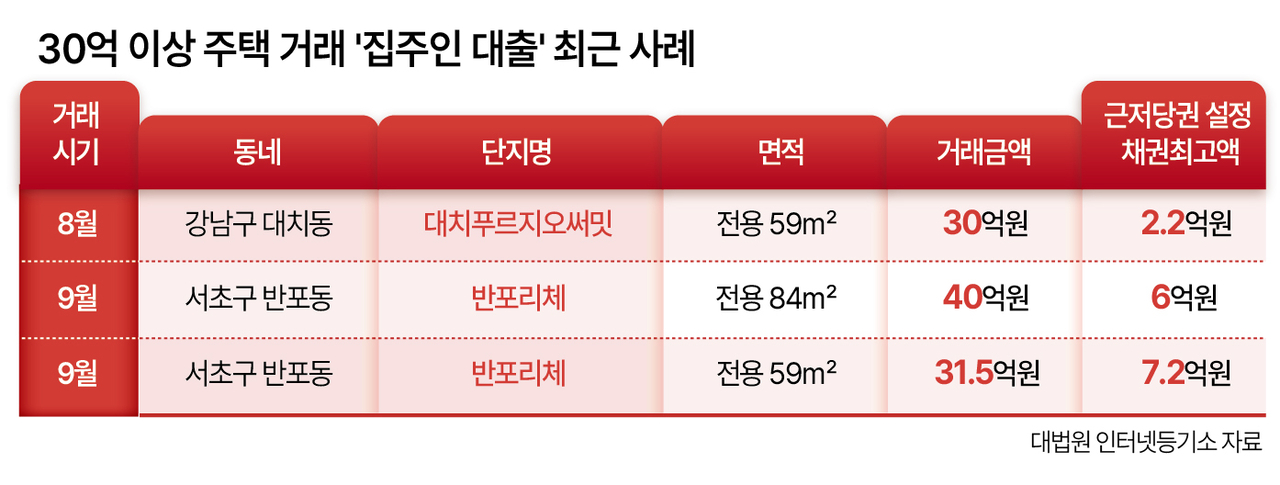
The agent added that attitudes have shifted markedly. "In the past, even asking a seller for a loan was considered rude, and sellers wouldn't entertain it," the agent said. "These days, some buyers ask upfront whether a collateral mortgage is possible — and if the answer is no, they say there's no point even viewing the property."
The practice drew wider attention after President Lee Jae Myung sold his apartment in Bundang-gu, Seongnam, Gyeonggi Province, in July. Lee and his wife sold the unit for 2.9 billion won, deferring the buyer's final payment while registering a collateral mortgage with a maximum claim of 1.77 billion won, with Lee named as the mortgagee.
The head of another Banpo-dong agency, identified as Agency B, said inquiries about "landlord loans" are coming mainly from buyers born in the 1970s through 1990s, most of them high-income professionals or salaried workers. "In the past, financial institutions would extend unsecured loans of hundreds of millions of won to high earners such as doctors," the agent said. "But with lending restrictions tightening recently, even high-income individuals are finding it hard to raise the funds needed to buy a home."
"Even when banks restrict lending, a seller can assess a buyer's occupation and income and decide to lend based on their own judgment of repayment capacity," the agent added. "Demand for funds that gets blocked by financial institutions ultimately migrates to private lending between individuals."
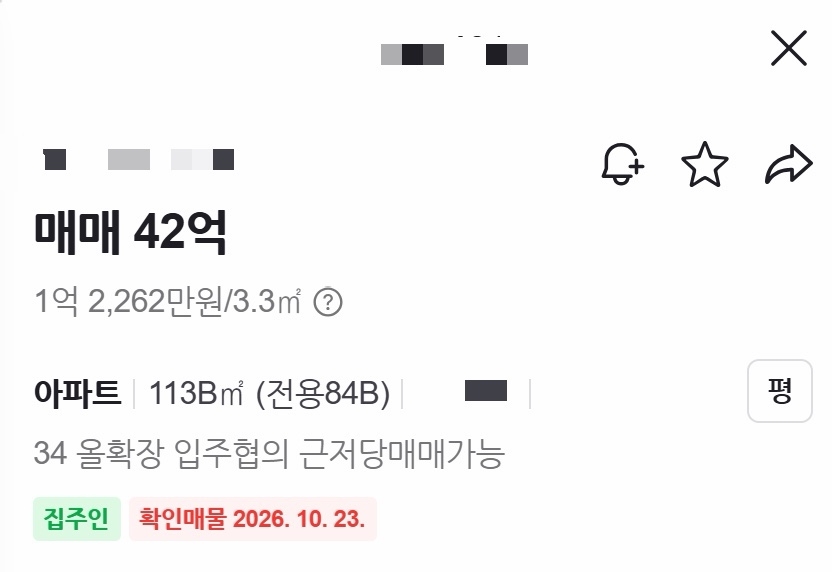
The Agency B head said loan amounts accepted in practice typically fall within 500 million to 1 billion won, with interest rates of around 5 percent per year and terms of six months or less. "There have been actual cases where the seller asked the buyer to submit two years' worth of earned-income statements directly, to verify repayment ability," the agent said.
The arrangement carries real risks for sellers, however. Waiting an extended period to recover a large portion of the sale price places a significant burden on the seller, and the private nature of the loan means disputes over default are a genuine possibility. If a buyer fails to repay principal and interest by the agreed date, the seller must pursue debt recovery through enforcement of the collateral.
The Agency B head recalled past cases in which a deferred final payment led to conflict. "There were instances where the final payment was delayed for several months, and during that time home prices rose sharply, creating friction between the seller and buyer," the agent said. "In one case, the seller refused to transfer ownership, and the dispute was ultimately resolved with the buyer paying an additional 50 million won on top of the original contract price."
Experts say the emergence of seller financing reflects not only tighter bank lending but also anxiety over rising home prices and the psychology driving buyers to act quickly.
Kwon Dae-jung, a chair professor in the real estate studies department at Hansung University, said the appearance of seller financing in the housing market signals that the urge to buy quickly remains strong even when conventional lending is constrained. "The priority should be stabilizing the market by expanding housing supply and sending a clear signal that prices will settle — so that buyers no longer feel they have to rush," Kwon said.
Kwon added that while seller financing is legally unproblematic, it operates outside the standardized screening criteria applied by banks. "Unlike a bank mortgage, the terms and scale of the loan are determined through individual negotiation between the seller and buyer," he said. "Those with more assets and higher incomes can secure more favorable financing, which could draw criticism for deepening the divide between the wealthy and those with fewer resources."
quq@heraldcorp.com
hope@heraldcorp.com