Youth housing protests spread across Spain, Portugal amid calls for rent controls
Spanish youth spend nearly all of their paycheck on rent
Global capital expands into Korea's rental market
Experts warn of prolonged shortage of non-apartment housing

"Your Airbnb was my home" (Tu Airbnb Era Mi Casa)
On Oct. 15, a tent protest against soaring housing costs was in full swing around Metropol Parasol — also known as Las Setas — a landmark tourist site in the southern Spanish city of Seville. Signs hung from the tents bore slogans such as "Our wages are their profit, our lives are their gain." Demonstrators called on the government to act, arguing that the expansion of short-term tourist accommodation and real estate speculation had driven up the cost of housing.
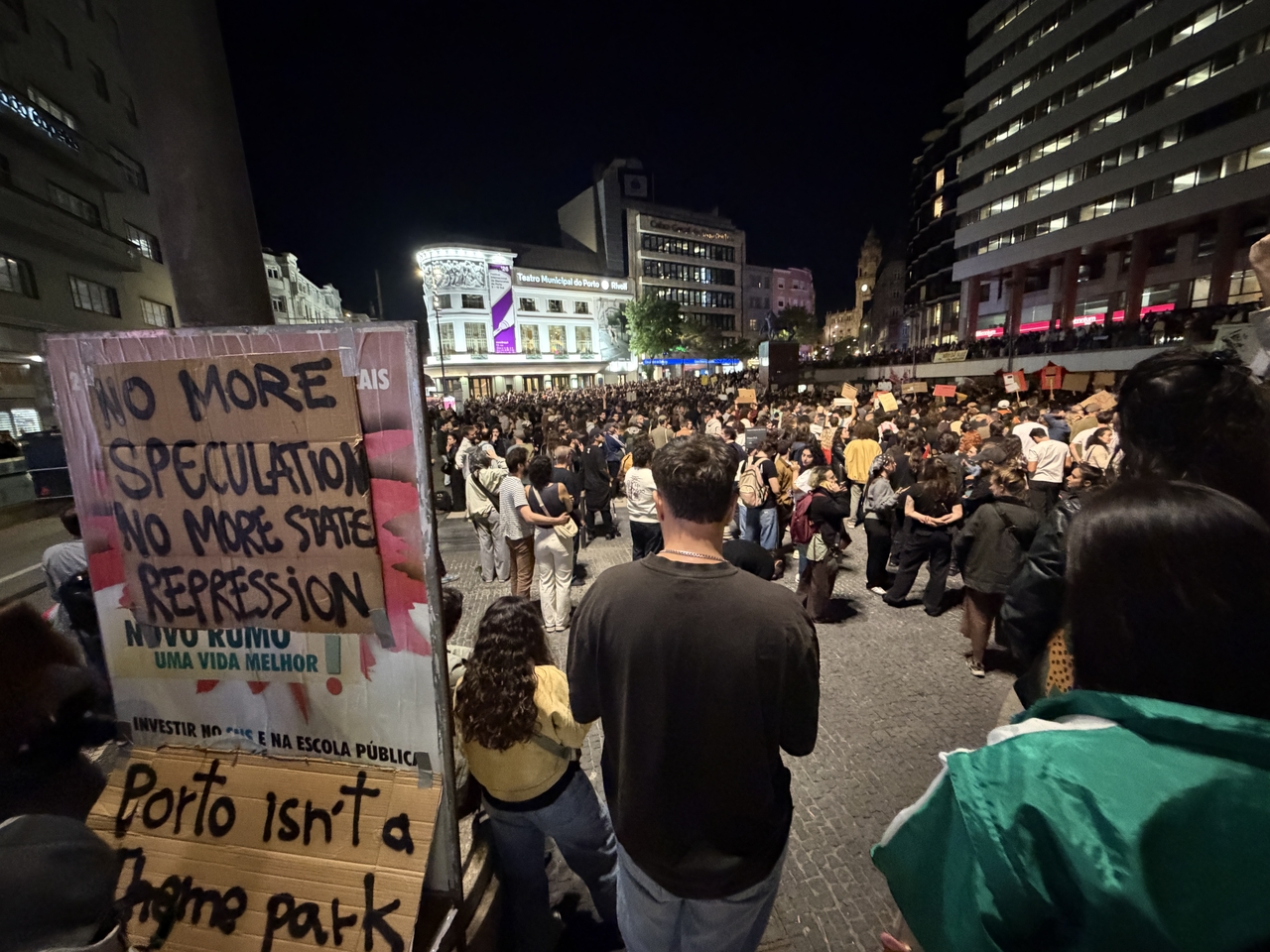
Similar protests broke out at Praça Dom João I in Porto, Portugal's second-largest city, where banners reading "No more speculation" and "Porto is not a theme park" were on display. How did some of Europe's most celebrated tourist destinations become the front lines of a youth housing rights struggle?
Young people take to the streets across Spain and Portugal as rents soar
Tent protests demanding housing rights have continued in Seville since late last month, according to foreign media reports. By Oct. 12, around 200 tents had been erected around Metropol Parasol. Demonstrators are calling for rent controls, restrictions on evictions, an expansion of public housing, and a ban on converting residential properties into tourist accommodation.
In Portugal, a tent protest that began at Praça Dom João I in Porto on Oct. 10 spread to the capital Lisbon. Protesters demanded the introduction of rent caps, greater public housing supply and restrictions on real estate investment funds purchasing residential properties. When police moved in to clear the encampments in Porto and Lisbon on Tuesday, 55 protesters in Lisbon were arrested and later released.
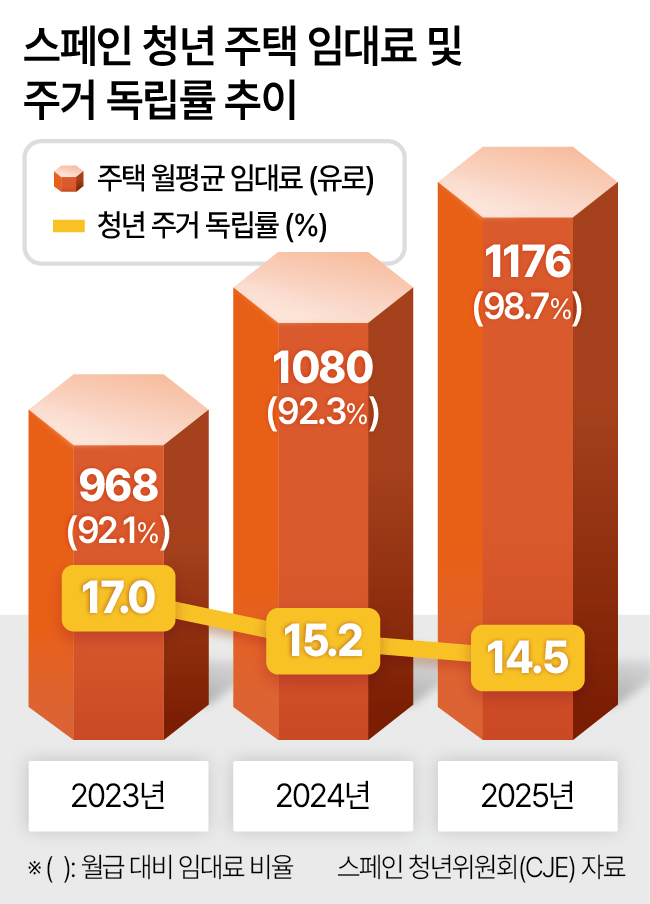
Behind the street protests lies a housing cost burden that has become nearly impossible for young people to bear on their incomes. According to a survey released in May by Spain's Youth Council, the average monthly housing rent in Spain last year reached 1,176 euros ($1,320) — equivalent to 98.7 percent of the average young worker's monthly net salary of 1,191 euros. In other words, a young person renting an average unit alone would have to hand over almost their entire paycheck in rent.
The burden has grown sharply in recent years. Average monthly rent stood at 968 euros at the end of 2023, rising to 1,176 euros last year — a 21.5 percent increase in two years. Over the same period, rent as a share of young people's monthly wages climbed from 92.1 percent to 98.7 percent. The share of 16-to-29-year-olds living independently from their parents fell from 22.1 percent in 2015 to 14.5 percent last year, the lowest level since records began.
Rising housing costs are a Europe-wide phenomenon. According to Eurostat, the EU's statistical agency, EU home sale prices rose 4.7 percent year-on-year in the second quarter of this year, while rents increased 3.0 percent. Portugal recorded the steepest home price increase among the 26 EU member states for which data were available, with prices climbing 16.5 percent over the same period. Spain was not far behind, posting a 12.1 percent rise — roughly 2.6 times the EU average.
8.51 million won a year for a single room: monthly rent pressure mounts in Seoul's university districts
The squeeze on young people's housing costs is being felt in South Korea as well. An analysis by real estate platform Dabang of studio apartments near 10 major Seoul universities, published in July, found that the average monthly rent for units with a deposit of 10 million won ($7,550) and an exclusive use area of 33 square meters or less was 625,000 won. That was up 7.7 percent from 581,000 won in the same month last year.
Management fees rose even faster. Average monthly management fees climbed from 75,000 won to 84,000 won over the same period, a 10.9 percent increase. Combined, the average monthly housing cost — rent plus management fees — came to 709,000 won, up 8.0 percent from 656,000 won a year earlier. Annualized, that amounts to 8.51 million won in housing costs alone.
By university, studio apartments near Ewha Womans University had the highest combined monthly rent and management fees, averaging 870,000 won. Those near Yonsei University averaged 758,000 won, followed by apartments near Hankuk University of Foreign Studies at 755,000 won. Near Seoul National University, average monthly rent jumped 26.0 percent — from 423,000 won in July last year to 533,000 won in July this year.
The shift from jeonse to monthly rent in Seoul's lease market is also accelerating. According to the Ministry of Land, Infrastructure and Transport, monthly rent accounted for 69.9 percent of all jeonse and monthly rent transactions in Seoul from January through August this year, up 5.8 percentage points from 64.1 percent in the same period last year. Analysts attribute the trend to tenants shunning jeonse arrangements for non-apartment properties amid jeonse fraud concerns, as well as landlords' growing preference for monthly rent.
Global capital flows into rental housing — will young people pay the price?
Foreign investment capital has been moving into South Korea's rental housing market in recent years. As the lease market shifts from jeonse to monthly rent, residential real estate offering stable rental income has emerged as an attractive new asset class. Singapore's GIC, US private equity fund KKR, the Canada Pension Plan Investment Board and Hong Kong-based Weave Living have all entered the domestic co-living and institutional rental housing market. Co-living refers to rental housing that combines private living spaces with shared facilities such as kitchens and lounges.
According to commercial real estate services firm R Square, Seoul had a total of 7,377 co-living units in the first quarter of this year, with the highest concentrations in Mapo-gu (1,055 units), Dongdaemun-gu (974 units) and Geumcheon-gu (840 units). Investment in Seoul co-living grew from 197 billion won in 2024 to 385 billion won last year, while the average monthly rent per square meter of exclusive use area rose about 33 percent — from 48,000 won in the first quarter of 2023 to 64,000 won in the first quarter of this year.
As the expansion of tourist accommodation and real estate speculation are blamed for driving up housing costs in Europe, concerns are growing in South Korea that profit-driven investment in rental housing could similarly add to the financial burden on young renters. The worry is that a growing supply of high-end rental units could pull up rents in surrounding areas as well.
The effect could be particularly pronounced in areas such as university districts and major business hubs, where demand for housing among young people is high but supply is limited. As more residential products targeting higher-income workers and foreign nationals — groups with greater ability to pay — come onto the market, ordinary young renters may find their housing options narrowing.
Park Hap-su, an adjunct professor at Konkuk University's Graduate School of Real Estate, said that if the shortage of non-apartment housing and studio units in South Korea persists, the market could become entrenched in a landlord-favorable structure, with the monthly rent market potentially being reshaped around foreign tenants who can afford higher rents. "To ease the housing cost burden on young people, what is needed is a greater supply of relatively affordable non-apartment housing," he said.
quq@heraldcorp.com