Tax burden on smallest unit could rise from 500 million won to 1.76 billion won
All 341 units at Nineone Hannam may fall under heavy taxation if common areas are counted
Hannam the Hill expected to be exempt; scope of essential facilities recognition is key variable
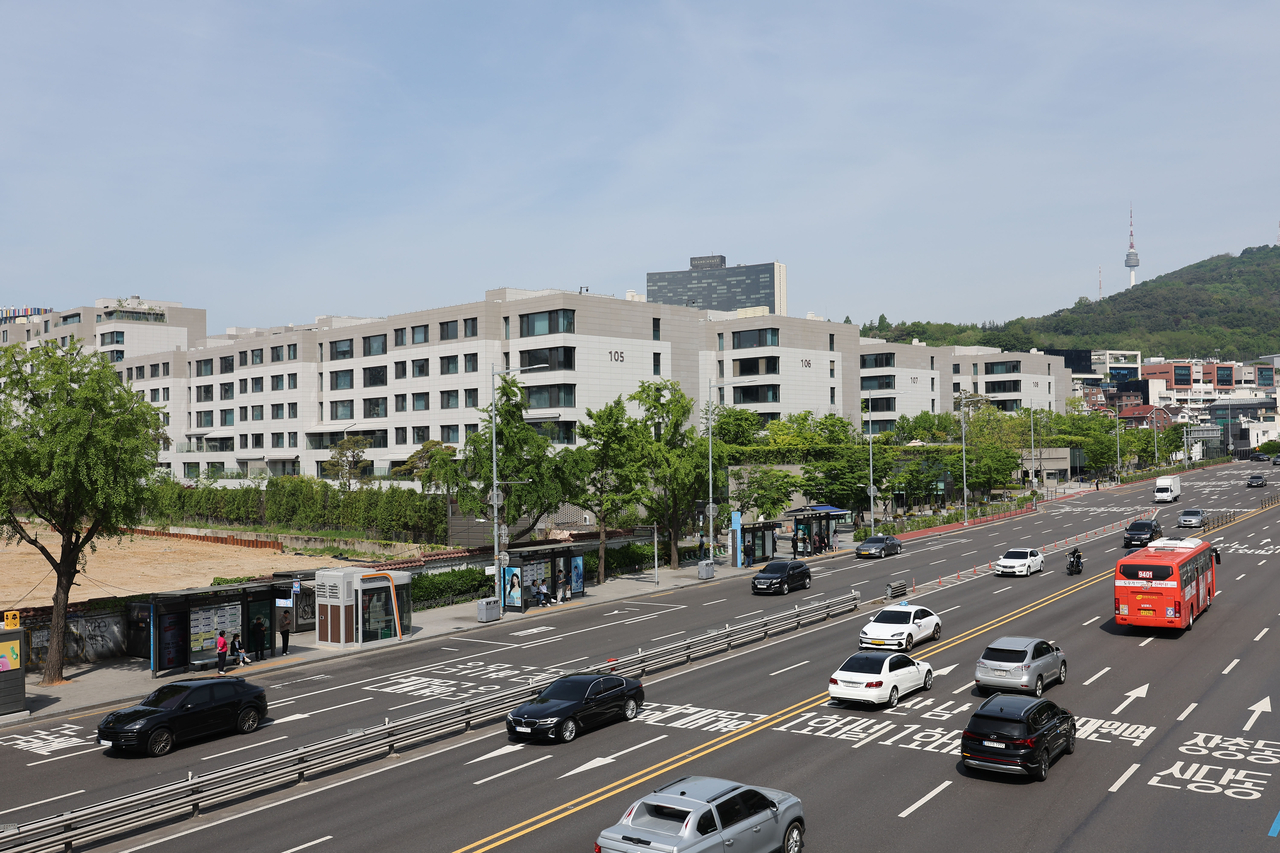
All 341 units at Nineone Hannam, a luxury apartment complex in Hannam-dong, Yongsan-gu, Seoul, could fall under the heavy acquisition tax rate for high-end housing under a proposed government rule change — including its smallest units. The revision would factor common areas such as parking lots into the taxable floor area threshold, potentially pulling in units that previously fell below the cutoff. For the complex's smallest unit type at 206 square meters of exclusive use area, the combined acquisition tax burden could rise from around 500 million won to 1.76 billion won — an increase of roughly 1.26 billion won.
According to the real estate industry, the Ministry of Interior and Safety published a proposed amendment to the Local Tax Act's enforcement decree and rules on Nov. 5, launching a legislative notice period. The core change, set to take effect Jan. 1 next year, would tighten the criteria for recognizing parking lots and other common areas in luxury apartment buildings for tax assessment purposes.
Under current law, apartments in the Greater Seoul area with an exclusive use area exceeding 245 square meters are subject to the heavy acquisition tax rate for luxury housing, with a threshold of 274 square meters for duplex units. Some ultra-high-end developments have skirted the surcharge by designing units with exclusive use areas just below those thresholds while expanding common areas such as parking lots.
To close that loophole, the government plans to add to the taxable area calculation any portion of common space that exceeds 100 percent of the unit's exclusive use area plus the area of legally required essential facilities. For parking lots specifically, only 25 square meters per household will be recognized as essential common area, regardless of the actual number of parking spaces provided.
The amendment would cast a wider net than initially anticipated. Not only penthouse units already close to the existing threshold, but also units with relatively smaller exclusive use areas could be caught if their allocated common areas — particularly parking — are large. The impact is expected to be greatest at ultra-luxury complexes designed with generous parking provisions.
Building registry records for a 206-square-meter unit at Nineone Hannam show total common area reaching 340.8 square meters. Of that, underground parking alone accounts for 252 square meters — more than 10 times the 25 square meters the proposed amendment would recognize as essential. While the unit currently falls outside the heavy tax bracket, it could be brought in under the new calculation method depending on how much area is recognized for other essential facilities.
A 273-square-meter duplex unit in the same complex has parking common area of 334 square meters, with total common area reaching 455 square meters. Calculations show the unit would exceed the new taxable area threshold even if all non-parking common areas were fully recognized as essential.
Of Nineone Hannam's 341 units, the smallest 206-square-meter type accounts for 174 units — more than half the complex. Previously, the heavy tax debate centered mainly on the 244-square-meter and 273-square-meter duplex units. The amendment would, for the first time, bring even the smallest unit type within the scope of the surcharge.
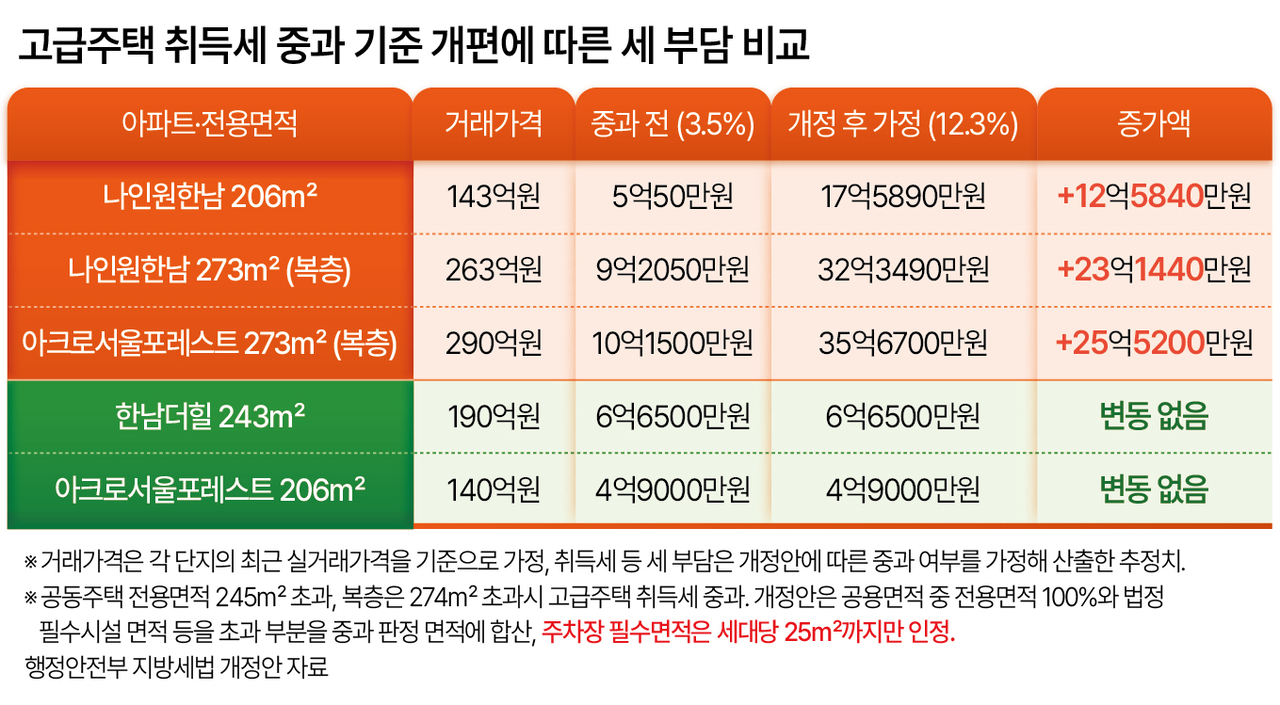
Hannam the Hill, another luxury complex in the same Hannam-dong neighborhood, is expected to be treated differently. Its 243-square-meter units fall about 2 square meters short of the existing 245-square-meter threshold, but their total common area — including parking — is smaller than the exclusive use area, meaning they are expected to remain outside the surcharge even under the new rules. Records for a unit in Building 106 of Hannam the Hill show parking common area of 132 square meters and total common area of 236 square meters. Despite having a larger exclusive use area than Nineone Hannam's smallest units, the smaller common area means a different tax outcome.
Duplex penthouses at Acro Seoul Forest in Seongdong-gu could be affected by the new standard. The 273-square-meter units fall just short of the 274-square-meter duplex threshold under current rules, but their total common area of 303 square meters exceeds the exclusive use area, with parking common area alone reaching 167 square meters — leaving room for inclusion under the new calculation. However, those units could still be excluded depending on how much area is recognized for other essential facilities such as management offices. The amendment means that even among ultra-luxury properties, acquisition tax exposure will vary significantly based not just on exclusive use area but on how parking and shared facilities are designed.
Earlier, the Seoul Metropolitan Government in 2023 moved to impose around 200 billion won ($150 million) in acquisition tax surcharges on 167 Nineone Hannam units, treating underground parking spaces and storage areas as effectively private spaces. The Tax Tribunal overturned the assessments in late 2024, ruling that spaces recorded as common area in official building registers could not be reclassified as residential exclusive use area. A similar tax dispute arose at PH129 in Cheongdam-dong. The current amendment is intended to codify in law the standards for recognizing common areas that were at the center of those disputes.
When a property qualifies as luxury housing, the combined rate for acquisition tax, local education tax and special rural development tax rises from 3.5 percent to 12.3 percent. Applied to the most recent transaction price of 14.3 billion won for a 206-square-meter unit at Nineone Hannam, the tax burden would increase from 500.5 million won to 1.76 billion won. For a 273-square-meter duplex unit acquired at 26.3 billion won, the burden would rise from around 920 million won to 3.23 billion won — an increase of more than 2.3 billion won.
The proposed amendment is currently in the legislative notice stage, with public comment accepted through Dec. 15. Whether any given unit is ultimately subject to the surcharge will depend on the final text of the regulation and the scope of essential common area recognized. If properties previously outside the heavy tax bracket are brought in under the new standard, the buyer's tax burden is expected to become a significant variable in transactions.
"Apartment complexes with large parking common areas due to a high number of parking spaces could be assessed as luxury housing and face a heavier acquisition tax burden, even if the exclusive use area is below the taxable threshold," said Park Jeong-hun, a premier pathfinder adviser at Shinhan Bank.
quq@heraldcorp.com