Seven garden test beds will track plant growth and adaptability across varying soil types, sunlight and rainfall conditions
Experts and community gardeners will spend two to three years accumulating growth data to develop a sustainable garden model resilient to climate change
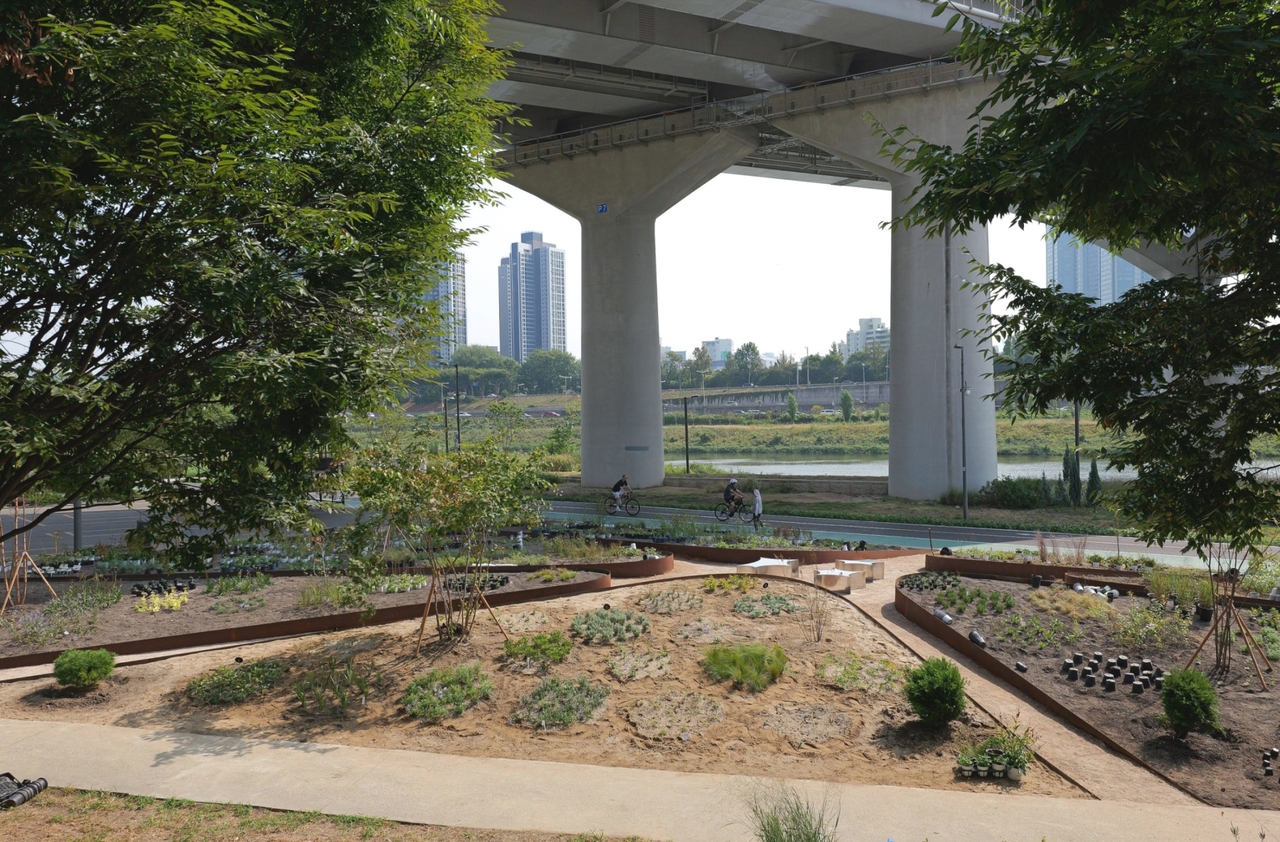
Seoul's Seongdong-gu has completed construction of "Seasons of Seongdong," a research garden designed to develop sustainable planting models in response to climate change, and has begun systematic observation and data recording of plant growth, the district said.
Located at the Eungbong entrance along Jungnangcheon stream, the garden was established to identify plants capable of thriving in rapidly changing urban environments — including extreme heat and heavy rainfall — with minimal maintenance.
The district formalized a public-private-industry-academic partnership through an MOU signed Sept. 18, and by the end of September had planted more than 6,000 specimens across 225 species in seven zones, working alongside Seongdong-gu community gardeners.
Unlike conventional gardens, which focus on presenting a finished landscape, "Seasons of Seongdong" is distinguished by its research orientation: the garden is designed to observe and document the process by which plants adapt and grow through seasonal and environmental changes.
A central focus is comparing how identical plant species perform in different soil conditions. The same plants are grown in three soil types — standard soil, coal ash soil and sandy soil — so researchers can track differences in growth and adaptability. The garden also monitors how varying levels of sunlight and rainfall affect plant development.
Smart plant labels will be used to systematically record growth conditions, with the accumulated data to be analyzed over roughly two to three years. For professional data collection and analysis, the district will share and study plant growth information with partner organizations including Second Nature, the graduate school of Jungbu University and participating farms.
Seongdong-gu community gardeners are directly involved in both the construction and ongoing care of the garden. Having participated from the planting stage, they will work alongside experts to tend the garden while observing and recording plant growth and change. The district plans to use "Seasons of Seongdong" as a hands-on training space to deepen the gardeners' expertise.
Drawing on the data gathered over time, the district intends to identify plant species and planting methods that are both climate-resilient and low-maintenance, then apply them incrementally to residential green spaces and public parks across Seongdong-gu.
"Seasons of Seongdong goes a step beyond making a garden beautiful — it is a garden that residents and experts complete together by recording how plants change and grow with the climate," Seongdong-gu District Mayor Yoo Bo-hwa said. "We will use the growth data we accumulate to build sustainable gardens that stay healthy even as the climate changes."
seouldream01@heraldcorp.com