Ministry to mandate stress tests, revise applicant ID system to prevent competition-rate leaks; audit hearing also sees clashes over children's credentials, absent witnesses
The Ministry of Education has attributed last month's breakdown of the college early-admissions application system to software compatibility failures and inadequate pre-launch testing. The ministry plans to mandate stress testing before the regular admissions round and revise the applicant ID numbering system so that competition rates cannot be inferred from registration numbers.
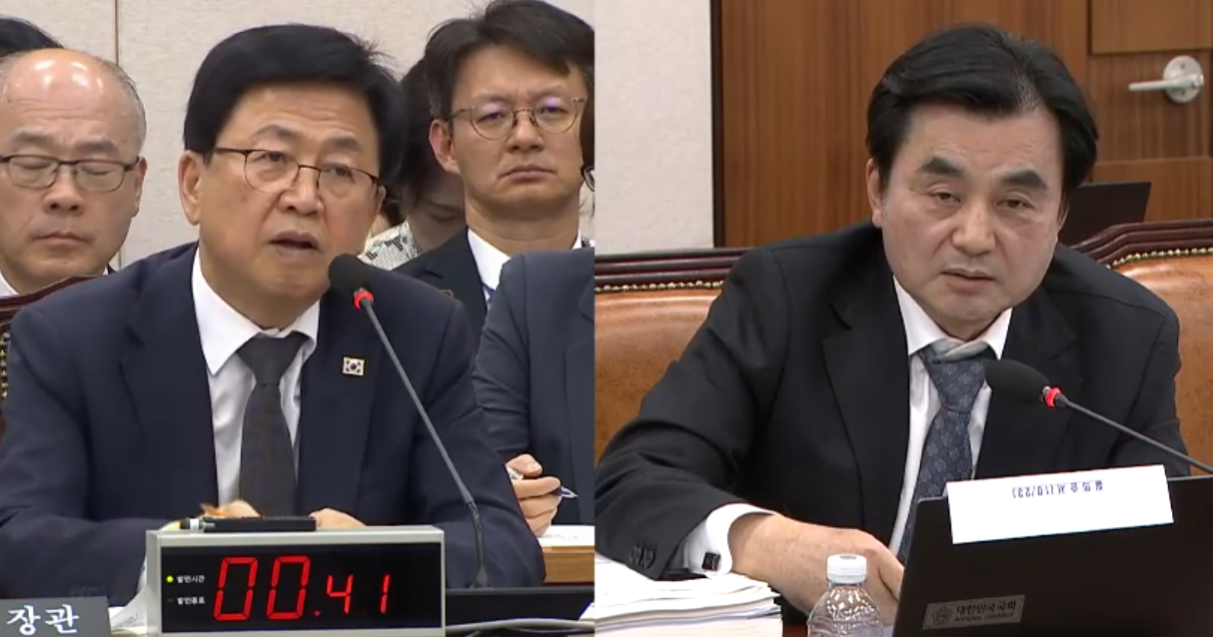
Education Minister Choi Kyo-jin presented the findings of a special investigation — cross-verified by the ministry, the Korea University Education Council and private IT firm LG CNS — at a follow-up briefing to the National Assembly's Education Committee comprehensive national audit on Friday.
"Technical compatibility problems arose between key software components when Uwayapply reinstalled its server operating system," Choi said. "The company failed to conduct advance testing that assumed various failure scenarios and did not put a concrete response framework in place."
The ministry said it will standardize the equipment specifications and functions used by application processing agencies and make preventive procedures — including stress tests — mandatory. It also plans to spell out how application deadlines will be extended under different failure scenarios and make the key contents of its response manual public. The timing and method of releasing final competition rates will also be changed to ensure they are not disclosed before the application period closes.
A revised applicant ID system that prevents users from inferring competition rates is being developed with an eye toward introduction in the upcoming regular admissions round. The ministry said it will conduct sufficient stability checks and consult with the National Assembly before setting a final rollout date.
"Starting with a thorough strengthening of public oversight and supervision, we will review a transition to a public management framework," Choi said. "We will have specific improvement measures and a plan to strengthen public accountability in place by December, before the regular admissions round begins."
Perjury referral sought over Ahn Min-seok; Han Dong-hoon's daughter allegations resurface; absent witnesses draw criticism
The audit session also saw clashes over allegations that Gyeonggi Province Superintendent of Education Ahn Min-seok had made false statements in his election campaign materials, as well as renewed allegations concerning the credentials of the daughter of independent lawmaker Han Dong-hoon.
People Power Party lawmaker Park Jeong-hun raised allegations that Ahn had falsely described in his campaign materials the circumstances under which he was fined for assaulting a police officer. Park also took issue with answers Ahn had given at an earlier audit session and called for a perjury referral. Education Committee Chairwoman Kim Hee-jeong said the matter should be addressed as part of the process of adopting the national audit results report.
Rebuilding Korea Party lawmaker Kang Gyeong-suk raised allegations that Han's daughter had ghostwritten and plagiarized academic papers and fabricated award credentials, calling for a reinvestigation and cooperation from education authorities. People Power Party lawmaker Seo Beom-su pushed back, arguing that the matter had already gone through an investigation and was being recycled as a political dispute.
Choi said the case "was investigated by police and cleared without charges in 2023, so I have nothing particular to add," but added that "if a reinvestigation takes place or a request for cooperation comes in during an investigation, we will do what we can."
Cha Jeong-in, chairman of the National Education Commission, expressed regret over allegations that his older sister had been operating an unaccredited international school. "I have not been in contact with my sister for more than 10 years and have had no involvement in her business," Cha said. Choi added that the matter had been flagged twice through official notifications and that the Incheon Metropolitan Office of Education was expected to file a criminal complaint or request an investigation in November.
Absent witnesses also drew sharp criticism. Seo called for a referral to prosecutors after saying he could not accept the reason given for the absence of the chief executive of an AI chatbot company who had been summoned to answer questions about youth protection measures. Chairwoman Kim said she would review the supporting documentation and, if no legitimate reason was found, proceed with a referral by agreement of the ruling and opposition parties.
Calls to toughen exam-question trading penalties; agency dismissals, KUEC secretary general's overseas trip questioned
Democratic Party lawmaker Kim Moon-su criticized the absence of English-language instructor Jo Jeong-sik and called for stronger legal grounds to punish instructors who trade exam questions with current teachers.
The dismissal procedures for heads of agencies under the Ministry of Education also came under scrutiny. People Power Party lawmaker Lee In-seon questioned whether sufficient investigation and due-process hearings had been conducted before the ministry moved to dismiss figures including Park Ji-hyang, chairwoman of the Northeast Asian History Foundation. Lee also said there were some discrepancies between the ministry's own audit findings and those of the Board of Audit and Inspection regarding the Korea Education Facilities Safety Institute, and called for confirmation that any decisions were grounded in objective evidence.
Questions were also raised about the delay in releasing a draft national education development plan. Lee asked whether there would be enough time for broad social consensus before the final plan is confirmed in March next year, given that the draft release had been pushed back to year's end. Cha said draft plans tend to be treated as final ones, and explained that the intent was to raise the plan's quality by allowing more public deliberation before its release.
Democratic Party lawmaker Ko Min-jeong questioned why Korea University Education Council Secretary General Lee Kyong-hee had traveled abroad during the early-admissions application period. Ko said the secretary general's trip from Oct. 7 to Oct. 12 overlapped with the application window of Sept. 7 to Sept. 11, and pressed the ministry on the absence of the official responsible and the breakdown in reporting procedures.
Lee Kyong-hee apologized, saying she "was abroad on an overseas trip due to my own poor judgment." Korea University Education Council President Lee Gi-jeong said he had not realized at the time of approving the trip that it overlapped with the application period. He explained that although the secretary general had later offered to cancel, he had decided to let her proceed, judging that there would be no major problem.
brunch@heraldcorp.com