Clinics exploit drug-separation exemption, capturing about 60% of self-injectable obesity drug supply
One Greater Seoul clinic received more supply than 174 hospitals combined
Government launches on-site inspections of clinics suspected of in-house dispensing
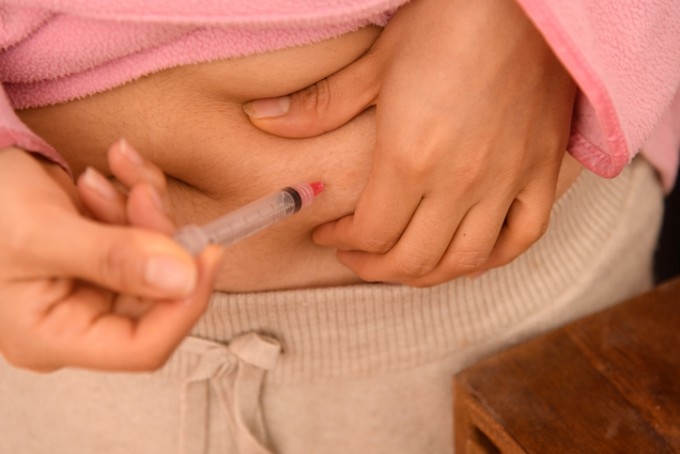
"Got it right away — so convenient." "Thanks for the careful ice packaging."
At first glance, these read like reviews left by online shoppers who just received a food delivery. In reality, they are reviews of a Greater Seoul clinic that prescribes obesity injections. Selling injectable drugs directly inside a clinic — beyond what is needed to demonstrate proper injection technique — is a clear violation of the Pharmaceutical Affairs Act.
Self-injectable drugs for obesity and diabetes, designed for patients to administer on their own, have emerged as a new blind spot undermining the country's drug-separation principle, which requires prescriptions to be filled at pharmacies rather than by physicians. A significant share of the self-injectable obesity treatments made by global pharmaceutical companies — products that have surged in popularity — are being supplied directly to medical institutions rather than pharmacies and sold on-site.
The government has launched intensive on-site inspections targeting medical institutions suspected of circumventing health authorities' oversight by distributing self-injectable drugs through irregular channels in violation of the Pharmaceutical Affairs Act.
According to the Ministry of Health and Welfare and medical industry sources, the distribution of Wegovy, an obesity treatment, and Mounjaro, a diabetes and obesity treatment — both of which have seen demand spike to the point of shortages — has been flowing through channels that conflict with the drug-separation principle.
Under current pharmaceutical law, self-injectable drugs must be dispensed by a pharmacist based on a physician's prescription before being handed to the patient. Physicians dispensing and selling drugs directly inside a medical institution are strictly prohibited.
Current law does recognize one narrow exception to the drug-separation rule: medical institutions may administer injectable drugs on-site on a trial basis only when it is necessary to instruct patients on the correct injection method and potential side effects.
In practice, that educational exemption is being exploited as a loophole to justify exclusive in-house sales — a pattern that distribution data make plain.
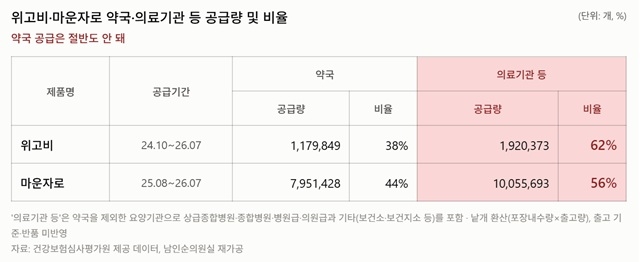
Data obtained from the Health Insurance Review and Assessment Service by Democratic Party of Korea lawmaker Nam In-soon, a member of the National Assembly's Health and Welfare Committee, show that from Wegovy's launch in October 2024 through July 2026, about 62 percent of the drug's supply — roughly 1.92 million units — went to medical institutions other than pharmacies, while pharmacies received the remaining 38 percent, or about 1.18 million units.
For Mounjaro, which launched in August 2025, about 56 percent of supply — roughly 10.06 million units — went to medical institutions and similar facilities through July 2026, with pharmacies receiving the remaining 44 percent, or about 7.95 million units. Less than half of a drug that is supposed to be prescribed by a doctor and purchased at a pharmacy is actually reaching pharmacies.
Among the different tiers of medical institutions — tertiary hospitals, general hospitals, hospitals and clinics — clinics account for an overwhelming share: 88.2 percent of Wegovy supply and 92.4 percent of Mounjaro supply.
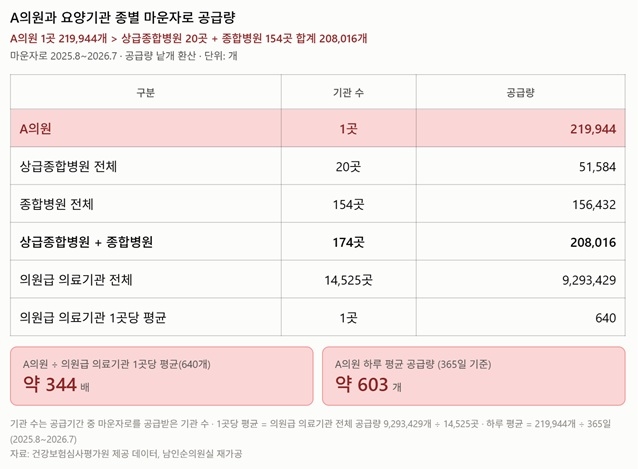
Clinic A, a Greater Seoul facility known as an "obesity treatment mecca," ranked first among all clinics in combined supply of Wegovy and Mounjaro. By drug, it ranked first in Mounjaro with 219,944 units and second in Wegovy with 23,124 units.
From the launches of Wegovy in October 2024 and Mounjaro in August 2025 through July 2026, the clinic received a combined total of more than 240,000 units of the two drugs.
Clinic A's Mounjaro supply alone exceeded the combined 208,016 units delivered to all 20 tertiary hospitals and 154 general hospitals that received the drug — roughly 344 times the average supply per clinic. That works out to an average of 603 Mounjaro units per day over approximately one year since the drug's launch.
As the situation grew more serious, the Ministry of Health and Welfare said it would significantly strengthen oversight to ensure the drug-separation principle is properly observed in the field.
The ministry said it would identify the top-supplied medical institutions nationwide suspected of illegally dispensing and selling self-injectable drugs in-house, and conduct sweeping joint on-site inspections with relevant agencies.
Any institution found to have dispensed large quantities of injectables in-house under the guise of patient education, or to have sold them directly to patients, will face administrative sanctions and criminal referrals.
"Self-injectable drugs are prescription medicines that can cause serious side effects if misused, making accurate diagnosis by a physician and thorough dispensing and medication guidance by a pharmacist essential," a health authority official said. "We will root out the irregular distribution practices that undermine the foundation of the drug-separation system and threaten patient safety."
This article is part of a series that explains useful policy information in plain language, examining the background behind policy proposals, what changes mean, and who can use them, when and how.
thlee@heraldcorp.com