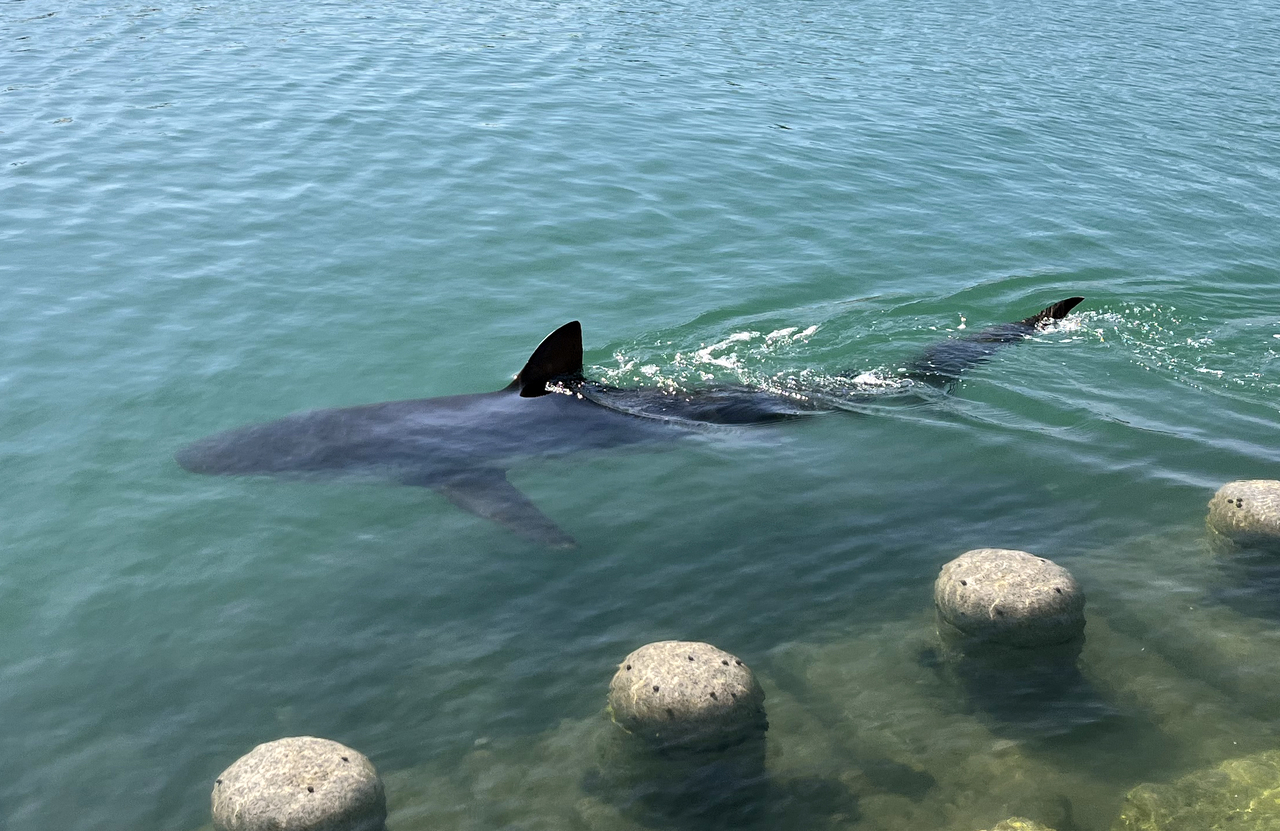
Some analysts say the blacktip shark known as "Bukang-i," which has been stranded in an artificial waterway at Busan's North Port Waterfront Park for 35 days, may have been unable to leave because of ship engine noise outside the channel.
According to the Ministry of Oceans and Fisheries, rescue authorities Thursday completed their latest guiding operation by reinforcing a second barrier net on the inner side of the waterway, and decided to wait for Bukang-i to swim out to sea on its own.
Bukang-i was spotted in the waters off Pier 1, near the waterfront park, after a third guiding attempt Wednesday, indicating it had initially made it out of the waterway. The shark then spent the night circling the area before squeezing back inside through a gap between the first barrier net and the channel floor.
Experts have largely concluded that Bukang-i is unlikely to head out to open water immediately. Choi Yoon, an emeritus professor of biological resources at Gunsan University, said the shark was probably blocked from reaching open water by ship engine noise.
"Having lived inside the waterway, it has grown accustomed to the interior, and the outside has become unfamiliar," Choi said. "On top of the noise, its physical condition is weakening, and the water outside is also deeper — so it will likely need some time to adjust."
He added that international cases show sharks in similar situations do not immediately head out to open water. "Once it adapts — which could take up to about a week — it should leave naturally," he said.
Lee Chung-il, a professor in the Department of Marine Convergence Science at Gangwon University's Gangneung campus, also pointed to ship engine noise. While the exact reason for the shark's behavior cannot be determined with certainty, he said, marine animals are highly sensitive to sound. "Ship engine noise could become a barrier," he said.
Lee added that while it is difficult to assess an animal's behavior based on only a few possibilities, sharks are sensitive to acoustic information. "If the sound is at a threatening frequency, it may simply be unable to pass through that wall of noise," he said.
klee@heraldcorp.com