City responds to Board of Audit and Inspection safety findings
Gocheok Sky Dome fitted with 29 AI monitoring units
Jamsil main stadium wind-load design confirmed adequate
Seoul World Cup Stadium substructure reinforcement underway
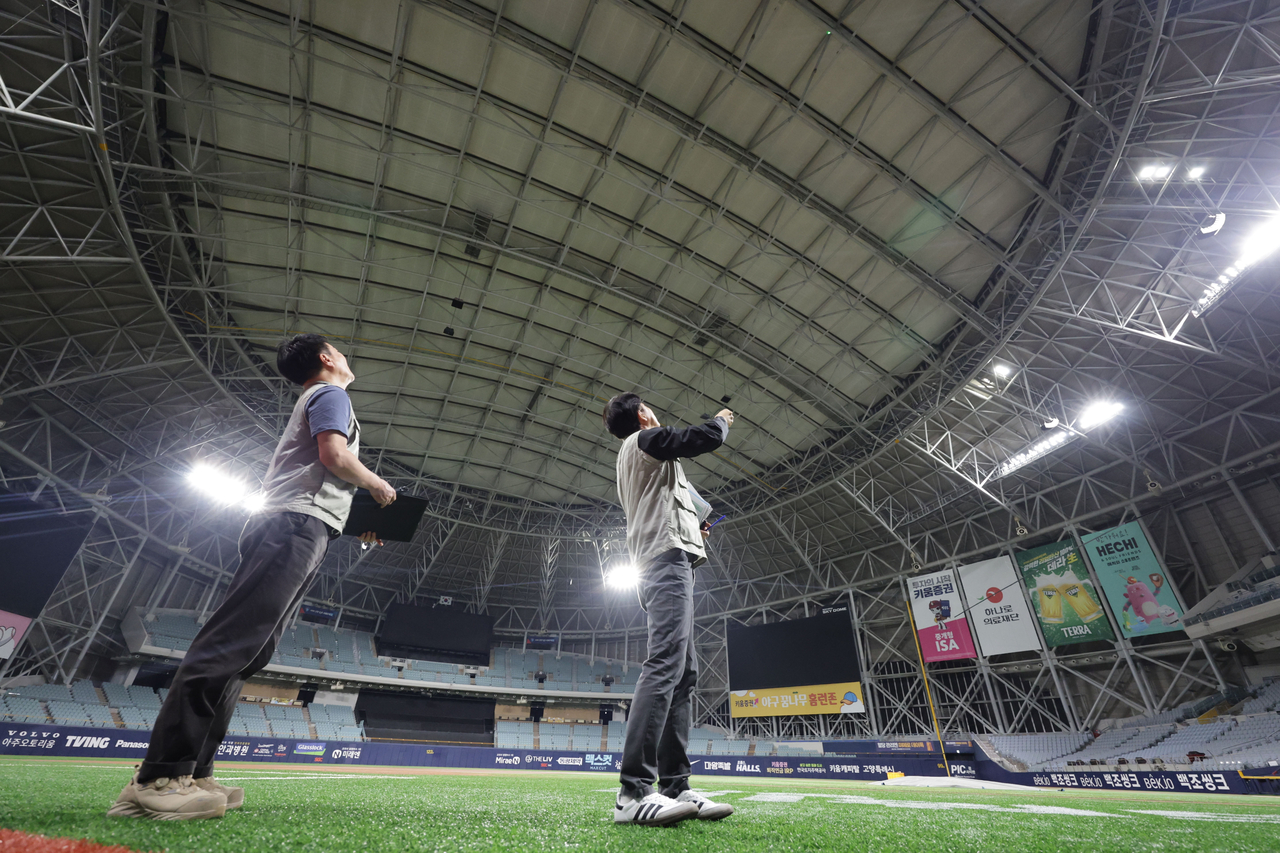
The Seoul Metropolitan Government said Thursday it completed reinforcement work on 97 roof steel trusses at Gocheok Sky Dome in March and plans to conduct additional verification next month to confirm the adequacy of the methods used. The announcement came in response to findings by the Board of Audit and Inspection, which recently flagged safety management problems at several major public sports venues, including Gocheok Sky Dome, Jamsil Sports Complex and Seoul World Cup Stadium.
The board said that during reinforcement of deformed truss joints on the dome's roof, only one side of each joint was reinforced — contrary to the findings of a detailed safety inspection — leaving insufficient load-bearing capacity. The city said the originally recommended reinforcement method was difficult to apply because it overlapped with roof cables, and that a different approach was adopted after consulting specialists.
The original detailed safety inspection had recommended reinforcing 12 of the 23 deformed trusses using a Y-shaped method and the remaining 11 with steel plate overlays. Instead, after specialist consultations, the city applied steel plate overlays to all 23 deformed trusses as well as 74 adjacent affected trusses, for a total of 97.
The city also said it installed 29 AI-based monitoring units in August to track deformation in the roof steel trusses in real time. In November, it plans to commission the Korean Society of Steel Construction to verify the adequacy of the reinforcement methods, taking into account extreme weather scenarios including heavy snowfall.
The city also addressed the board's finding that wind pressure loads applied during the Jamsil main stadium renovation were set lower than required. It said the wind loads used in the 2022 design were calculated in accordance with Ministry of Land, Infrastructure and Transport standards and were appropriate for the stadium's structural type.
"Wind tunnel tests conducted since July confirmed that the wind load values applied in the existing design are appropriate," the city said. It plans to carry out a final safety verification incorporating actual measurements of the roof steel's structural strength.
At Seoul World Cup Stadium, the city is moving to reinforce the substructure beneath a sauna facility's hot-stone room. The sauna was included in the original design when the World Cup Mall was built within the stadium complex in 2003.
The board said that during a detailed safety inspection in 2022, the load of the hot-stone room — which weighs approximately 120 metric tons — was not included in the assessment.
The city said a specialist review conducted during the audit found that the load-bearing capacity of the beams supporting the hot-stone room was insufficient in some areas. It plans to complete a detailed structural review before the end of the year to determine where and how reinforcement is needed, then begin construction immediately.
Both Seoul World Cup Stadium and Gocheok Sky Dome are also scheduled to complete electrical upgrades before year's end to prevent excessive loads on their emergency generators.
"We will meticulously follow through not only on the safety inspections and reinforcement measures currently under way but also on all subsequent steps, so that residents can use sports facilities with confidence," the city said.
ikson@heraldcorp.com