Samsung Electronics, SK hynix buybacks end, deepening supply-demand gap
Samsung falls 4.03%, SK hynix drops 5.72%
Investor deposits slip below 90 trillion won
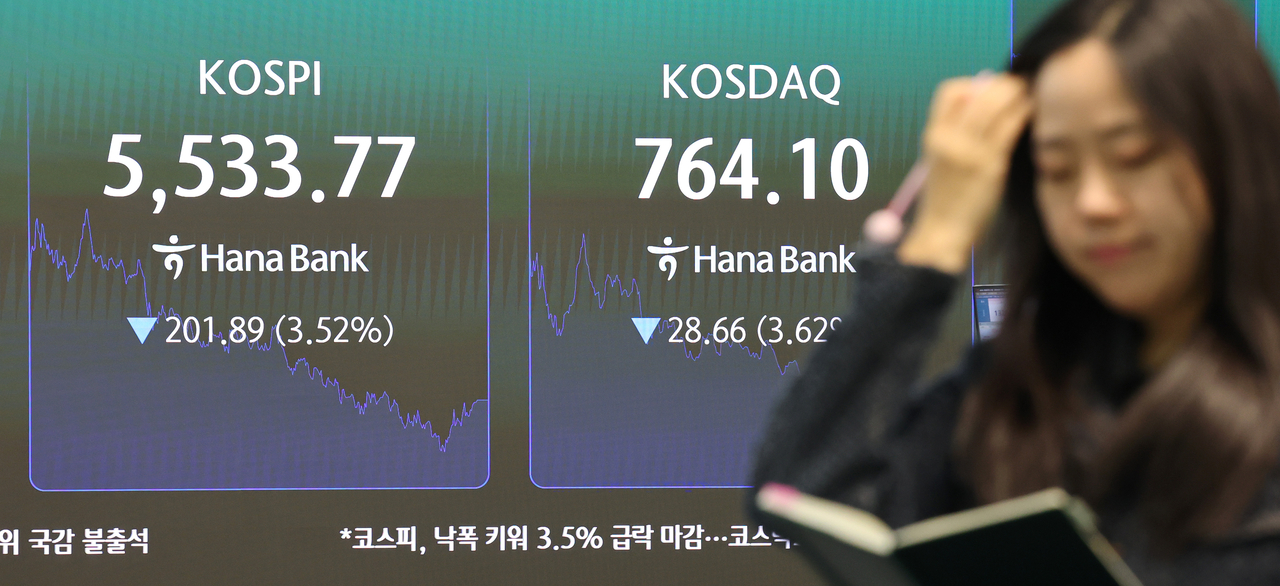
The Kospi fell more than 3 percent in regular trading Thursday, as strong quarterly results from Meta and Tesla failed to calm jittery investors. With domestic markets continuing their turbulent run, investor deposits — a gauge of money waiting on the sidelines — shrank below 90 trillion won ($67.9 billion).
The benchmark index closed at 5,533.77, down 201.89 points, or 3.52 percent, from the previous session. It opened 65.55 points, or 1.14 percent, lower at 5,670.11 and briefly turned positive, rising as much as 0.08 percent, before resuming a steep decline.
Samsung Electronics and SK hynix, the Kospi's two largest companies by market cap, both posted heavy losses. Samsung Electronics fell 4.03 percent to close at 214,500 won, while SK hynix dropped 5.72 percent to finish at 1.22 million won.
Samsung Electronics staged a modest early rebound and SK hynix trimmed its losses at one point, but both stocks quickly resumed sharp declines.
The selloff in the two semiconductor heavyweights appeared to reflect profit-taking after they surged more than 5 percent on Wednesday. In SK hynix's case, lingering concerns over a potential dual-listing issue — stemming from its US subsidiary Solidigm's planned stock market debut — also weighed on the stock.
Meta and Tesla both reported strong third-quarter results before Thursday's opening bell, but ongoing concerns about future profitability prevented the news from providing any meaningful relief to the market.
"It is true that, in an environment where the supply-demand base remains thin, tug-of-war moves are frequently occurring over AI — pitting real demand expansion and a sustained investment cycle against profitability concerns and funding risks," said Han Ji-young, a researcher at Kiwoom Securities. "Volatility is inevitable through next week as the market awaits earnings from other US hyperscaler companies and domestic semiconductor stocks."
Adding to the pressure, the large-scale buyback programs at Samsung Electronics and SK hynix — which had helped cushion the Kospi against downside pressure — recently concluded, leaving a gap in market support.
Samsung Electronics completed its 15 trillion won buyback on Oct. 6, while SK hynix wrapped up its 40 trillion won repurchase program on Wednesday.
By investor type, individuals and foreigners were net buyers in the Kospi market, purchasing 382 billion won and 58 billion won worth of shares, respectively, while institutions were net sellers at 463 billion won.
The Kosdaq also closed sharply lower, finishing at 764.10, down 28.66 points, or 3.62 percent. The index opened at 789.84, off 2.92 points, or 0.37 percent, before extending its losses throughout the session.
On the Kosdaq, individuals were net buyers at 221 billion won, while foreigners and institutions sold a net 122 billion won and 101 billion won, respectively.
Alteogen, the Kosdaq's largest stock by market cap, fell 4.37 percent to close at 229,500 won. Ecopro dropped 7.07 percent to 77,600 won, and Ecopro BM tumbled 9.75 percent to 98,100 won.
Elice, a domestic AI full-stack company whose shares plunged more than 30 percent on their Kosdaq debut and sent ripples through global AI and semiconductor stocks, has since rebounded sharply over two consecutive sessions. On Thursday, Elice surged 17.15 percent to close at 93,600 won.
As market volatility intensified, investor deposits stood at 89.63 trillion won as of Wednesday, down 663.1 billion won from the previous session. The last time deposits fell below 90 trillion won was Jan. 14 this year, when they stood at 89.31 trillion won — more than nine months ago.
Deposits have now declined for seven consecutive trading days. Compared with the first half of the year, when deposits grew even as investors were net buyers of shares during a rising market, investors now appear reluctant to commit fresh money to stocks.
Margin lending balances — a measure of leveraged investing — are also shrinking. The balance fell 242.8 billion won from the previous session to 30.27 trillion won, the lowest level since Aug. 11, when it stood at 30.04 trillion won.
While domestic markets have staged occasional rebounds, they have struggled to break out of their downward trend, pointing to a broad deterioration in investor sentiment.

jiyun@heraldcorp.com