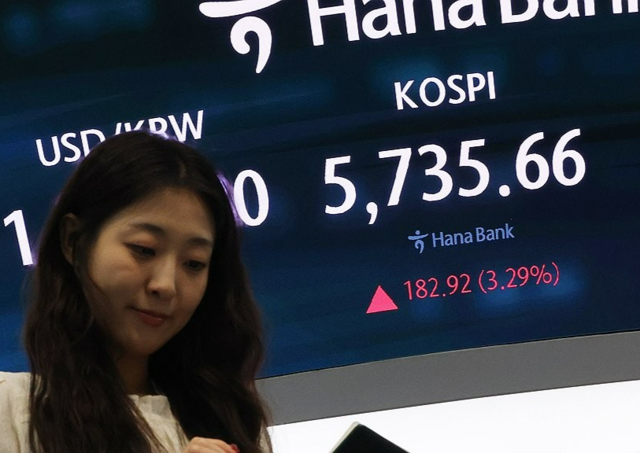
Even as the Kospi has been pushed down to the 5,500 level, a brokerage is forecasting the index could climb as high as 9,300 next year. Domestic companies are maintaining strong profitability, but their share prices have yet to fully reflect it, the analysis found.
Hanwha Investment & Securities set a Kospi target of 8,500 for next year in its "2027 Stock Outlook" report released Thursday, with an expected trading range of 6,000 to 9,300.
Ha Jang-kwon, a researcher at Hanwha Investment, said the recent market decline represents a situation where share prices have fallen sharply ahead of actual corporate earnings. He recommended buying on dips below the 6,000 level, arguing that macroeconomic concerns have already been substantially priced in.
The Kospi plunged on Oct. 13 and Oct. 15, briefly touching the 5,500 level. Concerns over a prolonged high-rate environment in the United States and uncertainty surrounding the semiconductor industry weighed on investor sentiment.
Meanwhile, earnings forecasts for major domestic companies have not deteriorated significantly. Hanwha Investment said this divergence between fundamentals and prices would serve as the basis for a future market rebound.
Record-high earnings, plunging share prices — forward PER falls to 4x
The key indicators Hanwha Investment highlighted are return on equity and price-to-book ratio.
Return on equity, or ROE, measures how much profit a company generates from its shareholders' equity. Price-to-book ratio, or PBR, shows how many times a company's share price trades relative to its net assets.
According to the report, the Kospi's forward 12-month ROE stood at 25.5 percent as of Friday — close to an all-time high.
Yet the PBR over the same period remained at just 1.08 times. Applying the historical relationship between ROE and PBR observed in the domestic market from 2005 to 2023, the current level of profitability would justify a PBR of around 2 times — but share prices are trading at roughly half that level, the report said.
The forward 12-month price-to-earnings ratio has also fallen to around 4 times, the lowest since 2010.
Ha said the ROE currently priced into shares is only about 11 percent — a significant gap from the trailing 12-month ROE of about 16 percent and the forward 12-month estimate of about 26 percent.
The report also noted that domestic companies' profitability compares favorably with peers in other major markets.
On an MSCI basis, Korean companies' forward 12-month ROE has surpassed that of Taiwan for the first time in about 12 years. Profitability has risen sharply, yet the valuation of the domestic market remains relatively low.
Hanwha Investment said a rerating of share prices would become possible once market confidence in the sustainability of corporate earnings growth is restored.
The market's forward 12-month ROE estimate for the Kospi at end of next year has risen from 18.2 percent in March to 22.7 percent recently, signaling that expectations for future corporate profitability are being revised upward.
Historical data was also cited in support of a potential rebound.
An analysis of periods since 2005 when the ROE priced into the market was lower than companies' actual trailing 12-month ROE found that the Kospi's average return one year later was 28 percent. The index rose in 84 percent of such instances.
Hanwha Investment said the key variable for a share price rerating will be how consistently companies can sustain their high profitability going forward.
Consolidation in the first half of next year, then a renewed rally — high-rate headwinds seen as limited
Hanwha Investment expects the Kospi to recover to around 7,600 in the fourth quarter of this year.
The brokerage set a first-quarter target of 7,700 for next year and a second-quarter target of 7,550. The rally is expected to slow temporarily in the first half, before resuming in the second half driven by growth in companies' net assets and improving profitability.
The third-quarter target for next year is 7,900, with the fourth-quarter target at 8,500.
Even if the high-rate environment persists, its drag on further market gains is expected to be limited.
Hanwha Investment forecast that the Federal Reserve will raise its benchmark interest rate to 4.25 percent in December and hold it there through the end of next year. The yield on the 10-year US Treasury note is expected to move in a range of 4.80 to 5.60 percent next year.
Ha said that based on the historical relationship between long-term US Treasury yields and market valuations, rising interest rates do not always lead to falling share prices.
An analysis of the relationship between the 10-year US Treasury yield and the forward 12-month price-to-earnings ratio of the S&P 500 since 1985 found that rates and valuations tended to move in the same direction as long as yields remained below 6 percent.
Above 6 percent, however, rising rates acted as a drag on equity valuations, the report said.
The report also flagged changes in the labor market driven by the spread of AI.
Hanwha Investment said that as AI adoption expands, workforce reductions will increase — particularly in high-wage sectors — which would limit wage-driven inflationary pressure.
If labor cost burdens and inflationary pressure ease while corporate profitability holds up, financial markets may be less likely to worry about further tightening even in a high-rate environment, the brokerage said.
On that basis, Hanwha Investment characterized share price corrections driven by macroeconomic uncertainty as opportunities to increase exposure to risk assets.
Semiconductors and IT in focus through year-end — banks and steel to broaden the rally from the second quarter of next year
The sectors expected to lead the market higher will vary by timing, the brokerage said.
Hanwha Investment identified semiconductors and IT hardware as the top investment picks from the fourth quarter of this year through the first quarter of next year.
Improving earnings at chipmakers and memory chip price negotiations are expected to serve as catalysts for share price gains.
In particular, earnings releases from major memory chip companies at the end of this month, long-term supply contracts at year-end, and HBM price negotiations for next year are all expected to influence a broader rerating of the sector.
From the second quarter of next year, the rally is expected to broaden to other sectors.
As upward pressure on interest rates eases and the won strengthens, investor attention could shift toward banks, steel, transportation and utilities, the report said.
Hanwha Investment forecast the won-dollar exchange rate to fall from 1,350 won per dollar in the first quarter of next year to 1,270 won in the fourth quarter.
A stronger won would benefit sectors where import costs for raw materials and energy fall as a result. The brokerage highlighted the possibility that the semiconductor-led rally could broaden to value stocks and cyclical sectors.
For the Kosdaq market, Hanwha Investment identified the second half of next year as the period to watch for a potential rebound.
The gradual unwinding of the liquidity squeeze caused by prior rate hikes — rather than rate cuts themselves — could serve as the trigger for a Kosdaq recovery, the report said.
On shareholder return policies in the domestic market, the brokerage said a closer link to corporate earnings is needed.
According to the report, South Korean companies' total shareholder return ratio last year was 31.1 percent, well below Japan's 65.0 percent and Taiwan's 56.8 percent.
Hanwha Investment said that while shareholder return policies such as dividends and buybacks can have a positive effect on share prices, sustained gains require underlying market confidence in corporate earnings.
Ha said what matters most is how high a level of profitability companies can maintain even during periods when ROE falls from its peak.
The Kospi target of 8,500 for next year was derived from the expectation that companies' improved profitability will be reflected in share prices. Hanwha Investment said the index could rise to the upper end of its forecast range — 9,300 — if earnings growth is sustained and market valuations normalize.
rainbow@heraldcorp.com