Three-year average tied to growth rate proposed as alternative
Boom-era revenues seen as source for AI, advanced industry investment
Balancing Assembly oversight with swift fund deployment poses challenge
A government-backed future reserve fund could see its accumulated resources fall by roughly 100 trillion won ($75.4 billion) in 2028 under the current calculation formula, a think tank has warned. Analysts say the fund should base its contribution threshold on a three-year average adjusted for economic growth, rather than a single year's tax revenue, to ensure stable financing.
Kim Hyun-a, head of the fiscal research division at the Korea Institute of Public Finance, made the case in a keynote address Thursday at a policy symposium on the Future Response Fund, co-hosted by the institute and Democratic Party of Korea lawmaker Oh Ki-hyung.
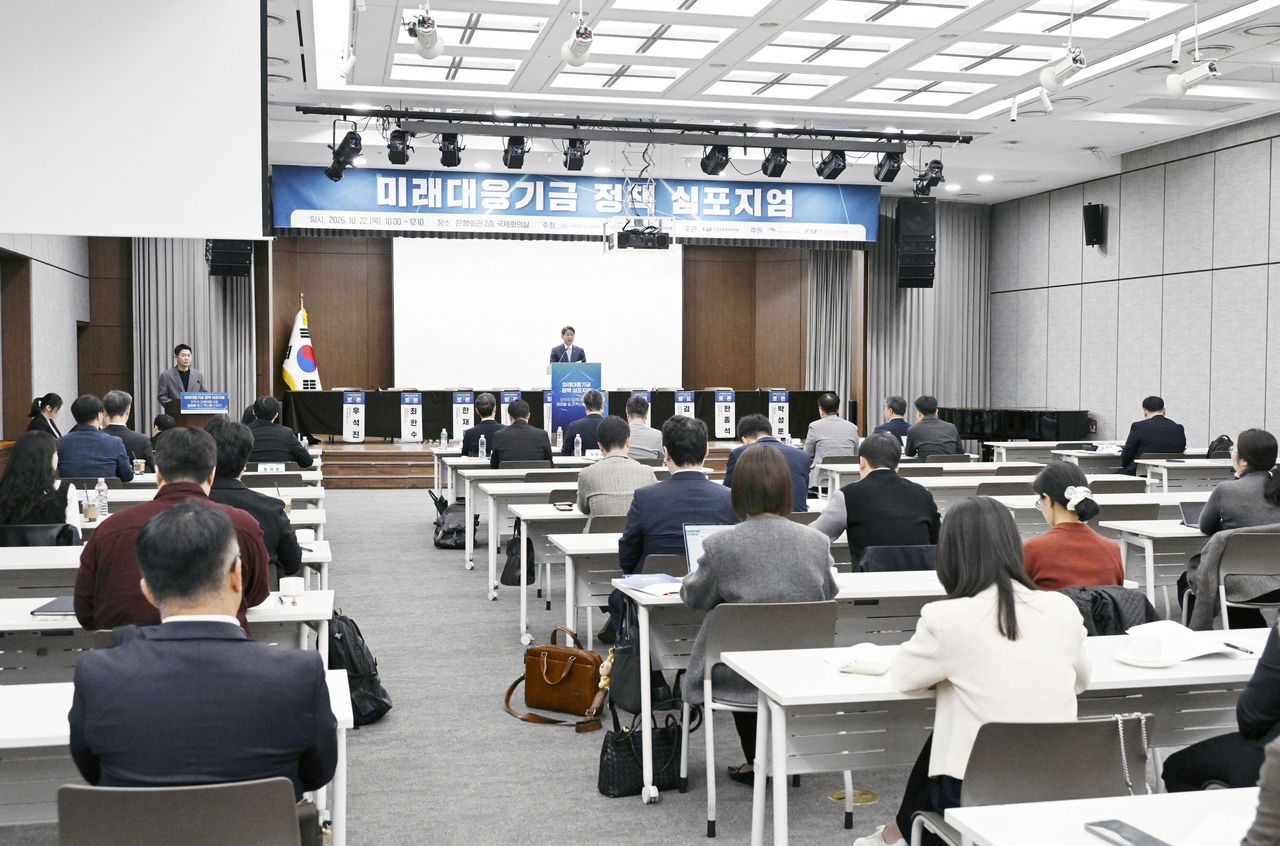
Kim said the Future Response Fund is designed to channel surplus tax revenues generated during economic upturns into long-term growth initiatives while cushioning the fiscal impact of revenue swings. She said, however, that the current accumulation formula makes it difficult to secure stable funding for the reserve.
Under the existing formula, the fund's surplus tax revenue is projected to fall from 162.3 trillion won in 2027 to 61.7 trillion won in 2028 — a drop of 100.6 trillion won.
The decline stems from how the baseline trend figure is calculated: it uses domestic tax collection results from two years prior as its reference point. When a tax boom persists, the elevated revenue figures feed into the following year's trend calculation, sharply reducing the surplus available for the fund.
Under the government's proposal, any amount by which the domestic tax budget exceeds the trend figure is deposited into the fund. The trend figure itself is derived from the average annual growth rate of domestic tax receipts over the preceding 10 years.
To address this structural problem, Kim proposed adopting a three-year average method adjusted for economic growth. Under that approach, the fund's 2028 accumulation is estimated at around 110 trillion won — more than 50 trillion won higher than under the existing formula.
Kim said the fund could reinvest boom-era tax revenues into AI, advanced strategic industries and talent development, strengthening the foundations for future growth.
She added that the fund could also serve as a fiscal stabilizer — enabling swift responses to new welfare demands and inequality without supplementary budgets, curbing deficit government bond issuance when revenue shortfalls occur, and smoothing out fluctuations in local allocation tax and local education finance grants.
Kim Jeong-hun, president of the Fiscal Policy Research Institute, estimated that the fund would generate annual fiscal benefits of between 1.2 trillion won and 1.8 trillion won. The estimate compares fund management and reduced government bond issuance after the fund's introduction against the baseline scenario before it, assuming an investment return rate of 3.5 to 3.85 percent.
Kim said the fund could mark a turning point away from what he called "rain-fed paddy" public finances — heavily dependent on a single year's revenue conditions — toward stable, medium-term fiscal management.
He also stressed that the fund could improve the predictability of local government finances. When actual domestic tax receipts fall short of the trend figure, the shortfall could be covered by fund reserves, cushioning sharp swings in local allocation tax and local education finance grants. He said this would allow both systems — in place for 65 and 55 years, respectively — to achieve stable spending trajectories for the first time.
Kim described the fund as a Korean-style fiscal management regime analogous to the standing borrowing authority used in Anglo-American systems, in that it supports stable execution of already-approved expenditures while preserving the National Assembly's fiscal oversight powers.
Participants also raised the need to ensure the fund can be deployed quickly while maintaining adequate parliamentary controls.
Kim Bong-hwan, a professor at Seoul National University's Graduate School of Public Administration, praised the fund as a nimble tool for responding to fiscal needs, but said the preconditions for allowing exceptions to the gross budget principle — such as caps on transfers to the general account — must be clearly defined.
He particularly stressed the need for greater transparency in revenue forecasts and fund management plans, along with stronger ex ante oversight procedures. He also proposed tightening ex post management — requiring that fund transfers and changes to management plans be reported promptly to the National Assembly, and that performance results be mandatorily reflected in the following year's plan.
Kim Nam-jong, head of the capital markets research division at the Korea Institute of Finance, said boosting productivity through AI adoption and new industry development is critical to countering the decline in potential growth caused by the low birth rate and aging population. He said timely investment — including in public infrastructure such as power and water supply — is essential to maintaining a technological edge in the semiconductor and AI industries and securing market leadership.
The panel discussion featured Lee Hang-yong, president of the Korea Institute of Finance; Woo Seok-jin, a professor at Myongji University; Choi Han-su, a professor at Kyungpook National University; Han Jae-jun, a professor at Inha University; Han Jong-seok, a professor at Dongguk University; and Park Sung-hoon, head of the Future Response Fund Task Force at the Ministry of Planning and Budget.
Panelists raised concerns that rapidly retiring a large volume of government bonds in a short period could amplify financial market volatility, in response to arguments that surplus revenues should be used first to pay down government debt. Participants also noted that because the government's annual medium-term fiscal plan does not include projections for surplus tax revenues, those revenues need to be managed from a medium-term perspective.
Vice Minister Cho Yong-beom of the Ministry of Planning and Budget said in his congratulatory remarks that the fund was established "as a strategic investment platform and fiscal stabilizer to transform the tax revenues swelled by the current semiconductor boom into 'opportunities for the future,' rather than letting them flow into single-year consumptive spending." He added that the ministry would design and operate the fund "with greater precision and transparency, given that it represents a groundbreaking innovation in the fiscal system."
He said the ministry would continue refining the framework "so that the Future Response Fund can become a fund for everyone — built together by local and central government, the National Assembly and the executive, and current and future generations."
y2k@heraldcorp.com