National Assembly defense committee holds first standalone audit of service academies
Air Force Academy chief: 'Expertise and identity must be preserved'
Naval Academy chief: 'Quantitative and qualitative analysis needed'
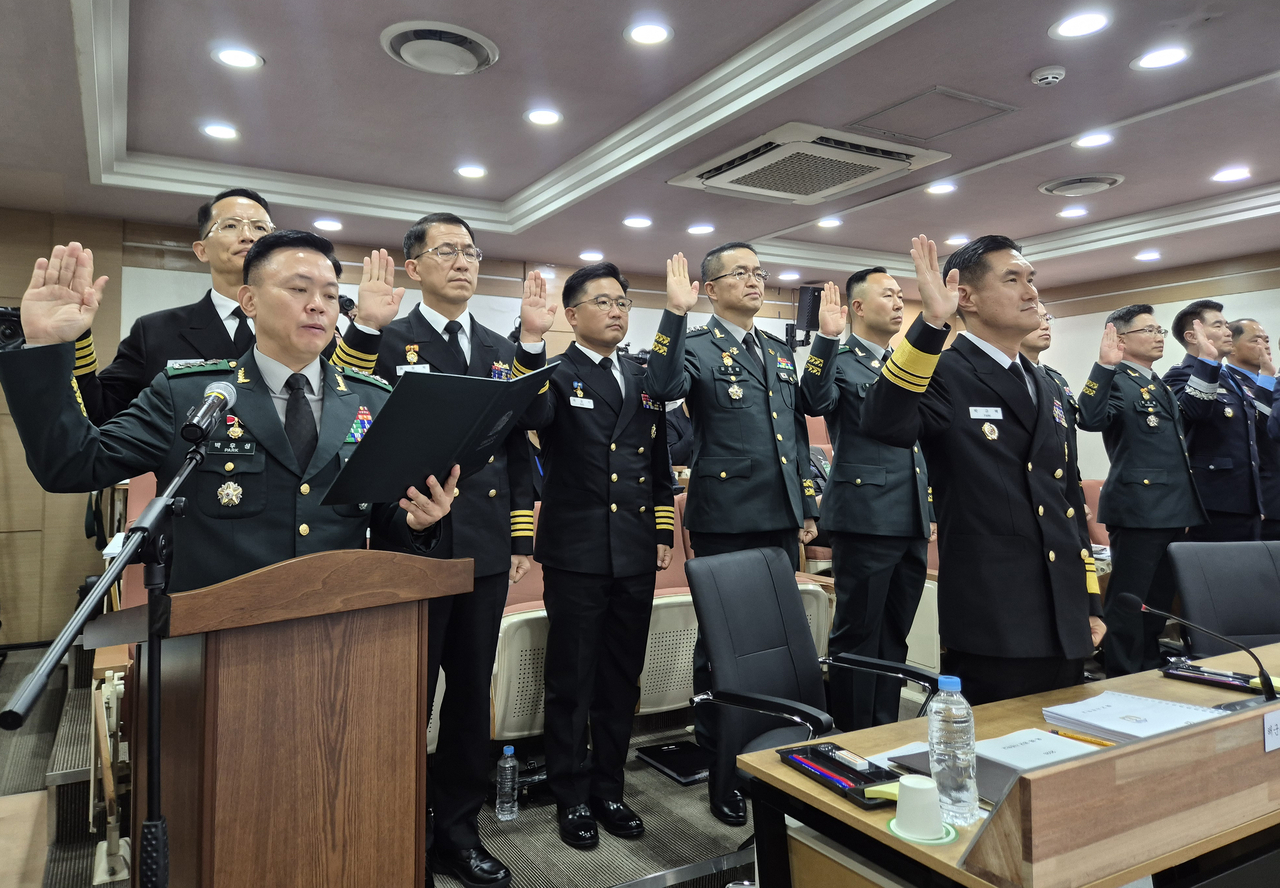
Korea Military Academy Superintendent Park Hu-seong said Thursday that the government's plan to merge the three service academies should move forward only after the base plan is revised and broad consensus is built. The superintendents of the Naval Academy and Air Force Academy also attached conditions to the proposal, with all three calling for a cautious approach to the pace of integration.
Park made the remarks as a witness at the National Assembly Defense Committee's audit of the Army, Navy and Air Force academies, held at the Korea Military Academy in Nowon-gu, Seoul. "Innovation and change in academy education are necessary, but I am aware of the concerns among cadets and professors," he said.
He said he had been raising the issue through official chains of command and would continue to do so as the plan for a unified national military academy takes shape. "If necessary during the concretization process, I will keep making these recommendations," he said.
When Democratic Party lawmaker Min Hong-cheol asked whether Park's failure to respond to a written National Assembly questionnaire on the merger amounted to opposition, Park said it would not be appropriate for a school superintendent to publicly voice opinions on a policy being pursued by the Defense Ministry. "It does not mean I am opposed," he added.
Park said he agreed that integration would help strengthen jointness among the services, but noted that the current separate academies were already making substantial efforts in that direction.
On President Lee Jae Myung's remarks attributing responsibility for past coups to Korea Military Academy graduates, Park said it was "gravely wrong" that some politically minded officers from the academy had committed historical errors. The vast majority of KMA graduates, however — past and present — had quietly devoted themselves to the nation and the military at posts across the country, he added.
The other two superintendents also set conditions. Air Force Academy Superintendent Park Heung-jae said that while integrated education would help strengthen jointness, it should be carried out "in a way that does not undermine expertise and identity."
Park also said that if the academies were consolidated at Jaun-dae in Daejeon, the logistical burden of transporting cadets for flight training would increase and operational efficiency could suffer.
Naval Academy Superintendent Park Gyu-baek said the expected benefits of integration for jointness would require both quantitative and qualitative analysis.
The audit also saw sharp exchanges between the ruling and opposition parties. Democratic Party lawmaker Kim Byung-joo, who serves as the president's special adviser on defense policy, said the academy merger was not unique to the Lee Jae Myung administration. "Almost every government since the Korean War has pursued it," he said. "It is a demand of the times."
People Power Party lawmaker Kang Seon-yeong pushed back, saying that even apartment reconstruction projects take five to 15 years, and questioning how a government that launched only last June could complete a merger within two years. "The falcon, the tiger and the dragon are being turned into ducks," she said, referring to the symbols of the Air Force, Army and Naval academies.
Meanwhile, this was the first time the defense committee has held a standalone audit of the service academies on a separate schedule. The academies, which are directly under each branch's headquarters, had previously been audited alongside their respective branch headquarters audits at Gyeryong.
rimsclub@heraldcorp.com