Lee Eok-won, Lee Chan-jin apologize again at national audit; deny rushed review
Retail investor losses reach 6.31 trillion won; confirmed losses at 2.32 trillion won
Lee Eok-won cites property rights on ban; Korea Capital Market Institute warns of volatility
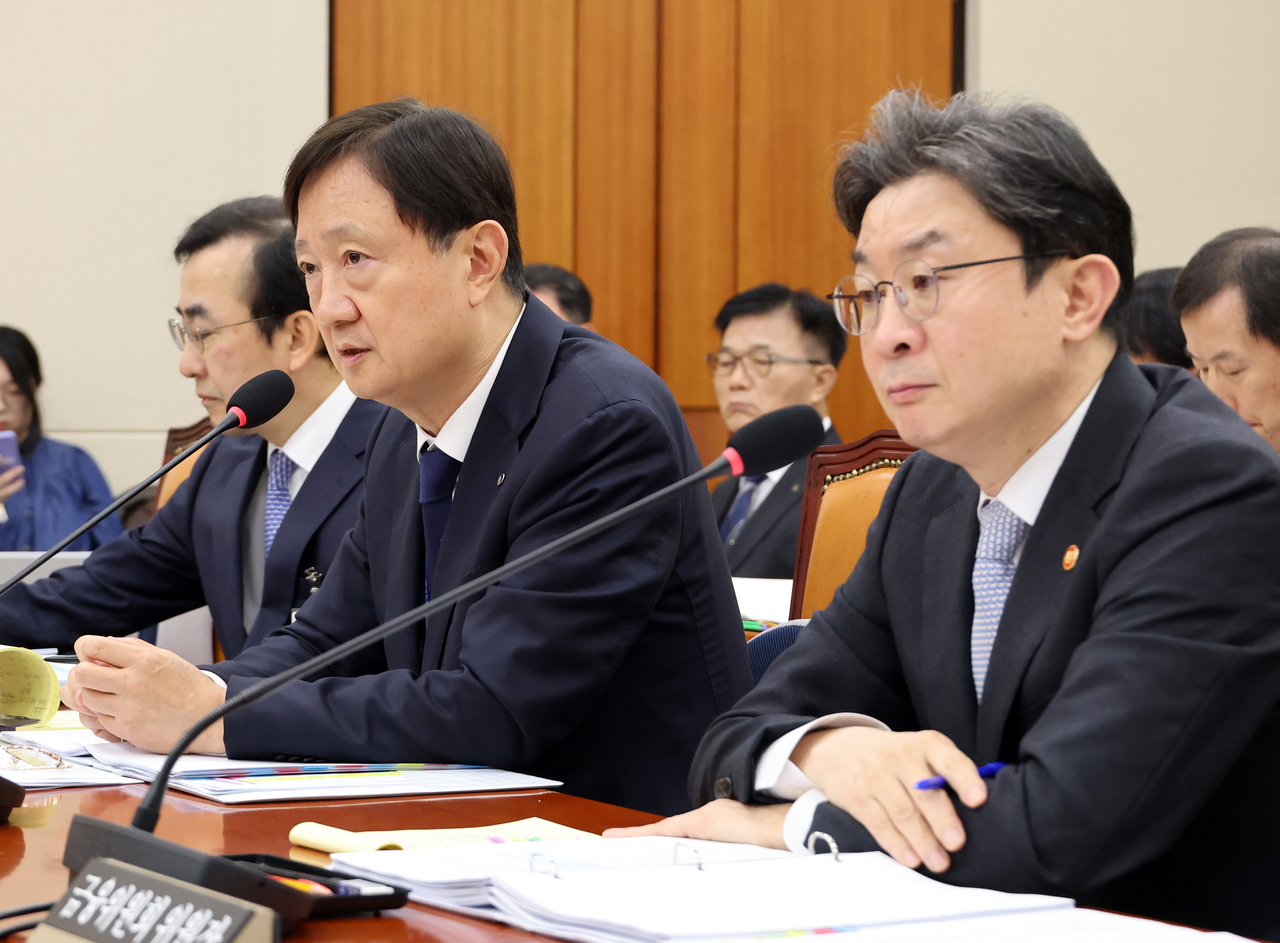
Financial Services Commission Chairman Lee Eok-won and Financial Supervisory Service Director Lee Chan-jin apologized again before the National Assembly over losses exceeding 6 trillion won ($4.53 billion) suffered by retail investors in single-stock leveraged ETFs. The financial regulators, however, denied that the products had been approved through a rushed review and expressed caution about banning them, citing investor property rights.
At Thursday's comprehensive national audit of the FSC and FSS by the National Assembly's Political Affairs Committee, People Power Party lawmaker Kim Jae-seop raised the retail investor losses caused by single-stock leveraged products and called on the heads of the financial authorities to apologize. Lee Eok-won said he felt "a great sense of weight" over the outcome despite what he described as various policy rationales behind the products' introduction, and pledged to handle investor protection and market stability "with greater care and precision."
Lee Chan-jin also said he "humbly accepts" the lawmaker's criticism and that the matter weighs on him constantly. "I feel deeply sorry to the public here today," he said, adding that he would treat the occasion as a moment to reflect deeply on his role and responsibilities as head of a financial supervisory body charged with protecting investors.
According to data submitted by the FSS to members of the Political Affairs Committee, retail investor losses from single-stock leveraged exchange-traded products totaled 6.31 trillion won between May 27, when the products launched, and Aug. 14. The figure was compiled from trading data at 10 comprehensive financial investment firms. Confirmed losses from sold positions stood at 2.32 trillion won, while unrealized losses on held positions amounted to 3.99 trillion won. About 546,000 accounts traded the single-stock leveraged products, with average losses of 11.56 million won per account.
The product review process also came under scrutiny. The average time to list a single-stock leveraged product was 29 days, shorter than the 62-day average for ordinary ETFs, fueling allegations of a hasty approval process. Lee Chan-jin had said at a national audit on Monday that the review had been expedited to meet listing schedules, but on Thursday he pushed back, saying he "cannot accept" the characterization that the products were approved through a rushed review.
When People Power Party lawmaker Park Sung-hoon asked who had requested that the review be expedited, Lee said the FSS had "rigorously reviewed the product structure and key risks during the 15-day securities registration review period and accepted the filing when those 15 days were up." He added that his earlier remark referred to the fact that the products had come directly to the FSS without going through a preliminary listing review, which had made the process faster.
The financial authorities also showed reluctance on the question of banning the products. When People Power Party lawmaker Shin Dong-wook asked whether a ban had been discussed, Lee Eok-won said discontinuing the products "raises property rights issues" and that while various measures had brought some stability, he would "continue to think it over."
Single-stock leveraged ETFs track twice the daily price movement of individual stocks such as Samsung Electronics and SK hynix. To maintain double exposure to the underlying asset's daily return, the products execute rebalancing trades that adjust equity and futures holdings in line with price movements. Critics have noted that this mechanism — buying more when prices rise and selling more when they fall — can amplify price swings.
Jang Geun-hyeok, a senior research fellow at the Korea Capital Market Institute, said that "due to their structural characteristics, single-stock ETFs can further amplify volatility through rebalancing trades." He noted, however, that the rise in volatility for Samsung Electronics and SK hynix reflected a combination of factors, including uncertainty in the global semiconductor market and the broader macroeconomy.
Jang called for ongoing monitoring of the growth in assets under management and the impact of rebalancing trades during periods of heightened volatility. He also urged investors to remain mindful of risk management, noting that risks can increase further after a share price rally and that concentration in a single stock carries its own dangers.

hajun825@heraldcorp.com