Last year's new businesses numbered about 908,000, with a startup rate of 11.7 percent — the lowest on record. High-growth firms shrank to 4,534, and the one-year survival rate hit its lowest in six years.

The number of new businesses in South Korea fell to about 908,000 last year, declining for the fifth consecutive year. The share of new businesses among all active companies — the startup rate — dropped to 11.7 percent, the lowest since records began in 2011. High-growth firms, defined as those that rapidly expanded both sales and employment, fell 15.9 percent over the same period.
According to the "2025 Business Birth and Death Administrative Statistics (Preliminary)" released Thursday by the Ministry of Statistics, new businesses decreased by about 14,000, or 1.5 percent, from the previous year. A new business is defined as a company that had no activity in the prior year but generated sales or hired salaried workers during the reference year. Over the same period, active businesses — those with sales or salaried workers — rose by about 106,000, or 1.4 percent, to about 7.748 million. The startup rate fell 0.3 percentage points, extending a declining streak to five consecutive years since reaching 15.6 percent in 2020.
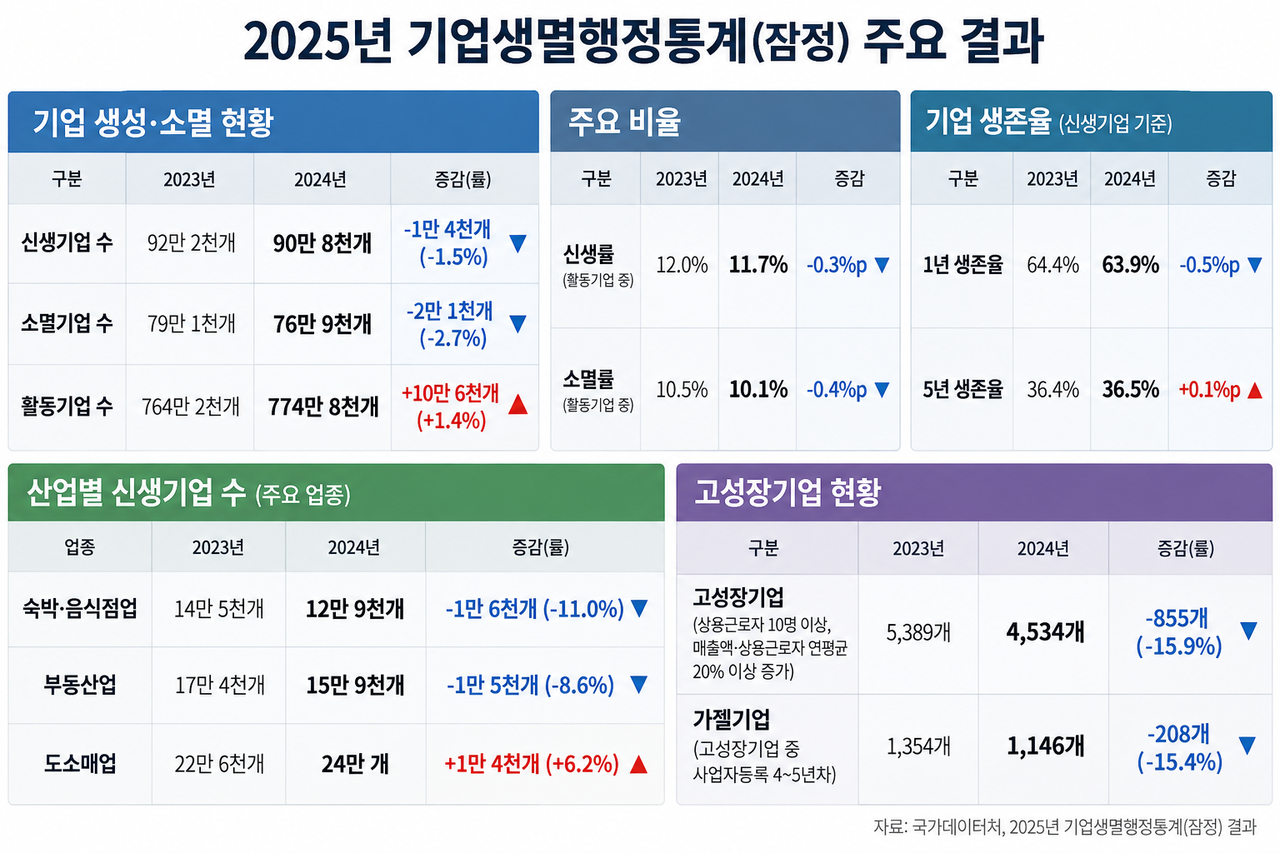
By industry, new businesses in the accommodation and restaurant sector fell by about 16,000, or 11.0 percent, marking a second consecutive annual decline. The real estate sector shed about 15,000 new businesses, down 8.6 percent, for a fifth straight year of decline. Wholesale and retail trade bucked the trend, adding about 14,000 new businesses, up 6.2 percent.
The number of dissolved businesses — active companies that lost both sales and salaried workers — stood at about 769,000 in 2024, down about 21,000, or 2.7 percent. The dissolution rate fell 0.4 percentage points to 10.1 percent, the lowest since records began. Dissolved businesses had peaked at about 791,000 in 2023, partly due to the impact of high interest rates, before turning lower in 2024.
Survival rates were mixed. The one-year survival rate — the share of businesses started in 2023 that were still operating in 2024 — fell 0.5 percentage points to 63.9 percent, its second consecutive annual decline and the lowest since 2018, when it stood at 63.6 percent. The five-year survival rate, however, rose 0.1 percentage points to 36.5 percent, a record high and the eighth consecutive year of improvement since 2016.
By workforce size, sole-operator businesses rose by about 114,000, or 1.9 percent, to about 6.217 million, accounting for 80.2 percent of all active businesses. Firms with two or more workers edged down by about 7,000, or 0.5 percent, to about 1.531 million. Among dissolved businesses in 2024, those with two or more workers increased by about 58,000, or 12.3 percent, while sole-operator firms fell by about 27,000, or 3.7 percent.
By age of business owner, active companies led by those aged 70 or older rose by about 91,000, or 12.7 percent, to about 810,000, while those led by owners in their 60s grew by about 61,000, or 3.4 percent, to about 1.877 million. Active businesses run by owners in their 40s fell by about 26,000, or 1.6 percent, and those run by owners under 30 dropped by about 15,000, or 6.7 percent.
High-growth firms — companies with 10 or more salaried workers whose sales and workforce each grew an average of at least 20 percent annually over the past three years — fell by 855, or 15.9 percent, to 4,534, slipping below the 5,000 range maintained from 2021 to 2024. Among high-growth firms, gazelle companies — those four to five years old since business registration — declined by 208, or 15.4 percent, to 1,146.
fact0514@heraldcorp.com