'2026 Country Risk Conference' co-hosted by KODATA and Coface
AI industry seen as growth opportunity for Korean economy
The growth of the AI industry presents opportunities for the South Korean economy, but experts warned Wednesday that the country must guard against over-reliance on semiconductors, rapid technological shifts and rising corporate financing burdens. With the benefits of expanding AI investment distributed unevenly across sectors, analysts said businesses need to diversify and manage their debt carefully.
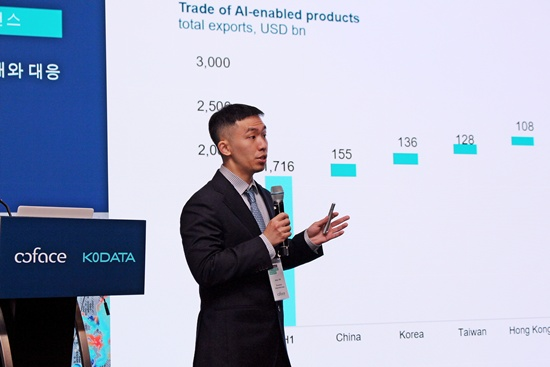
Jun-You Tan, East Asia regional economist at global credit insurer Coface, delivered the assessment Wednesday at the 2026 Country Risk Conference held at Conrad Seoul in Yeouido, according to Korea Credit Data & Analytics (KODATA). The event was co-hosted by KODATA and Coface.
In a keynote address titled "South Korea in the AI Boom: Opportunities, Risks and Responses," Tan said growing demand for AI infrastructure — including memory chips, materials and components, and data center equipment — offers growth opportunities for the Korean economy, though the benefits vary by sector.
He noted that growth is concentrating in information and communications technology and memory chips, while consumer electronics and traditional manufacturing may lag behind. He also said that if AI-driven efficiency gains alter memory chip demand and ease price increases, South Korea's semiconductor-heavy growth model could come under pressure.
Corporate refinancing burdens were also flagged as a risk. Tan said that given high interest rates at loan maturity and tighter lending conditions, companies in the timber, paper, textile and construction sectors should assess their ability to service debt and manage obligations coming due. He said the benefits of AI investment should be examined sector by sector, rather than assuming they will translate into a broad economic recovery.
He outlined three response strategies: diversifying into AI supply chains, moving into high-value-added segments, and managing interest rate and debt structures. He said companies should expand into areas such as semiconductor materials, advanced components and AI server assembly, and build competitiveness in differentiated fields including specialty metals, semiconductor chemicals and industrial textiles. He also called for securing fixed-rate financing, hedging interest rate risk, reducing debt ratios and extending repayment maturities.
The conference also addressed ways to manage counterparty credit risk. Henrik Bertelsen, head of business information for Asia-Pacific at Coface, said that tracking actual payment histories and delays — not just financial statements — is essential for closely monitoring changes in a counterparty's risk profile. He also stressed the importance of an integrated management framework linking pre-transaction due diligence, ongoing monitoring, credit insurance and debt collection.
Lee Ho-yeol, head of the Data Science Center at KODATA, introduced KOgrid, a corporate network service that analyzes risks arising not only within individual companies but also from relationships between them. The service uses data and AI to detect early warning signs of risk among domestic affiliates.
Raphael Rouslot, head of underwriting for Asia-Pacific at Coface, shared approaches to credit risk analysis and assessment in an environment of rising corporate insolvencies and payment delays. Lee Rae-hyeong, head of the AX Support Division at KODATA, presented on applying AI to corporate information analysis and credit risk management.
A KODATA official said the conference aimed to share insights that would help companies build efficient management strategies and strengthen credit risk management in response to economic change, adding that the organization would continue to provide a range of information and analysis to support stable business operations.
forest@heraldcorp.com