Greater Seoul area up 41.7% over 5 years vs. 14.3% for rest of country; Seoul accounts for 52.8% of total corporate tax despite housing 29.1% of registered firms
Sejong, North Gyeongsang Province and Jeju saw corporate tax burdens fall even as number of registered firms grew
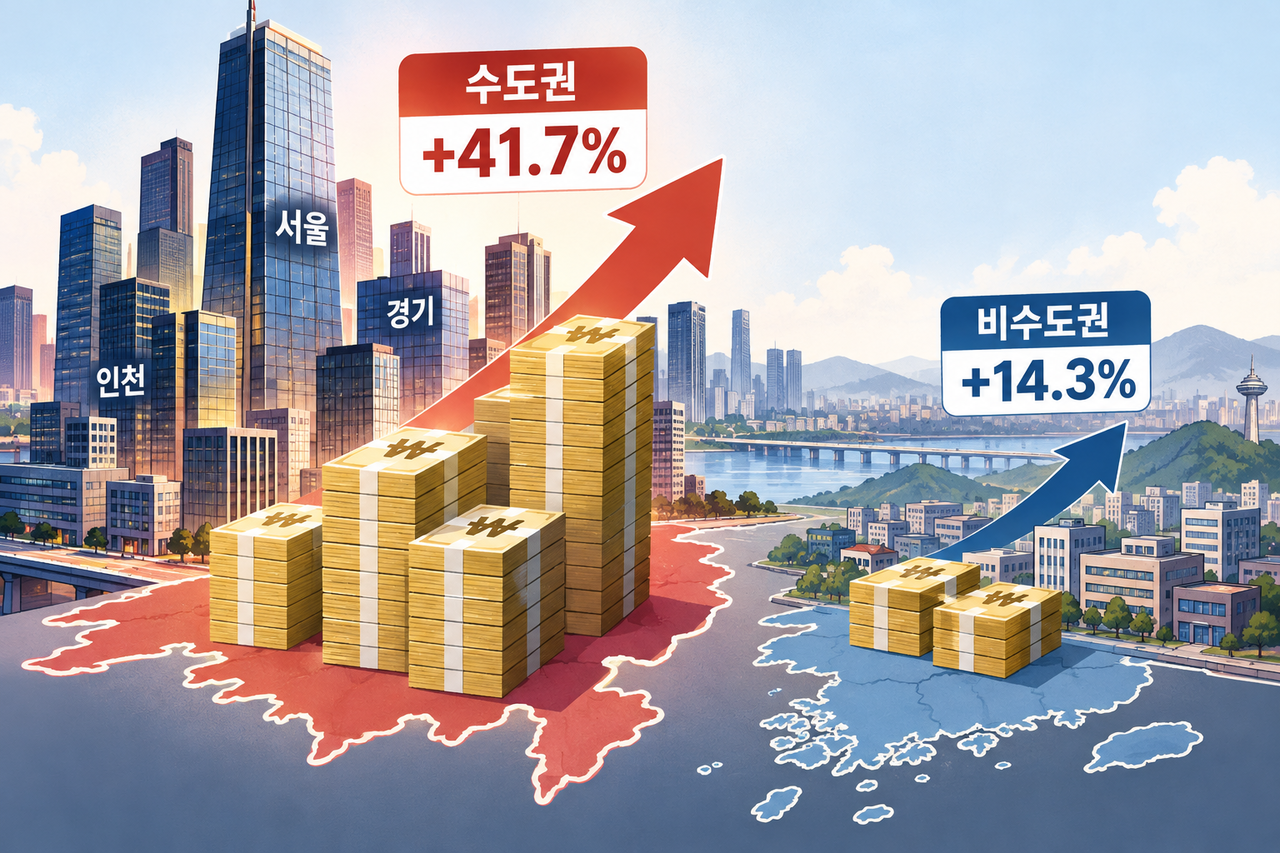
About 90 percent of the increase in national corporate tax revenue over the past five years came from the greater Seoul area, with the region's corporate tax burden rising 41.7 percent while the rest of the country grew by just 14.3 percent.
According to data submitted by the National Tax Service to Democratic Party of Korea lawmaker Jeong Tae-ho, a member of the National Assembly's fiscal and economic planning committee, the total national corporate tax burden last year reached 72.17 trillion won ($54.3 billion), up 18.6 trillion won, or 34.7 percent, from 53.57 trillion won in 2020. The figures are based on annual corporate tax filings and cover the registered head-office locations of firms across all 17 cities and provinces from 2020 to 2025.
Of that increase, 16.65 trillion won — or 89.5 percent of the total gain — came from the greater Seoul area. The combined corporate tax burden of firms headquartered in Seoul, Incheon and Gyeonggi Province rose from 39.96 trillion won in 2020 to 56.61 trillion won last year, a 41.7 percent increase. By contrast, the rest of the country saw its burden grow only 14.3 percent over the same period, from 13.61 trillion won to 15.57 trillion won.
As a result, the greater Seoul area's share of the national corporate tax burden rose 3.8 percentage points, from 74.6 percent in 2020 to 78.4 percent last year — meaning roughly eight out of every 10 won in corporate tax nationwide came from firms with head offices in the region. However, the greater Seoul area's share peaked at 79.3 percent in 2022, eased to 76.7 percent in 2024, and then climbed again last year.
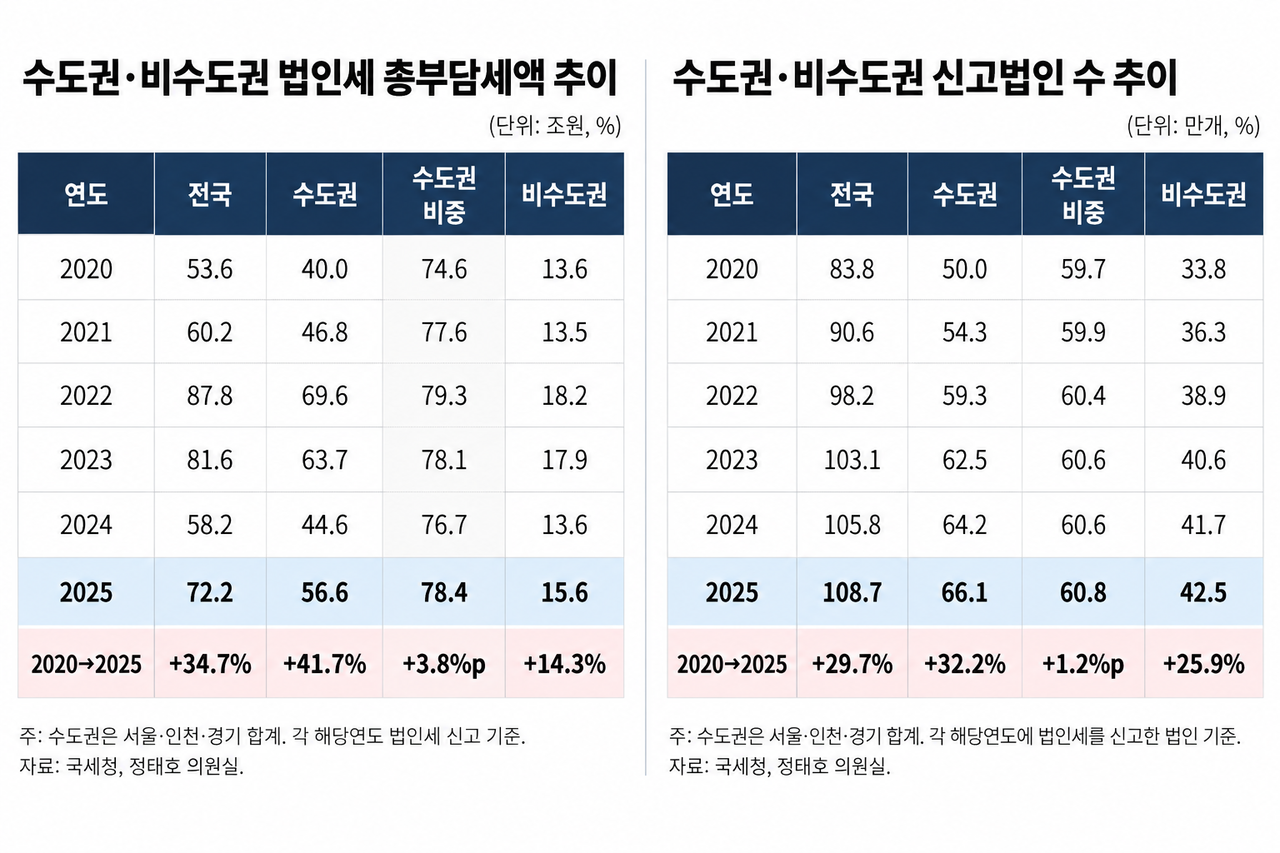
The concentration of corporate tax revenue in the greater Seoul area is outpacing the concentration of firms themselves. Of the 1,086,503 firms that filed corporate tax returns nationwide last year, 661,097 — or 60.8 percent — were based in the greater Seoul area, up 1.2 percentage points from 59.7 percent in 2020.
Over the same period, the greater Seoul area's share of the corporate tax burden rose by 3.8 percentage points. The gap between its share of registered firms and its share of the tax burden also widened, from 14.9 percentage points in 2020 to 17.6 percentage points last year, indicating that the concentration of the tax base is growing faster than the concentration of firms.
Seoul's concentration was particularly pronounced. The capital had 316,350 registered firms last year, accounting for 29.1 percent of the national total, yet its corporate tax burden of 38.1 trillion won represented 52.8 percent of the nationwide figure. Roughly three in 10 firms nationwide have their head offices in Seoul, but more than half of all corporate tax is concentrated there.
In some parts of the country outside the greater Seoul area, the corporate tax burden actually fell even as the number of registered firms increased.
Sejong saw its number of registered firms surge 46.5 percent, from 3,979 in 2020 to 5,829 last year, yet its total corporate tax burden slipped 2.5 percent over the same period, from 182.8 billion won to 178.2 billion won. North Gyeongsang Province recorded a 22.1 percent rise in registered firms but a 3.2 percent decline in its corporate tax burden. Jeju saw its firm count grow 22.2 percent while its tax burden fell 3.5 percent.
Gwangju also posted 21.9 percent growth in registered firms, but its corporate tax burden was essentially flat, edging up from 831.1 billion won to 831.3 billion won. Seoul recorded the same 21.9 percent increase in registered firms over the same period, yet its corporate tax burden surged 39.6 percent — a stark contrast.
The data are compiled on the basis of each firm's registered head-office location, however, and may not reflect where production facilities, business sites or employees are actually located. Profits generated at non-greater-Seoul operations of firms headquartered in the region could therefore be counted toward the greater Seoul area's corporate tax burden.
"Last year the total corporate tax burden in the greater Seoul area rose 41.7 percent compared with 2020, while the rest of the country grew by only 14.3 percent," Jeong said. "We need to take a close look at the trend of the tax base concentrating in the greater Seoul area." He added that balanced regional development cannot stop at simply increasing the number of firms attracted to a region. "We must review the outcomes and direction of policy to ensure that high-value-added companies, headquarters functions and the tax base genuinely take root in local communities," he said.
fact0514@heraldcorp.com