Shark reappears in channel between pedestrian bridges 1 and 2 at Bukhang Waterfront Park
Experts cite disorientation, vessel noise as possible reasons for repeated returns
Residents worry about cold weather, question why channel cannot be properly sealed
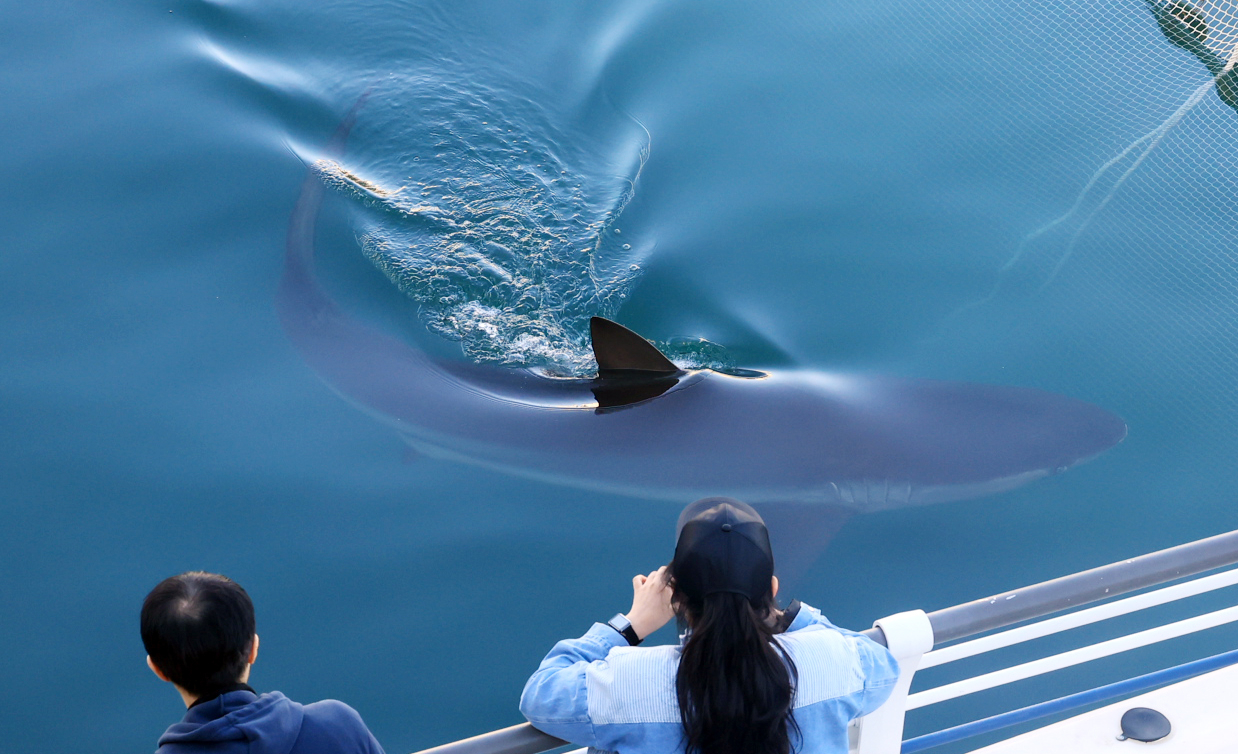
Buchang-i, a shark that had been lingering in the waterway at Bukhang Waterfront Park in Busan for more than a month, returned inside the barrier after being guided out during a third herding operation Wednesday, authorities confirmed Thursday.
Thursday morning, the shark surfaced every minute in the channel between pedestrian bridges 1 and 2 at the park.
Buchang-i had been driven out of the waterway at around 5:40 p.m. Wednesday following a third herding operation involving extensive preparation and execution. However, the shark continued to circle near the channel entrance and was spotted entering the inside of the first barrier — a pontoon, a floating platform used for waterborne work — at around 11 p.m. The pontoon had been installed to prevent re-entry.
A pontoon is a flat, barge-like floating structure used for work on the water. Wednesday, authorities secured nets to a wide pontoon measuring roughly 3 to 4 meters across and herded the shark from the area between bridges 4 and 5, where it had been frequently spotted, toward the exit near Marina Bridge, pushing it out of the waterway. Buchang-i passed through the structure and re-entered the channel in less than a day.
YouTubers who had stayed up through the night observing the shark suggested it may have slipped underneath the pontoon.
Thursday morning, Buchang-i was confined to a roughly 30-by-30-meter zone between the first barrier — the pontoon — and a secondary net. The shark repeatedly circled the narrow space, surfacing at regular intervals.
To return to the stretch between bridges 4 and 5 where it had previously been staying, Buchang-i would need to pass through two additional net barriers marked with yellow buoys. The secondary net features closely spaced yellow buoys with netting that extends all the way to the seabed, making it difficult to breach — prompting concern that the shark could wear out from swimming continuously in such a confined area.
As for why Buchang-i has returned despite three attempts to guide it out to open sea, experts have raised the possibility that the shark may have lost its sense of direction or that engine noise from nearby vessels disrupted its sensory organs, interfering with its ability to navigate. Shark experts note that cases of wild sharks entering narrow coastal channels or harbors and failing to find their way out for extended periods have been reported abroad as well.
From early in the morning, residents out for walks and YouTubers who had kept an overnight vigil gathered around the waterway to watch Buchang-i. Many expressed concern that the shark had failed to reach open water and had returned to the channel.
"The weather is getting cold, and I'm worried about why it won't go back to the sea," one resident said. "I heard a typhoon is approaching — I wonder if that's why it won't leave." Another resident questioned why the city had not done more to seal off the waterway. "Shouldn't Busan be consulting overseas experts to find out why Buchang-i won't go back to the sea?" the resident said.
kaf2002@heraldcorp.com