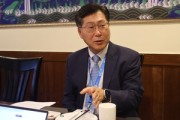
Rep. Song Ok-ju proposes legislation to activate carbon markets for farmers
Small farms to benefit from joint registration, simplified verification

A proposal has been put forward to reform South Korea's carbon credit system so that farms can earn new income by trading emissions credits proportional to their greenhouse gas reductions. The plan would simplify registration procedures to allow small farms to participate jointly in reduction projects and grant tax exemptions on income earned from carbon credit trading — shifting farmers from bearing only the costs of carbon reduction to receiving economic rewards for it.
Democratic Party of Korea lawmaker Song Ok-ju, a member of the National Assembly's Agriculture, Food, Rural Affairs, Oceans and Fisheries Committee, published a policy report Thursday titled "Current Status and Policy Recommendations for Domestic and International Agricultural Carbon Credit Systems" to coincide with the 2026 national audit.
Under the current domestic framework, greenhouse gas reduction projects are carried out through external projects under the Korean Emissions Trading Scheme (K-ETS) and the Forest Carbon Offset Program. These include capturing methane from livestock manure for use as energy and applying biochar to farmland.
However, participation remains low because most farms and related facilities are small-scale, and the measurement, reporting and verification (MRV) procedures required to register projects and document reduction results are complex. Farmers bear the costs of reducing greenhouse gases without receiving adequate economic compensation in return.
Song compared systems in the EU, the United States, China and Taiwan to identify four legislative priorities applicable to rural conditions in South Korea.
The first would amend the Emissions Trading Act to allow multiple small farms to register reduction projects jointly as a collective. Song also proposed simplifying the MRV process through sampling surveys and digital measurement methods to ease the burden on individual farms.
The proposal also includes linking biogas production from livestock manure to carbon credits. It calls for amending the Biogas Act so that greenhouse gas reductions from biogas produced by private obligated producers beyond their mandatory quota would be recognized as tradable credits.
Tax support for farms and investing companies is also proposed. Amendments to the Special Tax Treatment Control Act and the Local Tax Special Treatment Limitation Act would provide tax credits to companies investing in rural cooperative reduction projects, while income earned by farmers from carbon credit trading would be exempt from taxation.
In addition, the report calls for establishing a legal definition of "permanent carbon removal" and a government certification framework to foster technologies that remove and store carbon over the long term, such as biochar and bioenergy with carbon capture and storage (BECCS). It also proposes a legal basis for introducing a Carbon Contracts for Difference (CCfD) mechanism to bridge the gap between the cost of carbon reduction and the carbon price.
Several countries already operate dedicated support programs tailored to the agricultural sector. The EU supports carbon farming and biochar through its Carbon Removal Certification Framework (CRCF). The United States uses renewable fuel credits and tax deductions to support livestock manure biogas and clean fuel production. China allows power companies to offset a portion of their emissions with external reduction credits through its voluntary carbon market, the China Certified Emission Reduction (CCER) scheme.
Song said that for greenhouse gas reduction achievements in agriculture and livestock farming to translate into real income for farmers, the burden of individual farm participation must be reduced and a compensation system for reduction results must be established.
"Major countries around the world are transforming rural organic resources and ecosystems into core assets for greenhouse gas reduction," Song said. "I will do my utmost to improve the system and provide legislative support so that our farmers are not left bearing only the burden of carbon reduction, but can instead receive fair recognition through carbon credit trading and generate new income."
adastra@heraldcorp.com