Fruit fly trader (7): Trusting the AI's judgment — 5 trades, 5 stop-losses
Since the complete wiring diagram of a fruit fly's brain was made public, researchers abroad have been racing to build "virtual fruit flies" on ordinary computers — running games and simulations on them in what has become something of a trend. The Herald Business has been documenting its own experiment, in which a reporter used a virtual brain modeled on the published connectome to trade cryptocurrency. All trades were simulated, and the series is not intended as investment advice. [Editor's note]
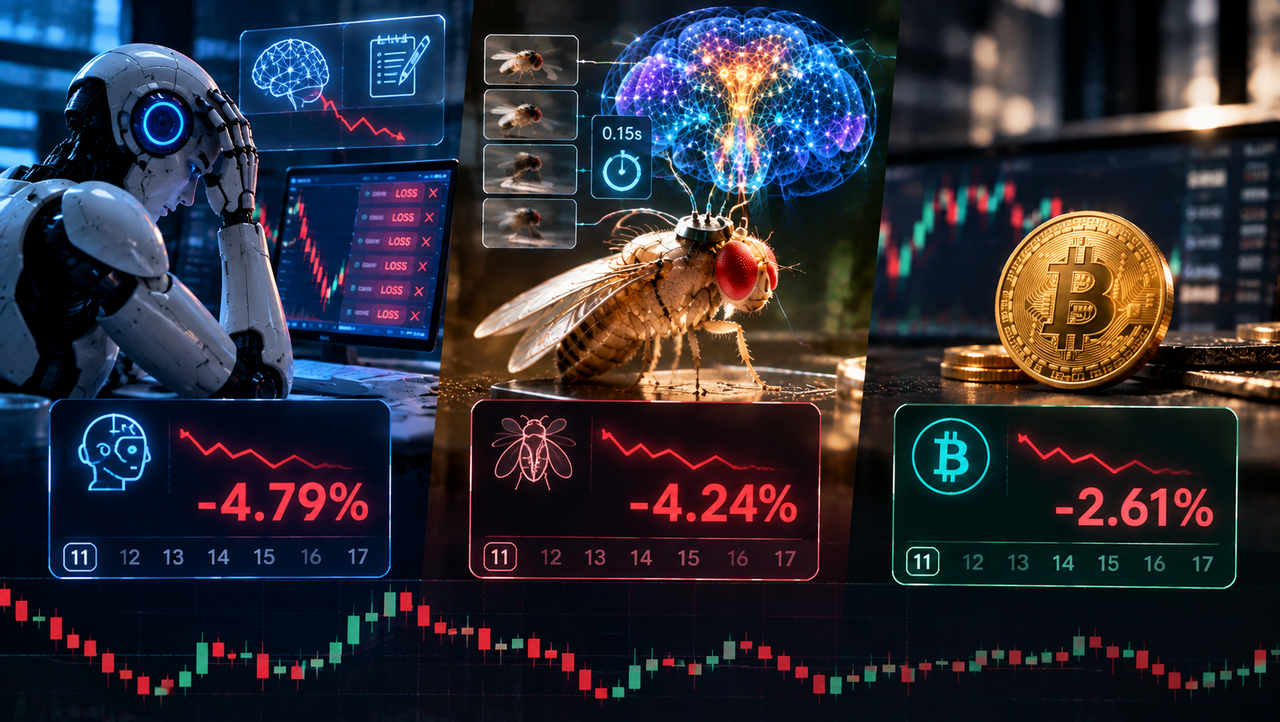
An AI that kept a daily trading diary to build up memory, and a virtual fruit fly that forgets everything within 0.15 seconds, were each given control of a Bitcoin portfolio for the same week — and both performed worse than simply holding Bitcoin.
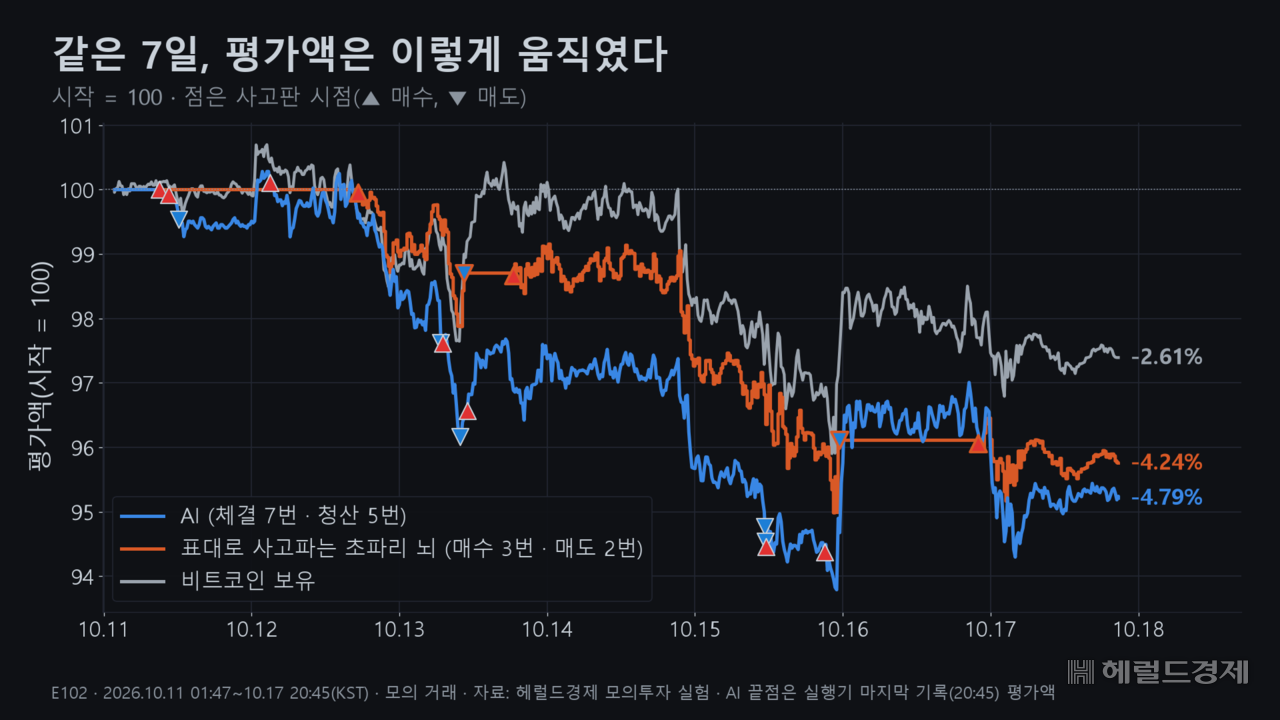
Over roughly seven days from Oct. 11 to Oct. 17, the AI posted a return of -4.79% while the virtual fruit fly returned -4.24%. Simply buying and holding Bitcoin over the same period would have meant a loss of only 2.61%. The AI bought in even after judging that a decline was more likely, and all five completed trades ended in stop-loss exits.
The Herald Business has been running a simulated cryptocurrency trading experiment using a virtual fruit fly — a digital model of the insect's brain running on a personal computer. The setup is based on the complete fruit fly brain connectome published by scientists in 2024: chart data is converted into odor signals the virtual brain can process, and its responses are read as buy or sell decisions.
As the experiment progressed, a key limitation emerged — the virtual fruit fly cannot remember the charts it has just seen. This installment compared that amnesiac brain against an AI capable of retaining past information and writing a daily trading journal.
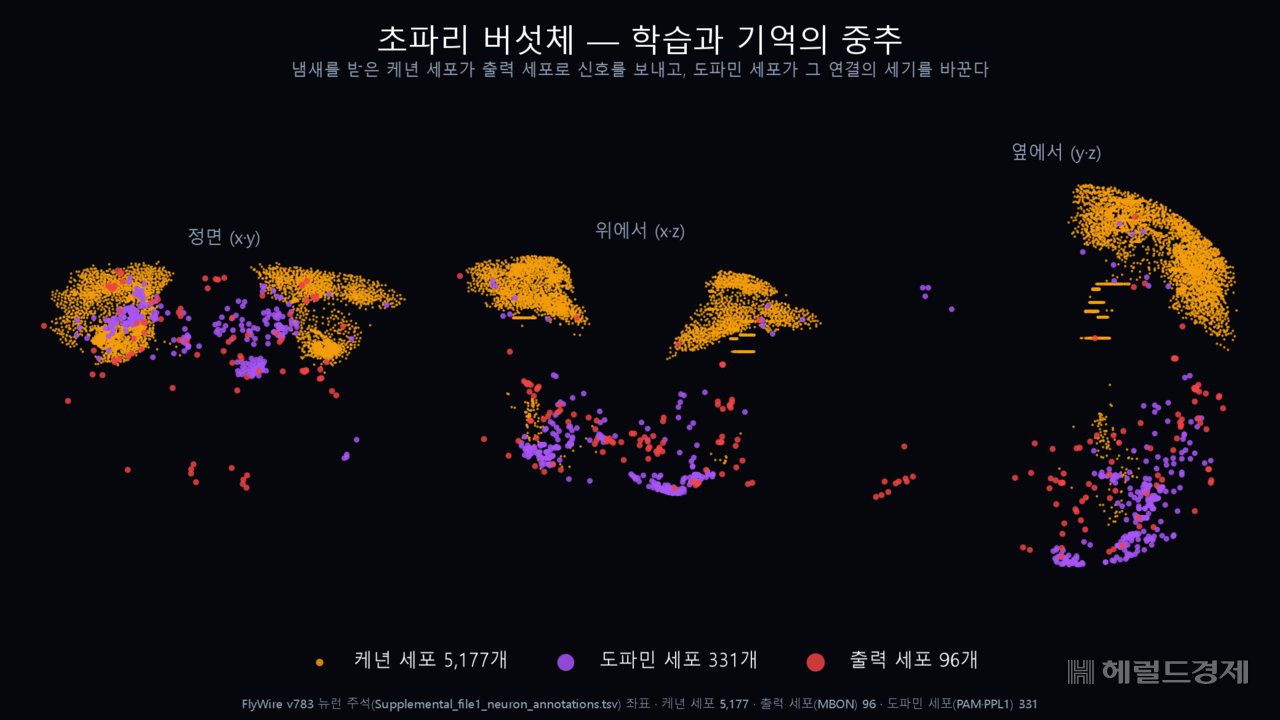
The fruit fly forgets in 0.15 seconds; the AI remembers
The virtual fruit fly trades according to a pre-built lookup table of chart responses. Past charts were fed to the virtual brain one by one as odor signals, its reactions were recorded, and the resulting table drove all buy and sell decisions.
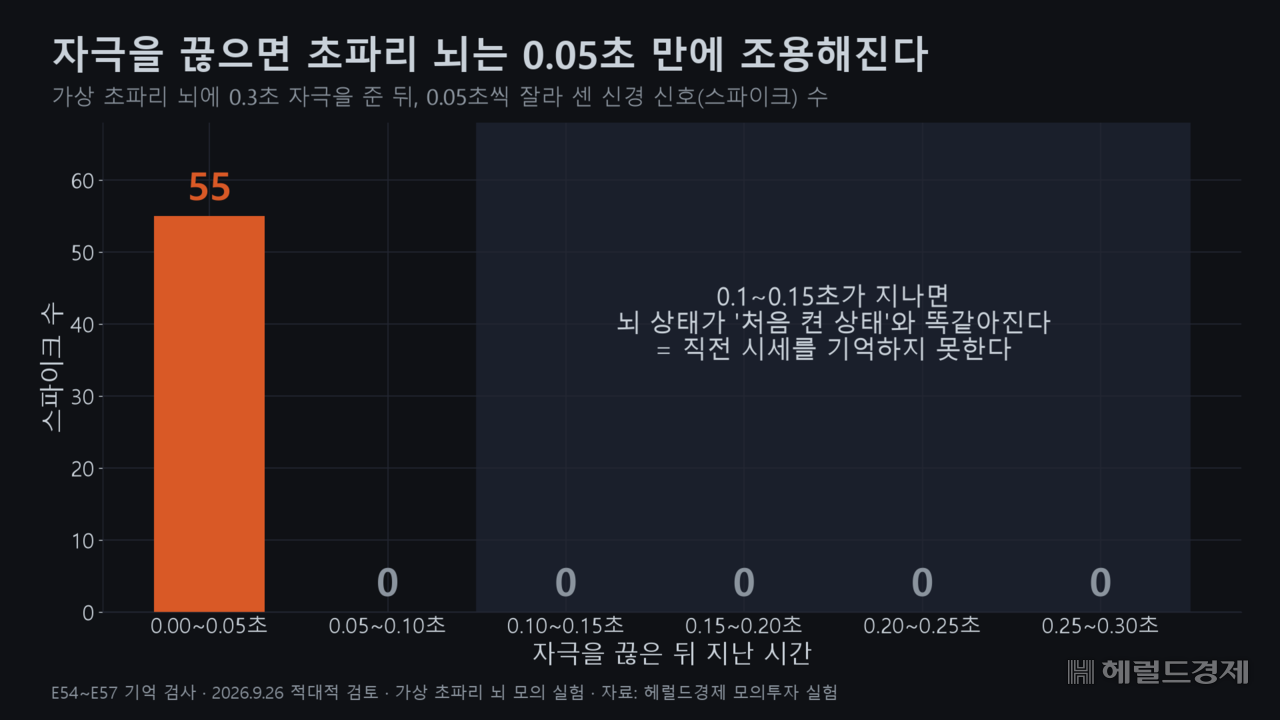
Memory tests conducted 14 times showed the virtual fruit fly could not retain information received even 0.2 seconds earlier — memory lasted only 0.1 to 0.15 seconds. Because chart analysis was therefore impossible, the fly traded strictly according to the pre-built rules.
Over the same period, the virtual fruit fly made two round-trip trades. Bitcoin purchased at 5:15 p.m. on Oct. 12 was sold at 10:30 a.m. the following morning, reducing the portfolio value by 1.25%. Bitcoin bought again at 6:30 p.m. on Oct. 13 was sold at 11:30 p.m. on Friday, resulting in a further loss of 2.63%. A third purchase made at 10 p.m. on Saturday was held through the end of the experiment.
The AI pitted against the fruit fly is an open-source language model running entirely on a home PC with no internet connection. It has 15 billion parameters — values the AI adjusts through learning that enable more complex judgments as their number grows.
Every 15 minutes, the AI reviewed charts for four cryptocurrencies — Bitcoin, Ethereum, Ripple and Solana — and independently decided whether to buy, wait or sell. Unlike the virtual fruit fly, the AI retains information across decisions.
The AI was trained on the 40 past chart patterns from the previous year most closely resembling current conditions, along with data on how prices moved over the following one, four and 12 hours.
Each day at 4:30 a.m., the AI was prompted to review its trading activity and write a kind of daily journal. The process mirrors what human investors do when they keep trading logs to identify what went wrong. The journal was fed back to the AI the following day to inform its decisions.
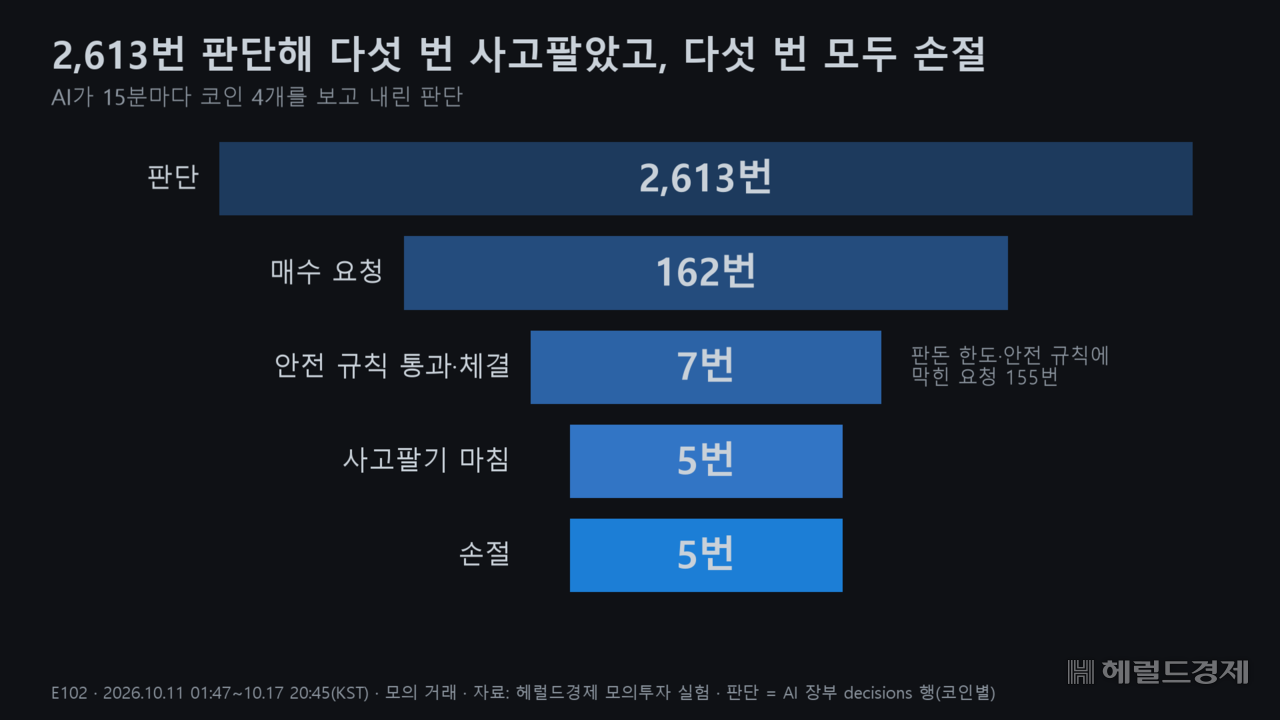
AI bought despite seeing high odds of a decline — and stopped out every time
Over seven days, the AI made 2,613 decisions and attempted to buy 162 times. Safety rules designed to prevent purchases exceeding the simulated investment limit allowed only 7 actual buys. Of the 5 trades that were fully closed, all 5 ended in stop-loss exits.
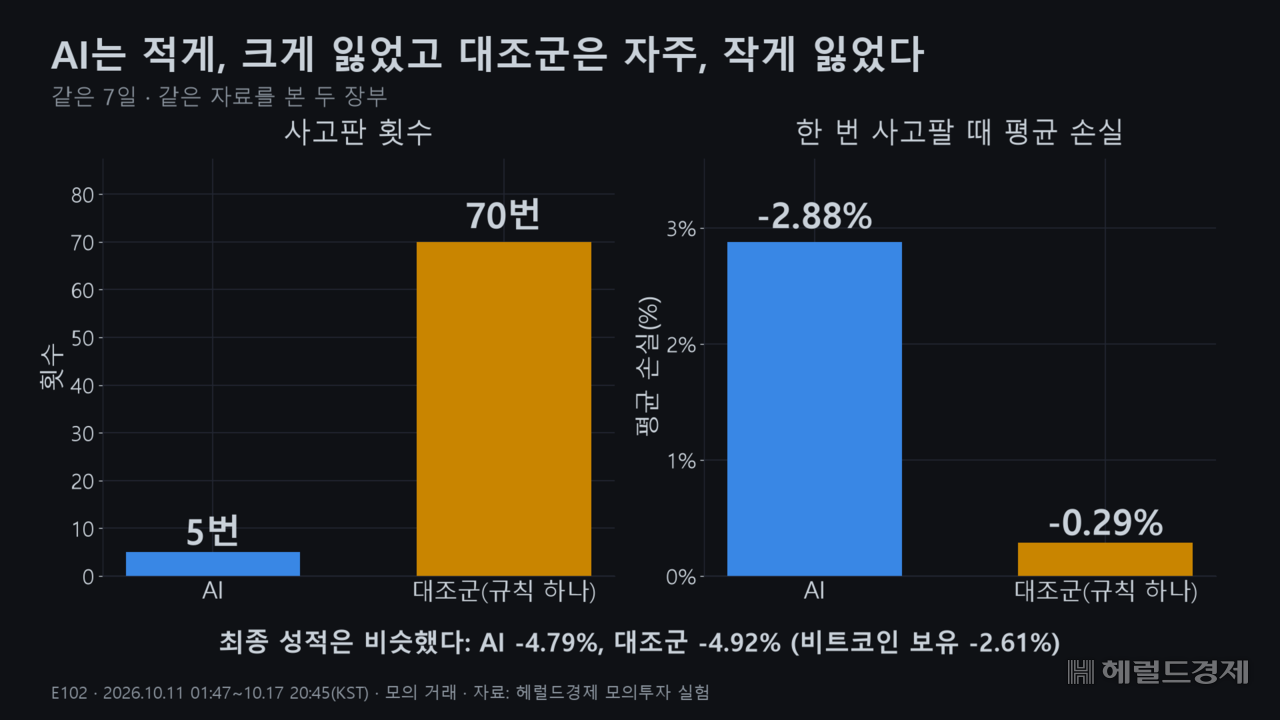
Individual losses ranged from 0.49% to 3.80%, averaging 2.88% per trade. When the experiment ended, the AI was still holding Ripple and Solana positions.
Before each purchase, the AI assessed its own probability of success. For all five trades that ended in stop-losses, the AI's self-assessed win rate ranged from 42 to 48 percent — below 50 percent in every case. The AI bought even when it judged that losing was more likely than winning.
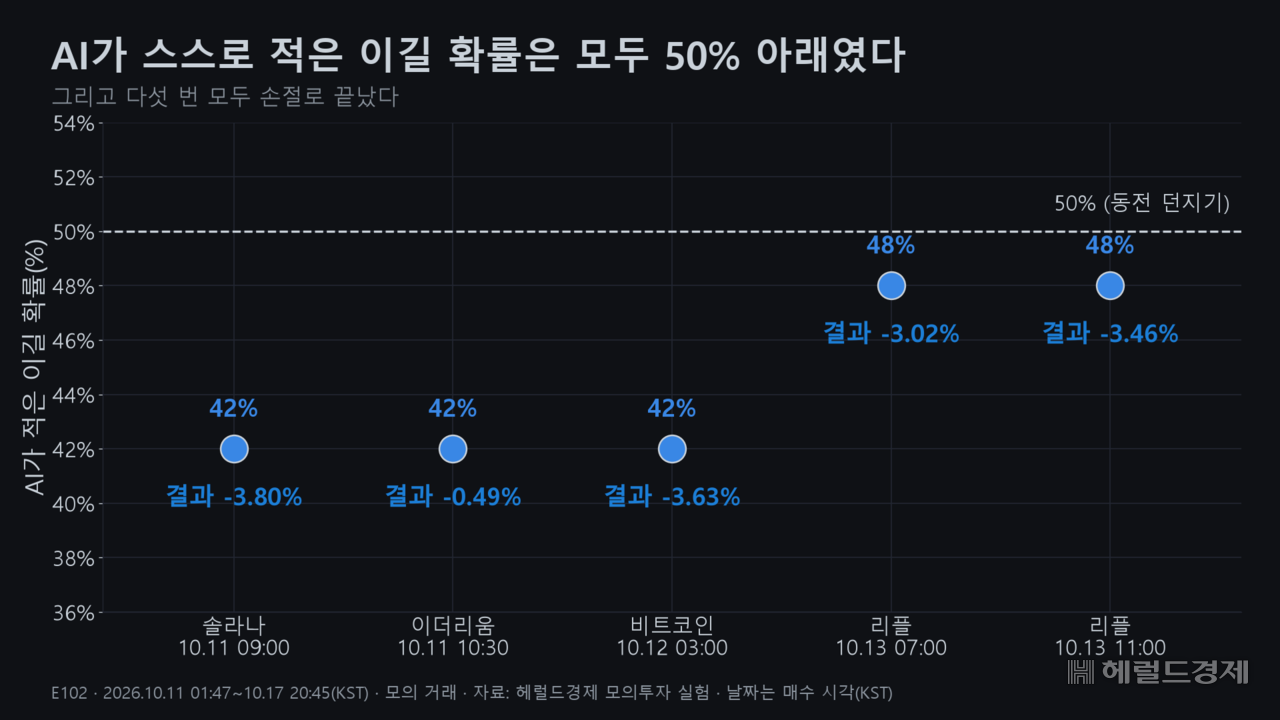
The AI's stated reasons for buying reflected this pattern directly.
When buying Solana at 9 a.m. on Oct. 11, the AI wrote: "Despite the short-term downtrend, SOL back-data (12h) demonstrates strong resilience with an average of +5.7bp, validating the entry point." Back-data refers to historical chart records; one basis point equals 0.01 percent.
The AI interpreted an average price gain of 0.057 percent over 12 hours in similar past situations as "strong resilience." That trade ended with a loss of 3.80 percent.
Buying Ripple at 7 a.m. on Oct. 13, the AI reasoned: "Historical back-data indicates a high probability of short-term decline; however, real-time asking price imbalance (buy-side dominance) and volume signals suggest an immediate rebound is possible, so I am entering." A buy-side asking price imbalance means buy orders outnumber sell orders in the order book.
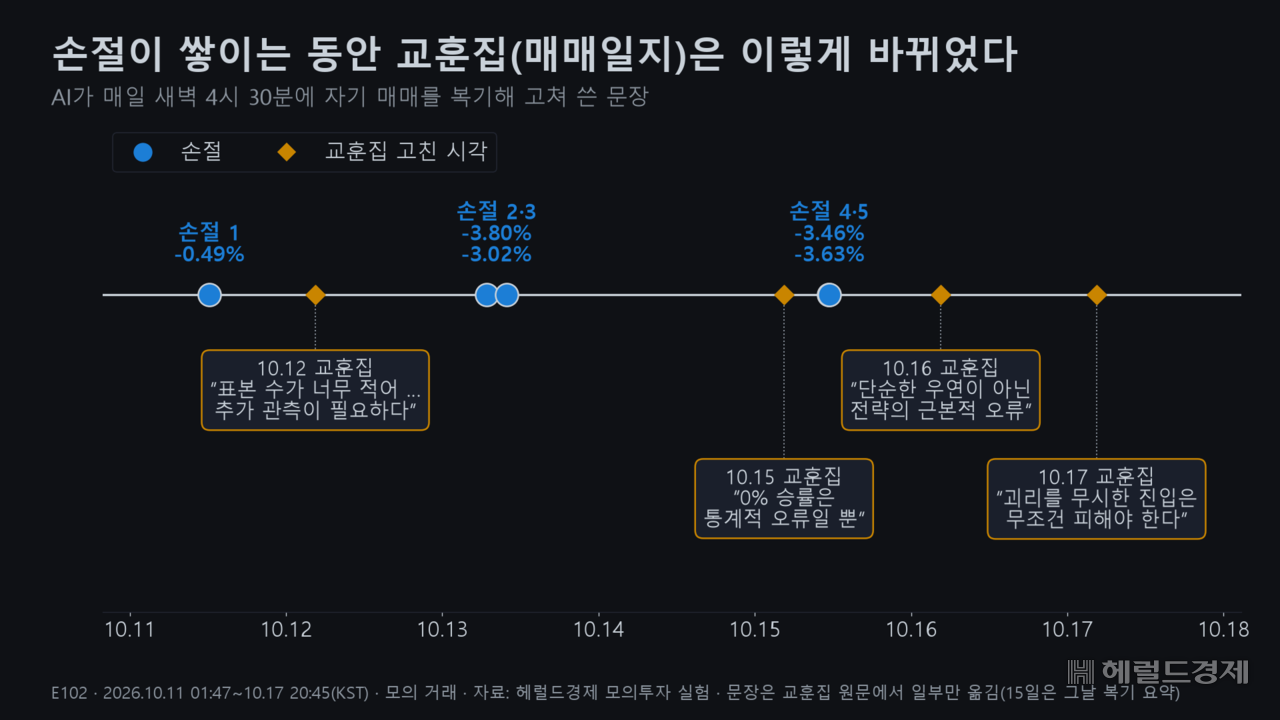
The AI bought because more people appeared to be placing buy orders at that moment, even though historical chart data pointed to a decline. That trade ended with a loss of 3.02 percent.
Three of the five stated reasons for buying followed the same logic: historical chart data was unfavorable, but current buy-side order dominance justified entry.
When the AI bought Bitcoin in the early hours of Oct. 12, it wrote: "The recent downtrend is treated as mere noise." It set a stop-loss at 3.5 percent and a profit target at 8.5 percent. That trade ended with a loss of 3.63 percent.
Both the AI and the fruit fly finished in the red
After seven days, the AI's final return was -4.79% and the rule-based virtual fruit fly's was -4.24%. Both lost more than simply holding Bitcoin over the same period would have (-2.61%).
The AI — which accumulated memory every day and kept a trading journal — ended up losing slightly more than the virtual fruit fly that forgets everything within 0.15 seconds.
A control program that used the same chart data as the AI but traded on a single fixed rule with no AI involvement made 70 trades and returned -4.92%. The control program lost an average of 0.29 percent per trade; the AI lost an average of 2.88 percent per trade.
The decision-making AI, the rule-only program and the memoryless virtual fruit fly all finished with broadly similar results.
A swarm of 30 virtual fruit flies modeled on the insect's natural behavior made 252 trades over the same seven days and returned a gain of 4.42 percent. However, that figure was calculated without accounting for trading fees. Once domestic exchange fees are applied — as they were for the AI and the rule-based virtual fruit fly — the result turns into a loss.
Meanwhile, a broader review of the entire experiment from the outset continued, examining why the virtual fruit fly has struggled to perform in live market conditions.
This series documents a reporter's experiment trading cryptocurrency using a virtual fruit fly built from the published fruit fly brain connectome. New installments run on Saturdays and Sundays for four weeks.
dbsdn1110@heraldcorp.com