Behind every public figure's appearance lies a personal regimen. This series examines the diets, workouts, procedures, and beauty and fashion choices of notable figures as practical lifestyle information.
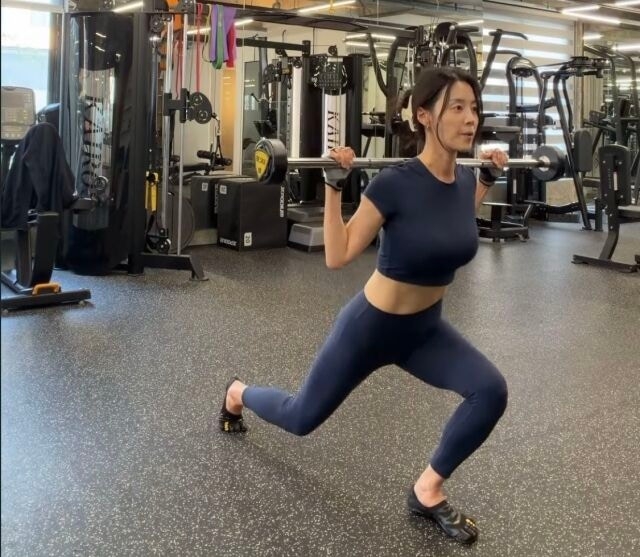
Actor Han Ji-hye has shared footage of herself doing barbell strength training followed by a protein-focused post-workout meal. The clip, which showed her performing weighted lunges to build lower-body muscle, drew attention for what came next: smoked eggs and low-sugar soy milk.
Han posted the workout video on her SNS on Monday, captioning it "A very exciting Monday workout session."
In the footage, she performed lunges with a barbell resting across her shoulders. She also shared photos of herself eating smoked eggs and drinking low-sugar soy milk after finishing the session.
Lunges are a foundational strength exercise that targets the major muscles of the lower body, including the thighs and glutes. Adding a barbell increases the load on those muscles, while consuming protein afterward supplies the nutrients needed for muscle recovery and growth.
Barbell lunges build thigh and glute strength — and influence resting metabolism
The barbell lunge Han demonstrated involves stepping one leg forward or backward, bending the knee to lower the body, then pushing back up to a standing position.
Adding the weight of a barbell to a standard lunge delivers a stronger stimulus to the lower-body muscles.
The primary muscles engaged are the quadriceps at the front of the thigh and the gluteus maximus. The hamstrings at the back of the thigh and the muscles around the pelvis also activate to stabilize the movement.
Because lunges alternate between legs, they help develop both lower-body strength and balance.
While one leg bears the body's weight, the abdominal and spinal muscles engage to keep the pelvis and torso from swaying. Placing a barbell on the shoulders further increases the demand on the core muscles to maintain the center of gravity.
Strength training of this kind helps preserve muscle mass and influences the body's overall energy expenditure.
Basal metabolic rate refers to the minimum amount of energy the body burns at rest to sustain basic functions such as breathing, maintaining body temperature and circulating blood.
Muscle tissue consumes energy even at rest, making muscle mass one of the factors that affects basal metabolic rate.
A 2020 analysis published in the Journal of Sports Sciences examined the effect of resistance training on resting metabolic rate.
After reviewing the relevant research, the authors found that groups who performed strength training had a resting metabolic rate roughly 96 kilocalories per day higher, on average, than control groups.
Consistent strength training increases muscle mass and strength, and over the long term can help with managing body weight and composition.
Strength training also plays an important role in managing body fat. When weight loss leads to a reduction in muscle mass, both resting energy expenditure and overall physical function can decline.
Incorporating strength training during weight loss helps preserve muscle mass. Pairing it with aerobic activities such as walking, running or cycling can further increase total energy expenditure.
Proper form is equally important when performing barbell lunges.
Throughout the movement, the lower back should not arch excessively and the torso should not tilt to one side. The knee and toes should generally point in the same direction, and the entire sole of the foot should bear the body's weight.
Beginners can start with bodyweight lunges to develop balance and technique before gradually adding dumbbells or a barbell as strength improves.
Smoked eggs and low-sugar soy milk after the workout — supplying protein for muscle recovery
After finishing her session, Han reached for smoked eggs and low-sugar soy milk.
Both foods provide protein, making them practical choices for a post-strength-training meal.
Eggs are a well-regarded protein source containing a balanced profile of essential amino acids.
A typical large egg contains roughly 6 to 7 grams of protein, along with nutrients including vitamin B12, choline and selenium.
Egg protein is particularly notable for containing leucine, an essential amino acid involved in stimulating muscle protein synthesis.
Strength training places mechanical stress on muscles, and during recovery the body ramps up muscle protein synthesis. The amino acids supplied through food serve as the raw material for building new muscle protein.
Soy milk is another source of plant-based protein.
Soy protein contains essential amino acids, and consuming it alongside eggs or other protein foods after a workout can diversify the body's protein sources.
Low-sugar soy milk is formulated to reduce added sugars such as sucrose compared with regular sweetened varieties, which can help limit overall sugar intake.
The protein, fat and carbohydrate content of soy milk varies by product. Some are fortified with higher protein levels or added nutrients such as calcium and vitamin D.
When choosing a soy milk for post-workout consumption, it is worth checking both the sugar content and the amount of protein per serving.
Building muscle requires securing a sufficient total daily protein intake, not just a single post-workout serving.
The International Society of Sports Nutrition (ISSN) recommends that healthy adults who exercise regularly consume approximately 1.4 to 2.0 grams of protein per kilogram of body weight per day to support muscle growth and maintenance.
For a person weighing 60 kilograms who trains regularly, that translates to roughly 84 to 120 grams of protein per day, though actual needs vary depending on training intensity, physical condition and individual goals.
Spreading protein intake across breakfast, lunch and dinner — rather than consuming it all in one sitting — may be more favorable for muscle protein synthesis.
Smoked eggs and soy milk are convenient post-workout protein options that can be factored into the day's overall protein intake alongside other meals.
When to eat protein — daily total matters more than the 30-minute post-workout window
After strength training, many people focus closely on the timing of protein consumption.
The concept of the "anabolic window" — the idea that protein must be consumed within a specific period immediately after exercise for optimal muscle growth — is widely known.
Muscle protein synthesis does increase after exercise, and supplying adequate amino acids during that period supports recovery and growth.
However, the muscle protein synthesis response triggered by exercise persists for a relatively extended period.
According to ISSN guidelines on exercise and protein intake published in 2017, muscles can remain sensitized to protein intake for at least 24 hours after resistance training.
Meals eaten before and after exercise, as well as total daily protein intake, all influence muscle growth — not just what is consumed immediately after a session.
The ISSN generally recommends consuming approximately 20 to 40 grams of protein per serving to stimulate muscle protein synthesis.
Spacing protein intake at intervals of roughly three to four hours throughout the day is also advised.
If a protein-containing meal was eaten before training, the urgency of consuming protein immediately afterward may be reduced. Conversely, if training was done on an empty stomach or a long time has passed since the last meal, eating a protein-containing meal after the session is advisable.
Carbohydrate intake also matters for post-workout recovery.
Muscles rely primarily on stored glycogen as fuel during exercise, and glycogen depletion increases with longer or more intense sessions.
Consuming carbohydrates after exercise helps replenish depleted glycogen stores. A meal combining protein and carbohydrates can support overall post-workout recovery.
For example, pairing eggs and soy milk with a banana or whole-grain bread provides both protein and carbohydrates. A full meal of rice, fish, tofu and vegetables is another option.
For those aiming to reduce body fat, managing total caloric intake while ensuring sufficient protein is key.
Cutting calories too aggressively can impair exercise performance and make it harder to maintain muscle mass.
The US Centers for Disease Control and Prevention recommends that adults get at least 150 minutes of moderate-intensity aerobic exercise per week, along with strength training on two or more days per week.
Strength training programs should work all major muscle groups evenly — not just the lower body, but also the back, chest, shoulders, arms and core. Exercise intensity should be adjusted to individual fitness levels, and adequate rest and sleep are essential for recovery.
Lower-body strength exercises such as barbell lunges can help build muscle mass, strength and balance. Consuming protein after training and maintaining nutritional balance across all meals throughout the day can support muscle recovery and body composition management.
rainbow@heraldcorp.com