Satellite data from the National Institute of Fisheries Science shows average sea surface temperatures of 26.95°C from July to September, the second-highest on record
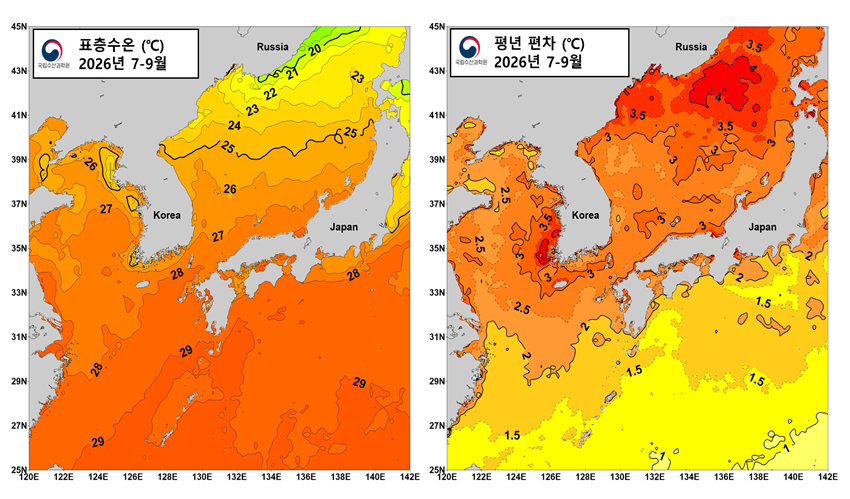
Global climate change is pushing up temperatures in South Korea's surrounding seas, new data shows.
The National Institute of Fisheries Science said Tuesday that satellite observations recorded an average sea surface temperature of 26.95°C in South Korean waters this summer — from July through September — which was 1.49°C above the long-term average for 1991–2020. The figure is the second-highest on record, trailing only last year's 27.75°C.
Particularly striking was the coastal picture: real-time water temperature monitoring showed that the average sea surface temperature along the East Sea and South Sea coasts in August reached 25.87°C, some 1.69°C above the 10-year average and 3.42°C above last year's level.
An institute official attributed the elevated coastal temperatures to a combination of heat dome conditions driven by high-pressure systems and marine heat waves, both of which intensified surface heating. The official added that weakened cold-water upwelling in the East Sea and South Sea allowed warmer offshore water to flow continuously toward the coast, sustaining the high temperatures. A marine heat wave is defined as a period of five or more consecutive days during which sea surface temperatures exceed the 90th percentile of the climatological average.
Kwon Soon-wook, director of the National Institute of Fisheries Science, said climate change is increasing the volatility and uncertainty of ocean temperatures. "We will respond proactively to changes in the marine environment through precise temperature monitoring and forecasting," he said.
kaf2002@heraldcorp.com