Coverage to reach 40.2% of all signalized intersections
Speeding, hard braking and signal violations expected to fall
Bus location data to update every 3 seconds; 209 new display boards to be added
Parking information integrated across 703 facilities
Incheon is accelerating improvements to its everyday transportation services, sharply expanding real-time traffic signal coverage while also refining bus location data and consolidating parking information to make getting around easier for residents.
The city aims to boost both traffic safety and public transit convenience by strengthening information access within the existing transport network alongside large-scale expansions of road and rail infrastructure.
According to the city, Incheon will open up real-time signal data at an additional 800 major-road intersections starting in November.
That will bring the total number of covered intersections from 835 to 1,635 — the highest figure among local governments nationwide.
Based on Incheon's total of 4,069 signalized intersections, the coverage rate will rise from 20.5 percent to 40.2 percent.
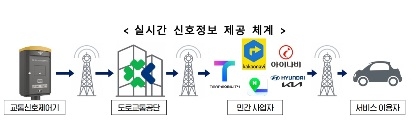
Drivers will be able to check the color and remaining time of upcoming traffic lights through Tmap, Kakao Navi, Naver Maps, and the built-in navigation systems of Hyundai and Kia vehicles.
The city also expects the service to reduce collision risks between pedestrians and vehicles by providing pedestrian signal information at crosswalks encountered during right turns.
However, because coverage still falls short of half of all intersections, ensuring data accuracy remains a challenge alongside the expansion.
The city plans to work with the Incheon Metropolitan Police Agency to improve traffic signal controller performance and conduct trial operations and data verification through December.
The safety benefits of real-time signal information have also been confirmed through driving data analysis in other regions.
The Korea Road Traffic Authority analyzed about 1.75 million vehicle driving records collected at six intersections in Gangneung last November. Vehicles receiving signal information had a speeding rate of 20.40 percent — 9.45 percentage points lower than the 29.85 percent recorded for vehicles without the service. Hard-braking incidents were 13.50 percentage points lower, and signal violations were 5.69 percentage points lower.
However, those findings are based on Gangneung data, and the city cautioned that identical results cannot be assumed for Incheon.
The Incheon Research Institute is studying the impact of real-time traffic signal data on road safety and plans to release its findings between late this year and early next year.
Improvements to bus services are also under way. Following the introduction of a high-precision bus location service last September, the city is working to further improve the accuracy of vehicle position data.
The location data collection interval has been shortened from 60 seconds to 3 seconds, allowing riders to track buses in real time on a map. The service covers all bus routes in Incheon and is linked to Kakao Map.
There are currently 2,671 buses equipped with high-precision GPS units. The city plans to add 75 more by the end of this month.
Bus stop display infrastructure will also be expanded. As of July, 4,175 of Incheon's 6,423 bus stops had passenger information displays installed, an installation rate of about 65 percent.
The city plans to install 209 additional displays by the end of this year, add 200 more between 2027 and 2030, and replace 400 aging units over the same period.
The city is also broadening its parking information service to include private parking facilities, having previously covered only public lots.
Since January, Incheon has offered integrated information on public parking lots — including locations, capacity, operating hours and fees — through the Incheon Transportation Information Center website. The city is also pursuing partnerships with private parking data providers to link public and private information.
As of late September, there were 703 parking facilities across the city. However, only 28 of them provide real-time availability data.
Expanding the scope of data integration will be necessary to move beyond basic location and fee information and offer drivers actual vacancy data.
The city aims to open parking data as public data in June 2027 and to link the system with the national parking information network by December of that year.
Alongside these everyday transport service improvements, Incheon is continuing to expand its regional transit network.
The city is pushing ahead with construction of the GTX-B line and the addition of new stations, and is advancing follow-up procedures for the second Incheon urban rail network plan, which includes seven lines — among them the Incheon Circular Line 3, the Yonghyeon-Seochang Line and the Songdo Tram.
The city is also seeking to extend the Daejang-Hongdae Line to Cheongna and to have the GTX-D and GTX-E routes included in the national rail network development plan.
"Expanding roads and rail is important, but so is improving the safety and convenience of the transportation services residents use every day," said Park Seong-sun, director of Incheon's transportation policy bureau. "We will continue to improve the accuracy and accessibility of real-time traffic information."
gilbert@heraldcorp.com