Findings published in Life Sciences journal, following clinical trial in Serbian patients
Three-strain complex cuts uremic toxins by up to 92.7% in animal tests, eases kidney damage markers
Research expands 'gut-kidney axis' science into chronic disease drug and treatment territory
Cell Biotech has identified the mechanism by which its proprietary CBT probiotics may improve chronic kidney disease (CKD).
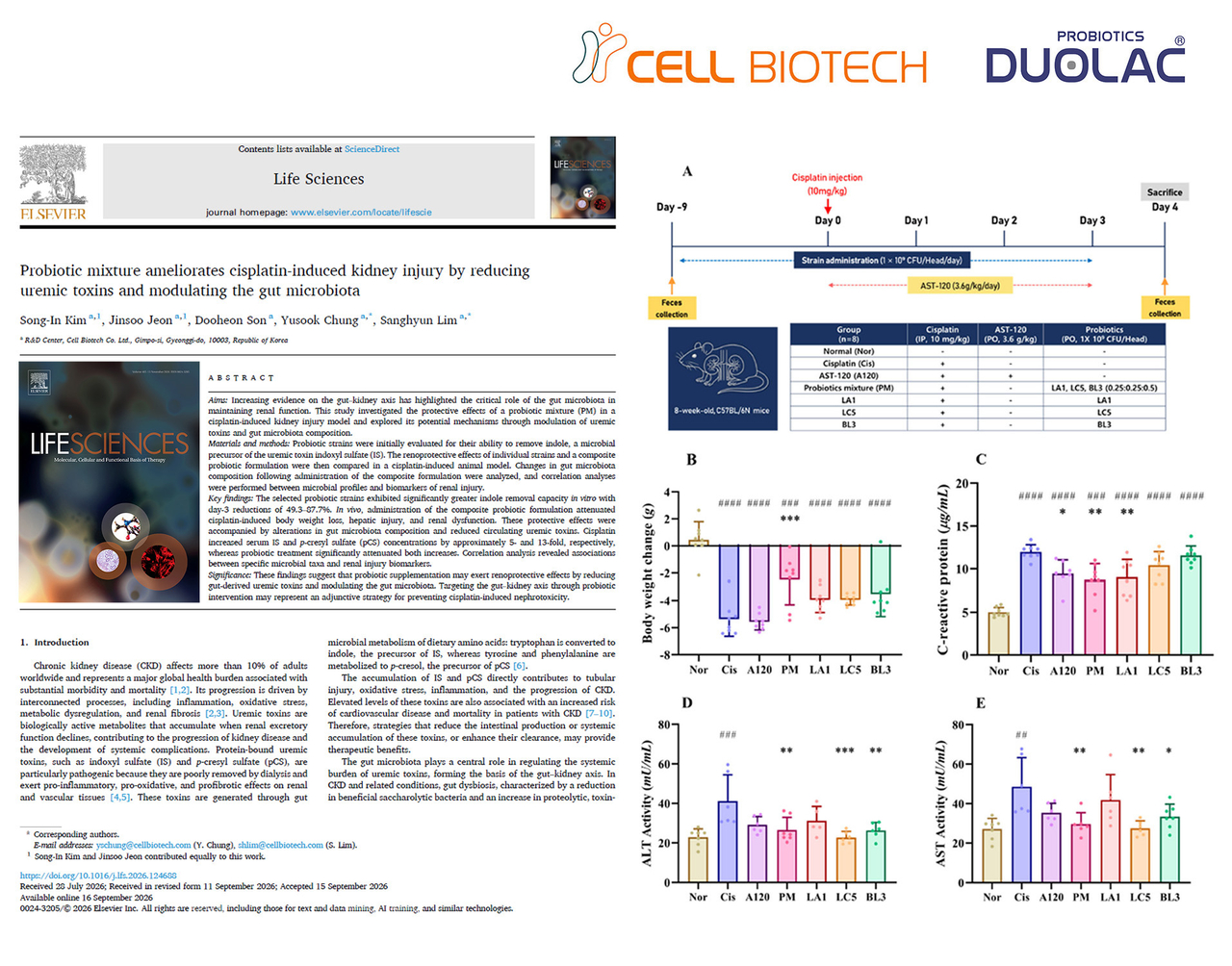
The company announced Tuesday that research into the CKD-improving mechanism of three patented strains — CBT-LA1, CBT-LC5 and CBT-BL3 — used in its flagship Duolac products had been published in Life Sciences, an international peer-reviewed journal in the field of pharmacology.
The study is a follow-up mechanism investigation to an earlier clinical trial conducted at Zvezdara University Medical Center in Serbia, which enrolled 34 pre-dialysis CKD patients at stages G3 to G4. That trial found that patients who consumed the CBT probiotics showed a 12.5 percent increase in glomerular filtration rate and a 21.5 percent reduction in indoxyl sulfate, a gut-derived uremic toxin, pointing to measurable improvements in kidney health indicators.
In subsequent in vitro and animal experiments, the three CBT strains reduced indole — a precursor to uremic toxins — by up to 87.7 percent. In a mouse model of cisplatin-induced kidney injury, blood concentrations of the gut-derived uremic toxins indoxyl sulfate and p-cresyl sulfate fell by 82.7 percent and 92.7 percent, respectively.
The kidney injury marker KIM-1 dropped by 73.3 percent, while blood urea nitrogen and creatinine levels fell by 71.5 percent and 37.3 percent, respectively. Notably, only the probiotic group — not the group treated with a conventional uremic toxin adsorbent (spherical activated carbon) — showed gut microbiome recovery toward a composition similar to that of healthy controls.
"Following the clinical trial in patients, we confirmed in animal experiments that CBT probiotics can regulate uremic toxins and alter the gut microbial environment," an official at Cell Biotech's R&D center said. "We will continue research into the gut-kidney axis and the broader microbiome to expand the potential applications of our probiotics across diverse health areas."
The significance of the research lies in moving beyond the conventional view of probiotics as tools for digestive health. By mapping the gut-kidney axis mechanism — through which gut microbiome modulation reduces toxins and protects organs — the findings open a path for Korean-developed probiotics to enter the fields of adjunct treatment for kidney disease and microbiome-based biotech drug development.
silverpaper@heraldcorp.com