Army unveils new combat doctrine targeting China
Weapons, ammunition and fuel to be pre-positioned along First Island Chain
New 4th Multi-Domain Task Force of about 2,100 troops activated
Military aims to be ready to respond 'from day one of any conflict'
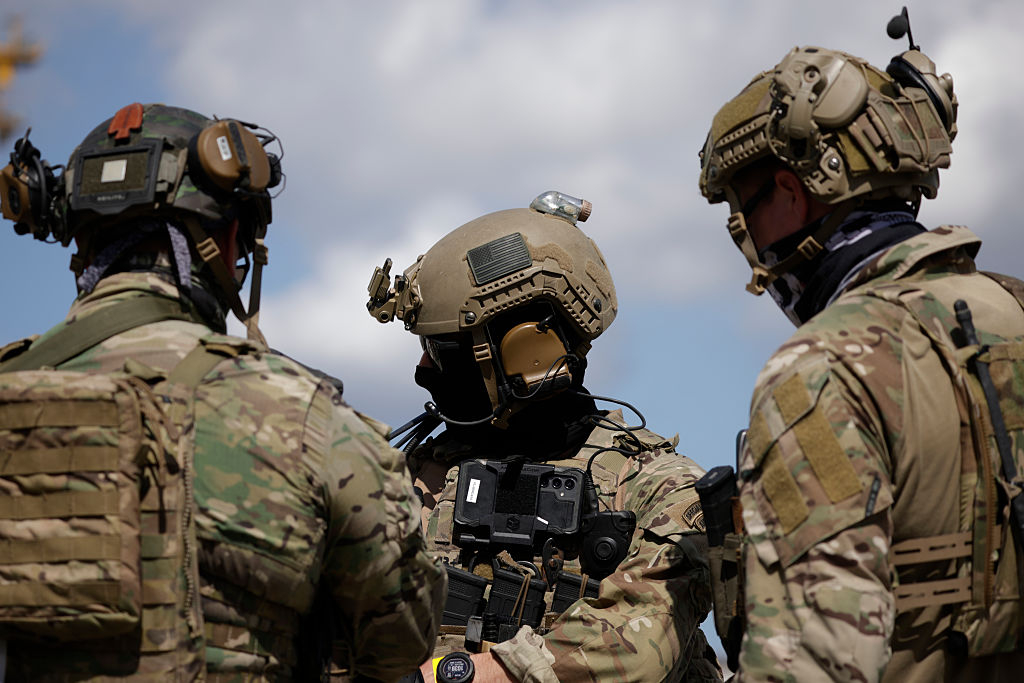
The United States is moving to concentrate military resources along the First Island Chain — the western Pacific's critical defensive line — in response to China's expanding military power, while also standing up a new special operations unit designed to neutralize Beijing's strategy of denying US forces access to the region. The moves reflect a broader push to sharpen American combat readiness across the Indo-Pacific so that US forces can respond immediately from the first day of any conflict, including in the Taiwan Strait.
According to the US Department of Defense, the Army published a new combat operations doctrine on Oct. 7 titled "How the Army Fights." Prepared under acting Army Chief of Staff Gen. Christopher Laneve, the document designates China as the "top-priority threat" and spells out how Army forces will be employed across the Pacific.
The centerpiece of the doctrine is what it calls "total force projection" along the First Island Chain — a notional defensive arc stretching from Japan's Okinawa through Taiwan and the Philippines to the South China Sea. The chain has emerged as a strategic chokepoint as China seeks to extend its military reach into the Pacific.
The Army plans to apply its Total Army Pre-positioning Equipment system, known as TAP2E, across the chain. The approach expands on existing pre-positioned stock concepts, ensuring that weapons, ammunition, fuel and other combat resources are secured in advance and immediately available if hostilities break out.
Along the Second Island Chain, the Army will establish ammunition and fuel resupply hubs to support forward units on the First Island Chain. Given the vast operational distances across the Pacific, the plan calls for using not only conventional surface vessels but also unmanned surface vehicles and unmanned aerial vehicles as resupply platforms.
The measures directly target China's anti-access/area-denial, or A2/AD, strategy. Beijing has steadily built up long-range missiles and air-defense networks designed to block US forces from entering the region and complicate American operations there. The Army's own doctrine acknowledges that China possesses "considerable capability" to disrupt US forces deploying to the Pacific.
"We must be postured to act immediately from day one of a conflict," the Army said in the document, adding that it would "improve combat infrastructure in the Pacific to offset the top-priority threat."
The doctrine also calls for expanding military cooperation with regional allies. The Army describes allied and partner nations as an "active ground-force network" and envisions converting forward bases into sustained operational hubs for US forces. It also outlines plans to review and expand basing agreements and overflight rights.
The buildup of special operations forces aimed at China has also accelerated. On Oct. 8, the Army activated the 4th Multi-Domain Task Force, or MDTF, at Fort Carson, Colorado, with a force of about 2,100 troops.
The MDTF integrates long-range missile capabilities, air defense, cyber warfare and electronic warfare. Its mission is to disrupt China's missile defense networks and command-and-control systems while carving out operational space for US forces.
The newly activated 4th MDTF will be assigned to the Pacific Multi-Domain Command alongside the 1st MDTF, which is headquartered in Hawaii. The addition brings to three the number of MDTFs — the 1st, 3rd and 4th — conducting operations against China across the Indo-Pacific.
US Naval Institute News said the activation gives the Army three specialized anti-access units capable of countering China's access-denial strategy.
The doctrine is also drawing attention for the shift it signals in how the US military plans to fight. Where the previous approach relied on reinforcing from the homeland and rear bases after a conflict began, the new emphasis is on pre-positioning combat resources forward before any fighting starts, raising the capacity for an early response.
"Ground force options that do not rely on legacy long-lead deployment timelines are needed to counter China's rapid deployment capabilities," the Army said. Analysts see the strategy as an effort to shorten the time needed to reinforce US forces in contingencies such as a Taiwan Strait crisis and to deny China any early military advantage.
sjy@heraldcorp.com