Gap between Yeoksam Prugio and Mapo Raemian Prugio narrows from 750 million to 400 million won range
Raemian Oksu Rivergen trades at 2.85 billion won, topping Seocho Raemian
Gangnam correction shrinks price gap, though some call it a temporary shift
As the government moves to tighten the tax burden on high-priced apartments, prices in Gangnam have entered a correction phase, visibly narrowing the gap with top-tier apartments in Gangbuk. In some cases, apartments in key northern Seoul districts such as Seongdong-gu and Mapo-gu have matched or even surpassed the distressed-sale prices of certain Gangnam complexes.
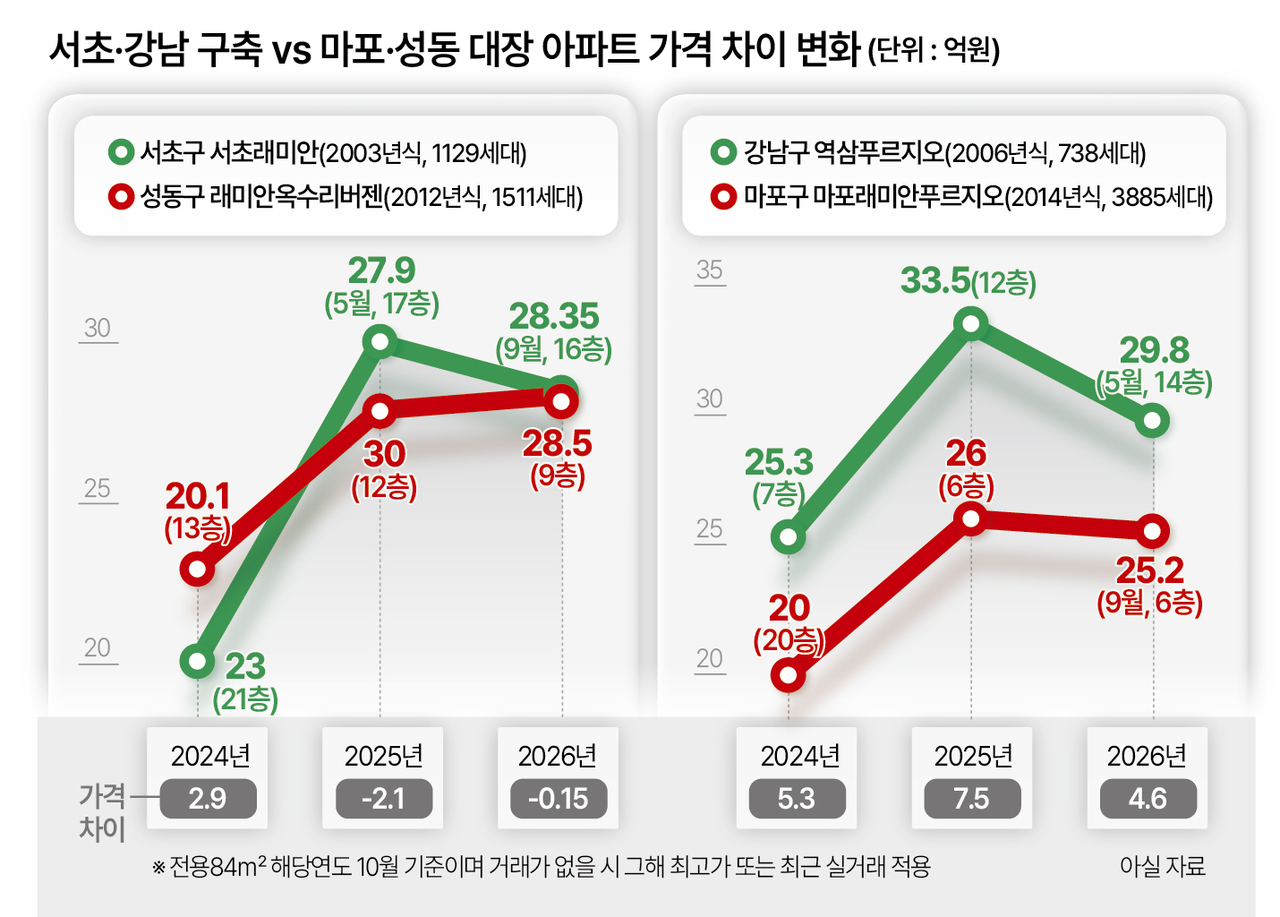
According to the Ministry of Land, Infrastructure and Transport's actual transaction price system, the 84-square-meter unit at Seocho Raemian — a large complex in Seocho-gu — sold two years ago for 2.3 billion won ($1.71 million) on the 21st floor, about 300 million won more than the same-sized unit at Raemian Oksu Rivergen in Seongdong-gu, which changed hands at 2.01 billion won on the 13th floor. The tables have since turned. The 84-square-meter unit at Raemian Oksu Rivergen sold Monday for 2.85 billion won, exceeding Seocho Raemian's most recent transaction — recorded Sept. 18 — of 2.835 billion won.
The price gap between Yeoksam Prugio in Gangnam-gu and Mapo Raemian Prugio in Mapo-gu — both regarded as flagship complexes in their respective districts — has also narrowed sharply for 84-square-meter units, from about 750 million won a year ago to the 400 million won range recently. Yeoksam Prugio set a record actual transaction price last October at 3.35 billion won on the 12th floor, but trading slowed and prices corrected, with a 14th-floor unit selling last May for 2.98 billion won — down 11 percent from the peak. Mapo Raemian Prugio, meanwhile, set its own record at 2.7 billion won for an 84-square-meter unit last September, before a 6th-floor unit sold last month for 2.52 billion won, helping close the gap.
A move-in rights contract for a new Mapo-gu apartment recently crossed 3 billion won for the first time, pulling level with sale prices for older Gangnam and Seocho apartments. The 84-square-meter move-in rights for Mapo Xi Hillstate La Chelles — a Mapo-gu complex scheduled for occupancy next March — changed hands last month at 3.18 billion won, setting a record for an 84-square-meter unit in Mapo-gu. That represents roughly double the pre-sale price of 1.6 billion to 1.7 billion won set in 2024, a near-doubling in just over two years. Though smaller in scale, the price is comparable to the asking price for a 77-square-meter unit at Daechi Eunma, one of Gangnam-gu's most prominent reconstruction-slated complexes.
A broker at a real estate agency in Yeoksam-dong, Gangnam-gu, said foot traffic from prospective buyers has all but dried up. "Buyers sometimes come in and offer to buy only if the seller drops the price by 100 million to 200 million won," the broker said. "Some owners pull their listings, saying they won't sell at that price — so there are basically no deals getting done."
District-level price data back up the trend. According to the Korea Real Estate Board's survey as of Oct. 12, Gangnam-gu's weekly decline deepened to minus 0.35 percent from minus 0.34 percent the previous week, while Seocho-gu held steady at minus 0.27 percent. By contrast, Han River belt districts all widened their gains over the same period — Gangdong-gu moved from 0.13 percent to 0.14 percent, Dongjak-gu from 0.02 percent to 0.09 percent, Mapo-gu from 0.22 percent to 0.26 percent, and Seongdong-gu from 0.09 percent to 0.12 percent.
Market watchers expect Gangnam apartment prices to remain soft for now. Yoon Su-min, a senior real estate specialist at NH NongHyup Bank, said Gangnam surged sharply last year and now appears to be coming off its peak, while areas such as Mapo, Yongsan and Seongdong have yet to see a major correction — making the narrowing gap a matter of timing rather than a structural shift.
Even so, analysts say the narrowing gap is unlikely to trigger a wave of buyers trading up into Gangnam. Nam Hyeok-woo, a real estate researcher at Woori Bank, said the slowdown in Gangnam transactions and the soft price trend would persist for now, driven by dampened investment sentiment amid rising interest rates. "Just because the price gap has narrowed doesn't mean buyers will smoothly move up into Gangnam," he said.
Yoon also cautioned buyers considering a move into early-stage Gangnam reconstruction projects. "Some people are using this period of narrowed gap to trade into early reconstruction projects in Gangnam, but they need to carefully weigh the long-term holding costs — including reconstruction levies — and the livability during the process," he said.
hope@heraldcorp.com