Shares of Samsung Electronics and SK hynix have been falling sharply in recent weeks, even as securities analysts expect fourth-quarter DRAM price gains to exceed earlier forecasts. Analysts project a medium- to long-term rebound driven by improving earnings at both companies, but say a near-term recovery will require foreign selling pressure to ease and confidence in AI investment to be restored.
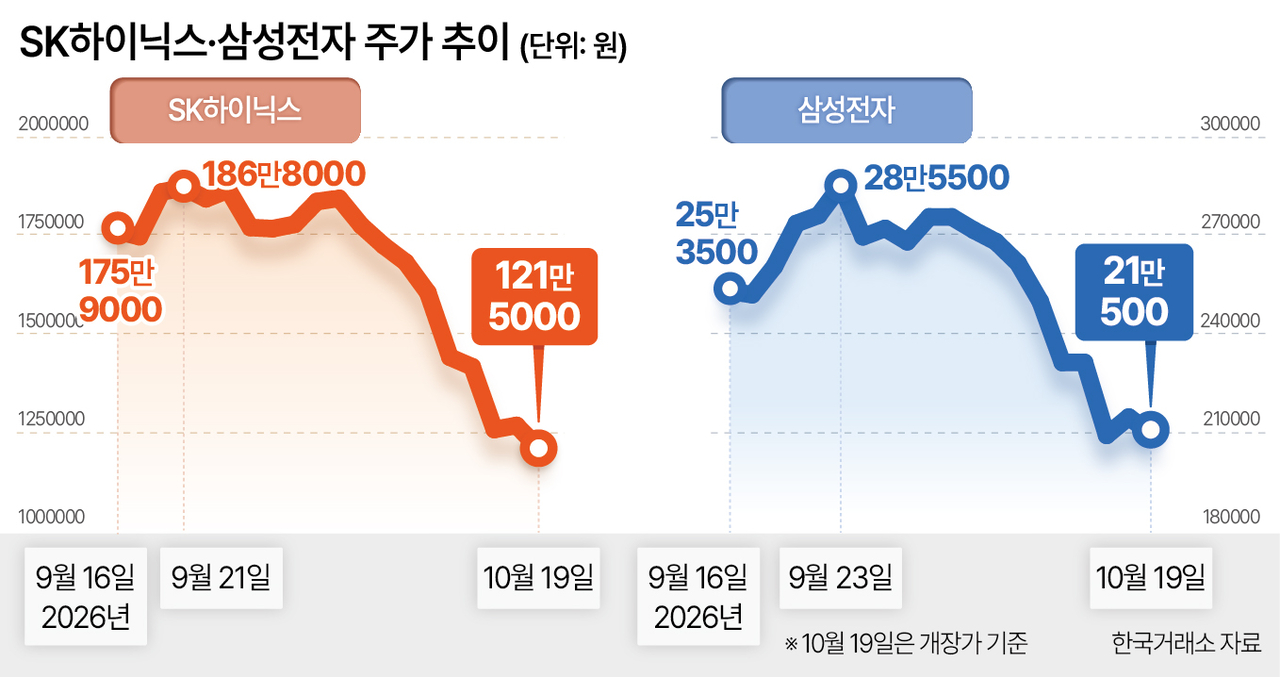
According to Korea Exchange, both stocks opened lower Monday — Samsung Electronics at 210,500 won ($157) and SK hynix at 1,215,000 won. By 9:04 a.m., Samsung Electronics was trading down 1.38 percent from the previous session at 214,000 won, while SK hynix had fallen 1.90 percent to 1,241,000 won.
Both stocks also posted steep losses last week. Samsung Electronics closed Friday at 217,000 won, down 17.2 percent from its closing price of 262,000 won on Oct. 8, just before the "chuseok" autumn harvest holiday. Over the same period, SK hynix dropped 24.7 percent, from 1,681,000 won to 1,265,000 won. Both declines outpaced the Kospi's 14.5 percent fall over the same stretch.
The gap between analyst price targets and actual share prices has also widened. According to financial data provider FnGuide, the consensus target price for Samsung Electronics as of Monday stood at 495,227 won — 128.2 percent above Friday's closing price of 217,000 won. The consensus target for SK hynix was 3,257,727 won, or 157.5 percent above its Friday close of 1,265,000 won.
Anxiety over the profitability of AI investment lies behind the sharp share price declines. Big tech companies have been pouring large sums into data centers, but doubts are growing over whether investment returns and cash flows can justify the spending. Concerns about a medium- to long-term supply glut also surfaced after Tesla CEO Elon Musk recently forecast that China would significantly expand memory chip production by 2028. The disclosure of next-generation DRAM technology by Chinese chipmaker CXMT added further pressure on domestic semiconductor stocks.
DRAM prices, however, have continued to rise even as share prices have fallen, reflecting strong demand from AI data centers against a backdrop of tight supply. "Third-quarter DRAM prices came in better than expected, and the pace of price gains in the fourth quarter is also expected to be revised upward from earlier forecasts," said Kim Rok-ho, an analyst at Hana Securities. "Supply shortages remain serious, and price increases are proving stronger than anticipated."
Rising DRAM prices bode well for earnings at both Samsung Electronics and SK hynix. Further gains in low-power DRAM (LPDDR) prices used in mobile devices are expected to lift earnings forecasts further. "If earnings estimates are revised upward again on the back of LPDDR price increases, share prices should also trend higher," Kim said. He added that while memory chipmakers' share prices had risen sharply this year, "it is unclear why AI-related concerns should disproportionately weigh on memory stocks in particular."
Lee Su-rim, an analyst at DS Investment Securities, said the current situation — in which earnings forecasts remain intact while valuations and supply-demand conditions deteriorate simultaneously — "could represent a buying opportunity for investors." DS Investment Securities expects that a higher share of HBM in the product mix will help both companies maintain profit levels above historical norms even if the industry cycle softens. Lee estimated that even in a scenario where DRAM average selling prices fall 20 percent in 2028, 10 percent in 2029 and 5 percent in 2030, the decline in operating profit at Samsung Electronics and SK hynix would be limited to 7 to 12 percent and 12 to 18 percent, respectively, compared with 2027 levels.
Analysts also note that a near-term rebound will require foreign selling to subside. According to Hana Securities, foreign investors recorded net selling of 11.16 trillion won on the Kospi last week. Net selling in Samsung Electronics and SK hynix amounted to 3.48 trillion won and 5.36 trillion won, respectively, accounting for roughly 79 percent of total net selling. Whether concerns ease over AI companies' fundraising conditions and rising US interest rates will also be a key variable shaping the stocks' near-term trajectory.
SK Securities similarly argued that easing selling pressure and the emergence of new buyers matter more than earnings improvement for a near-term rebound in both stocks. "Given the nature of the correction now unfolding, what is needed right now is not so much earnings results but an end to selling pressure and the appearance of new buyers," said Cho Jun-ki, an analyst at SK Securities.

hajun825@heraldcorp.com