Dual-income mothers spend 4 hours a day on housework and childcare — men spend 2 hours 17 minutes
Gender gap among dual-income couples with children narrowed from 3 hours 16 minutes to 1 hour 43 minutes over 10 years
Even childless working wives spend 34 more minutes on household duties; leisure time falls after marriage and childbirth
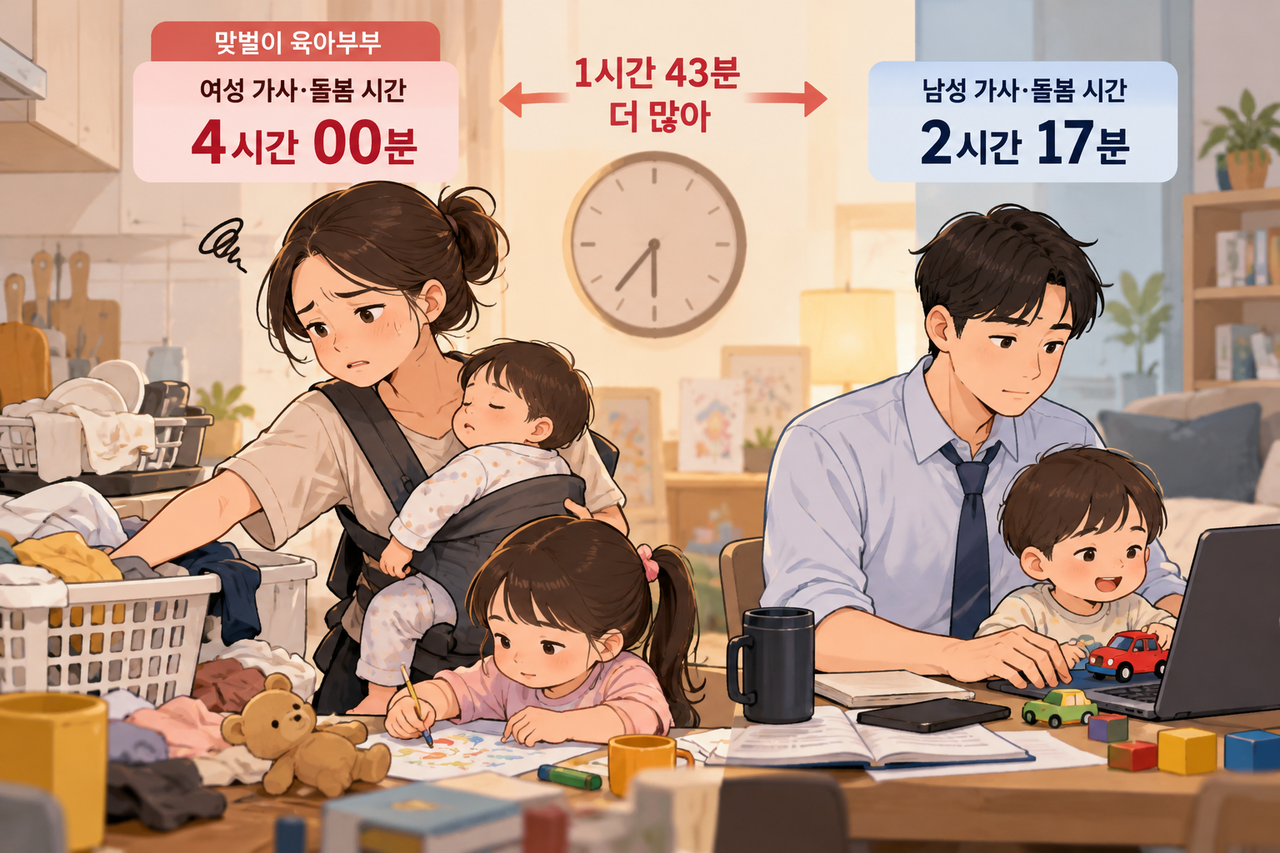
Even in dual-income households, women spend 1 hour and 43 minutes more per day on housework and childcare than men, according to new government data. The gap has narrowed by nearly half compared with a decade ago as men have taken on more domestic responsibilities, but the childcare burden remains heavily concentrated on women. The disparity persists even among dual-income couples without children, with women spending 34 more minutes a day on household duties than their male partners.
The Ministry of Statistics released the findings Monday in a report analyzing how youth aged 25 to 39 allocate their time based on marital status and whether they have children. Married dual-income women with children spent an average of 4 hours a day on housework and childcare, while men in the same situation spent 2 hours and 17 minutes — 1 hour and 43 minutes less.
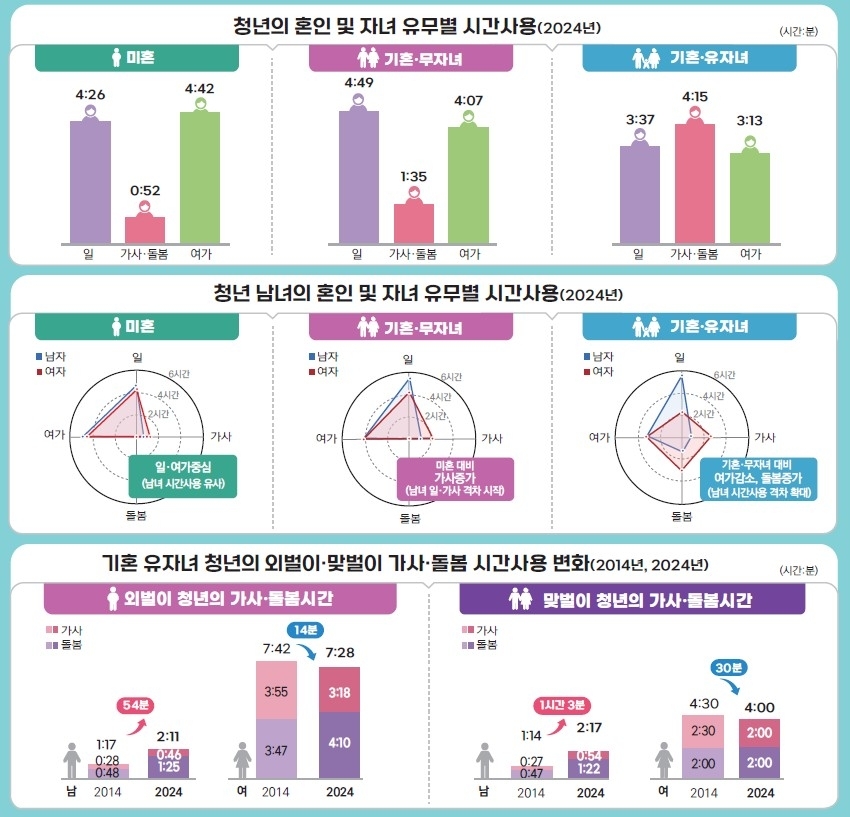
The analysis drew on time-use survey data to compare how people aged 25 to 39 spend their 24 hours depending on whether they are married and whether they have children.
The housework and childcare gap between men and women in dual-income couples has narrowed significantly over the past decade. Among dual-income couples with children, the gender gap shrank by 1 hour and 33 minutes — from 3 hours and 16 minutes to 1 hour and 43 minutes.
Men spent 27 more minutes on housework and 35 more minutes on childcare compared with 10 years ago. Women, by contrast, spent 30 fewer minutes on housework, while their childcare time remained unchanged. The narrowing gap reflects men's growing participation in domestic and child-rearing duties.
However, working women still spend roughly 1.75 times as many hours as men on housework and childcare, suggesting that the burden of balancing work and family life continues to fall disproportionately on women.
A gender gap was also evident among dual-income couples without children. Married, childless working women spent an average of 1 hour and 39 minutes a day on housework and caregiving, while men spent just 1 hour and 5 minutes. The data show that women shoulder a greater share of household duties regardless of whether they have children.
The gender divide was even more pronounced when looking at all married youth aged 25 to 39 with children, regardless of whether both partners work.
Married fathers spent an average of 5 hours and 29 minutes a day on paid work and 2 hours and 14 minutes on housework and childcare. Married mothers, by contrast, devoted 5 hours and 45 minutes to housework and childcare, while their paid work time came to just 2 hours and 14 minutes.
The pattern shows men allocating more time to paid work while women devote more to household and caregiving duties.
Time use among young adults also varied sharply depending on marital status and whether they had children.
Single youth spent an average of 4 hours and 26 minutes a day on paid work and 4 hours and 42 minutes on leisure, with 51 minutes devoted to housework. Compared with a decade ago, paid work time fell by 12 minutes, while housework and leisure time increased by 10 and 11 minutes, respectively.
Married youth without children worked 23 more minutes and spent 42 more minutes on housework per day than their single counterparts, while leisure time was 35 minutes shorter.
Married youth with children spent 2 hours and 20 minutes more on childcare and 20 more minutes on housework per day than married youth without children. Their paid work time fell by 1 hour and 12 minutes and leisure time by 54 minutes.
The data point to a pattern in which household duties increase after marriage and childcare demands surge after childbirth, leaving less time for both work and leisure.
The burden on women stood out sharply when the data for married youth with children were broken down by gender. The findings carry important implications not only for youth labor force participation but also for policies aimed at helping parents maintain careers after childbirth and better balance work and family life.
"This analysis offers a concrete picture of how time use among young adults changes depending on marital status and whether they have children," said Ahn Hyung-jun, minister of statistics. "We will continue to closely track how Koreans use their time through the time-use survey and provide the foundational data needed to develop policies that support work-life balance and improve quality of life."
fact0514@heraldcorp.com