- Single spray process simultaneously forms fiber and coating without high-voltage equipment
- Fiber maintains performance after 30,000 cycles, with applications in smart door locks and wearable sensors

South Korean researchers have developed a technology to produce electricity-generating fibers using nothing more than a spray — no high-voltage equipment required.
The Korea Research Institute of Chemical Technology announced Monday that a joint research team led by principal researchers Son Eun-ho and Kim Ju-hyeon, together with Professor Bae Jin-woo of Korea University of Technology and Education, had successfully manufactured self-powering fibers by mixing two different polymers and spraying the blend onto a surface.
The key advance is that the new method combines fiber formation and surface coating — previously carried out in separate steps — into a single spray process.
Self-powering fibers harness triboelectricity, the static charge generated when two different surfaces come into contact and then separate. Because they can produce electricity from everyday movement, they are drawing attention as a core material for battery-free sensors and next-generation electronic devices.
Existing methods required high-voltage equipment to spin ultrafine polymer fibers, followed by a separate coating step to prevent electrical leakage. The process was complex and difficult to apply uniformly over large areas.
The research team solved this problem by blending a fluorine-based polymer, P(VDF-TrFE), which has a strong tendency to attract electrons, with a silicone-based polymer, PDMS, which holds electrical charge effectively.
When the two polymers are mixed and sprayed, the force generated during spraying stretches and aligns the polymer chains. The solvent then evaporates rapidly, forming a structure well suited to electricity generation.
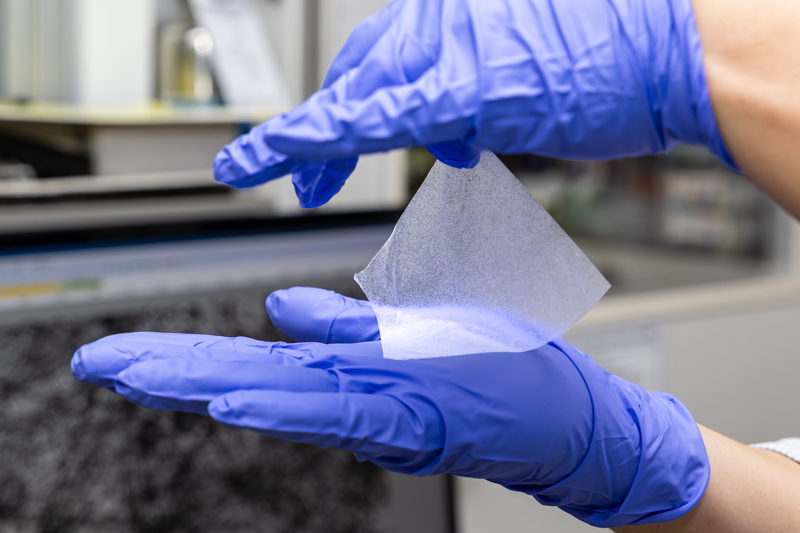
Particularly notable is a "self-stratification" phenomenon observed as the sprayed polymers dry: the two materials naturally settle into distinct positions, with PDMS migrating to the outer layer of the fiber and P(VDF-TrFE) concentrating toward the interior. This arrangement suppresses electrical leakage without any additional coating.
The self-powering fiber recorded a peak voltage of 290 volts, a current of 7.5 microamperes and a power density of 1.23 watts per square meter. It maintained its initial output even after 30,000 contact-and-separation cycles.
To verify real-world applicability, the team also built a prototype smart door lock incorporating the self-powering fiber. A keypad made up of 12 triboelectric sensors detects input signals and activates the lock when a password is entered — without any separate power supply for the sensors.
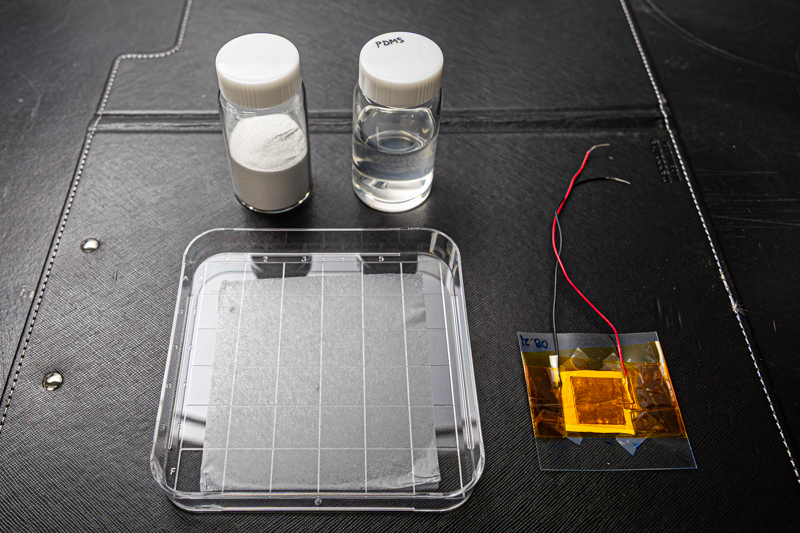
The team confirmed that the fiber can be used in a range of devices that detect human movement or touch — including handwriting recognition pads, smart door locks and wearable sensors — and identified potential applications as an energy-harvesting component for Internet of Things devices.
However, challenges remain before the technology can be commercialized. The spray technique developed at the laboratory scale must be scaled up into a continuous mass-production process, and performance degradation in high-humidity environments needs to be addressed. Power management technology to store and use the generated electricity reliably will also be necessary.
"We expect this to be used to simplify the manufacturing process for large-area self-powering sensors and wearable electronic devices," said Professor Bae Jin-woo of Korea University of Technology and Education.
Shin Seok-min, director of the Korea Research Institute of Chemical Technology, said the work was "a good example showing that the capabilities the institute has built up in fluorine materials — a field with few dedicated research institutions in Korea — can be applied across a wide range of areas."
The findings were published in the September issue of the international journal Advanced Composites and Hybrid Materials.
nbgkoo@heraldcorp.com