Embers thrown into the night, tracing fleeting arcs of red
Haman-gun's nakkhwa nori revived at Mujinjeong Pavilion
A Joseon-era prayer for peace, now a living tourism draw
No thunderclap — only the quiet glow that seeps into darkness
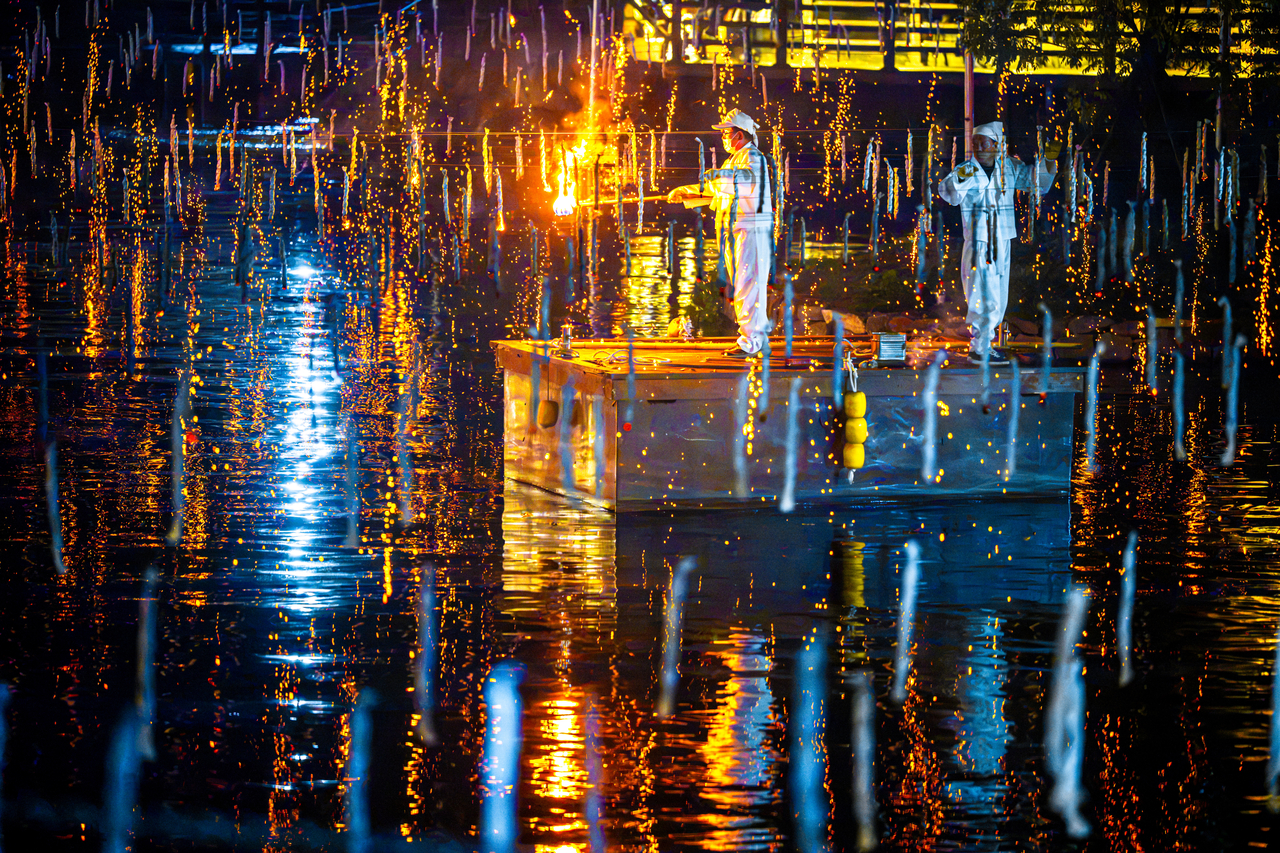
Glowing embers scatter and fall toward the center of the pond. In the instant before light meets darkness, countless threads of brilliance unfurl across the trembling surface of the water.
Red lines dance against the black, spreading like brushstrokes. It is only in the moment of burning away that the charcoal dust blazes most brightly. Nothing in this world lasts forever. The dying sparks, as if mocking human desire, leave behind only a brief crackling sound before sinking quietly into the hearts of those watching.
Crossing the sea to find the flame
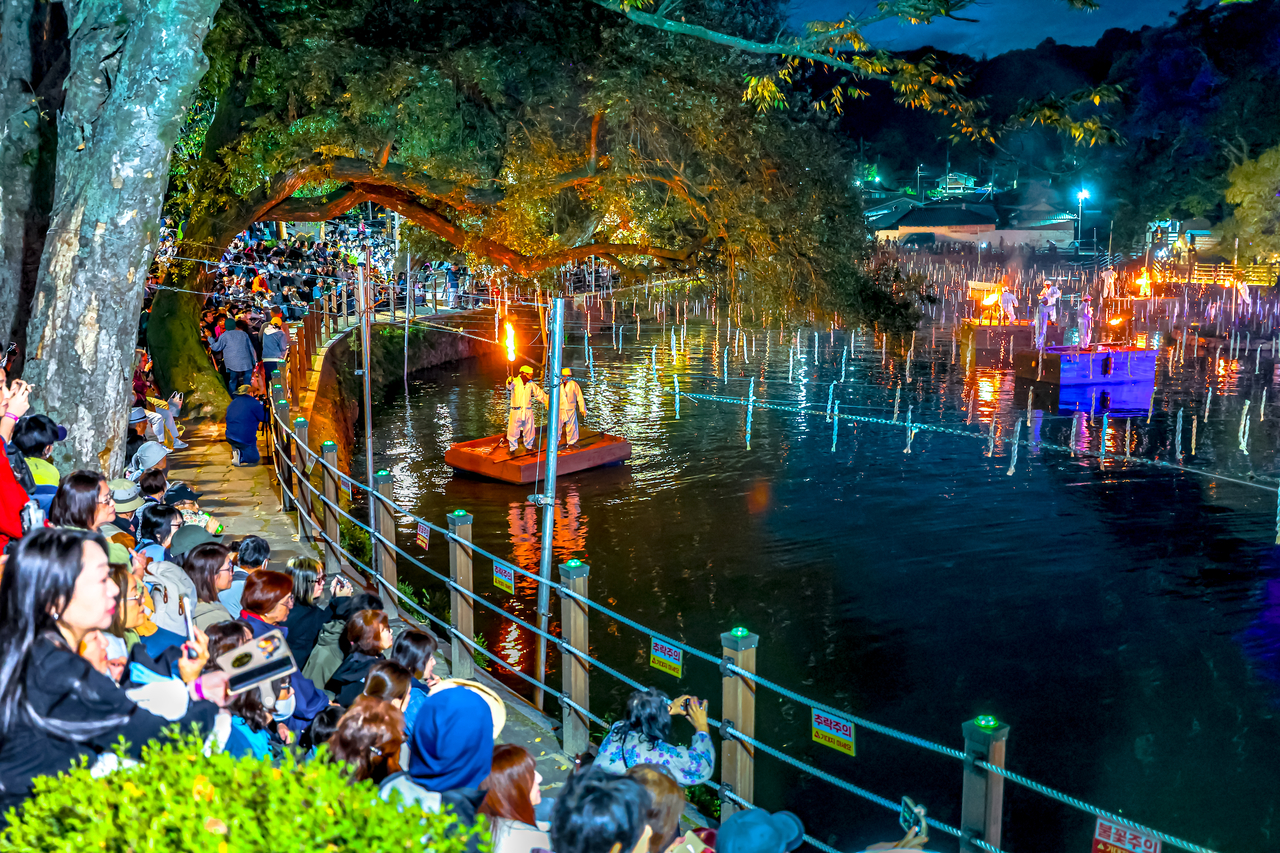
At the cusp of autumn in Haman-gun, South Gyeongsang Province, the pond in front of Mujinjeong Pavilion was packed with spectators. Mujinjeong is a pavilion built in 1542 by Joseon-era scholar-official Jo Sam as a place to nurture students and spend his later years. Thousands of nakkhwa bong — tightly wound charcoal sticks — hung from ropes strung above the water, swaying gently in the breeze. The crowd waiting for the flames was large, but the mood was calm.
Announcements in foreign languages and the voices of event staff carried across the grounds. Of the spectators gathered along the pond that evening, 1,500 were Japanese tourists who had come for the 2026 Haman Nakkhwa Nori Japan Special Day. Outdoor booths were covered entirely in Japanese signage, giving the venue an atmosphere that felt almost like being in Japan.
One Japanese tourist at the scene said she had visited Seoul and Busan after watching K-dramas, and had since grown curious about the culture of other regions. "I saw the Haman nakkhwa nori in a video by a Japanese travel YouTuber and knew I had to come see it for myself," she said.
Pure charcoal, no gunpowder — Haman's defining commitment
The precise origins of Haman nakkhwa nori are unknown. It is said to have been started by Jeong Gu, a county magistrate during the reign of King Seonjo of Joseon, who held the event on Buddha's Birthday to pray for the safety and prosperity of the people. Records in the historical document "Haman Chongswaeron" show that nakkhwa nori was performed across the town on the fourth day of the fourth lunar month in both 1890 and 1892.
The tradition was suppressed during the Japanese colonial period as part of policies aimed at erasing Korean culture, but local residents revived it after liberation. In 1960, the youth association of Goehang village re-enacted nakkhwa nori at Mujinjeong on Buddha's Birthday. The event continued sporadically before becoming a regular fixture in 1985 with support from Haman-gun and the Haman Culture Center. It was designated an intangible cultural heritage of South Gyeongsang Province in 2008, and last year was selected as a regional specialty content winner at the 2025 Korea Tourism Star awards.
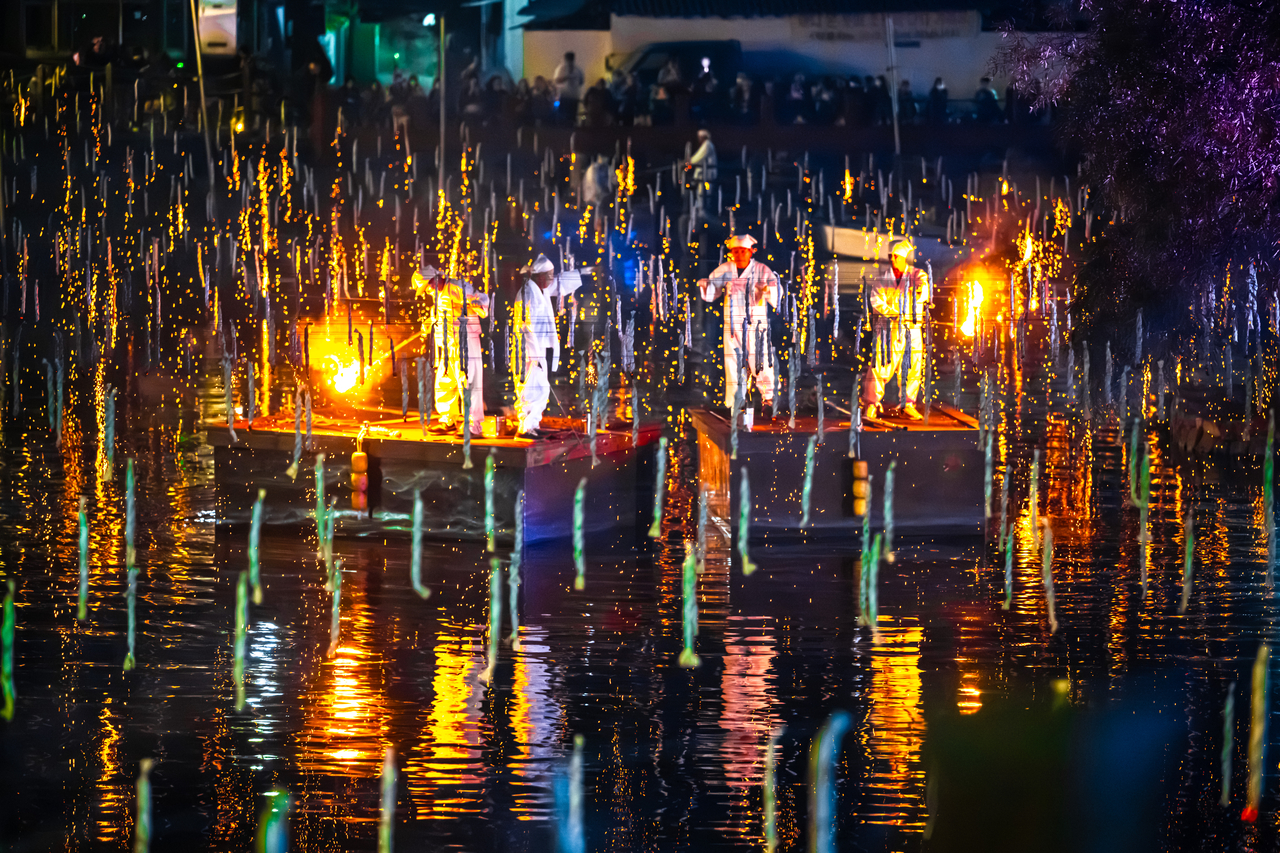
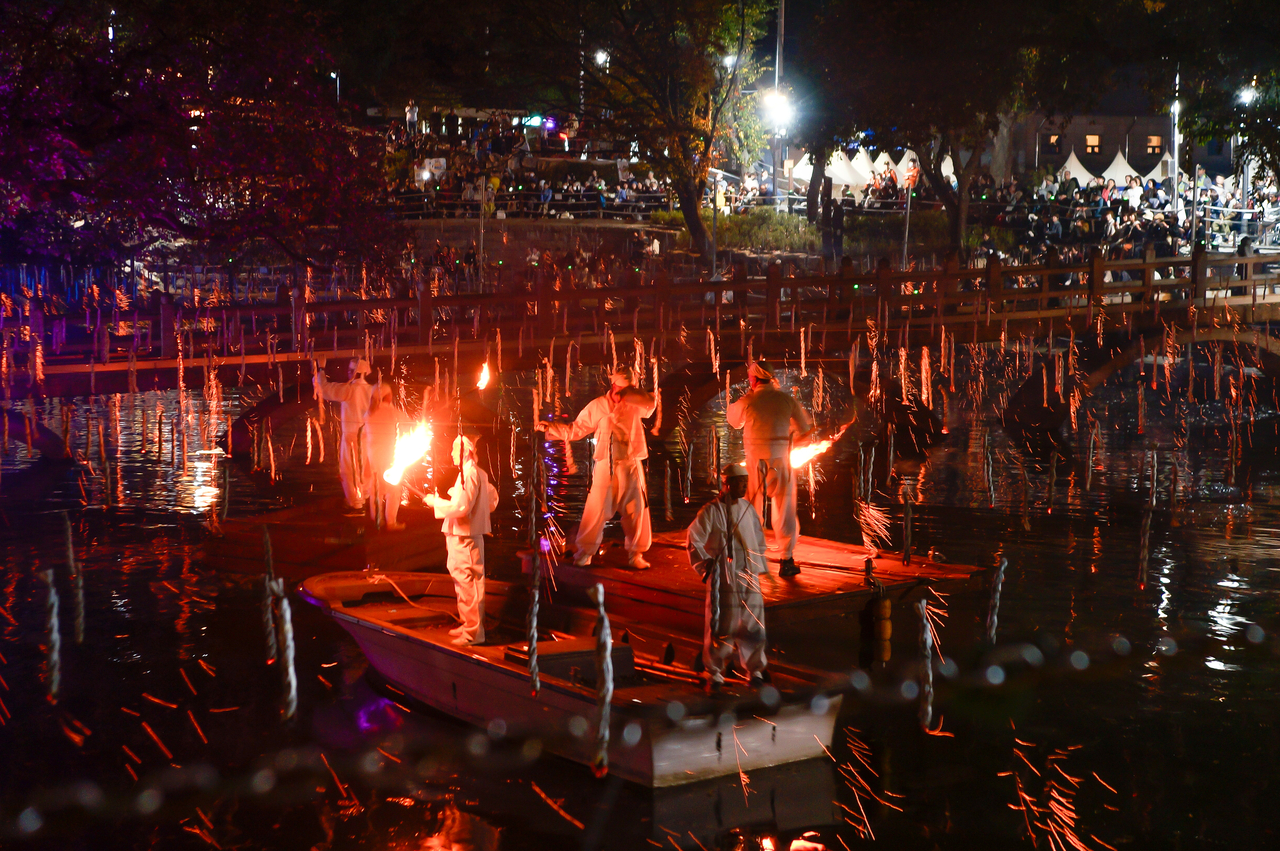
True to its name — the hanja characters for "falling" and "fire" — Haman nakkhwa nori relies not on the explosive force of gunpowder but on the slow, steady combustion of charcoal. The nakkhwa bong hang about three meters above the water and shed sparks continuously for roughly two hours, holding the audience in a kind of trance. The angle at which the embers drift shifts from moment to moment with the strength and direction of the wind, and the flow of air shaped by nature and weather etches a different pattern in the sky with every passing second.
The festival distills generations of local knowledge and craft. Because a single event requires between 2,500 and 3,000 nakkhwa bong to be hung above the pond, members of the Haman Nakkhwa Nori Preservation Society and residents of Goehang village gather before each event to roll every one of them by hand.
The process, from gathering materials to finishing each nakkhwa bong, is painstaking. Oak trees thinned from the hills behind the village are charred using traditional methods, then ground into fine powder. The powder is placed on hanji (traditional Korean paper) with a cotton wick laid down the center, then twisted and wound into a tight spiral. The key is controlling the tension: too loose and the whole stick ignites at once; too tight and it burns out before its time. Skilled hands are essential.
Among all traditional nakkhwa nori practiced across the country, Haman is the only place that uses pure oak charcoal powder with no additives — no gunpowder, salt, sulfur or mugwort. Without those ingredients, the sparks fall gently rather than flying in all directions, and the sticks burn without smoke or sharp odors.
The pole swings, red rain pours, the crowd gasps
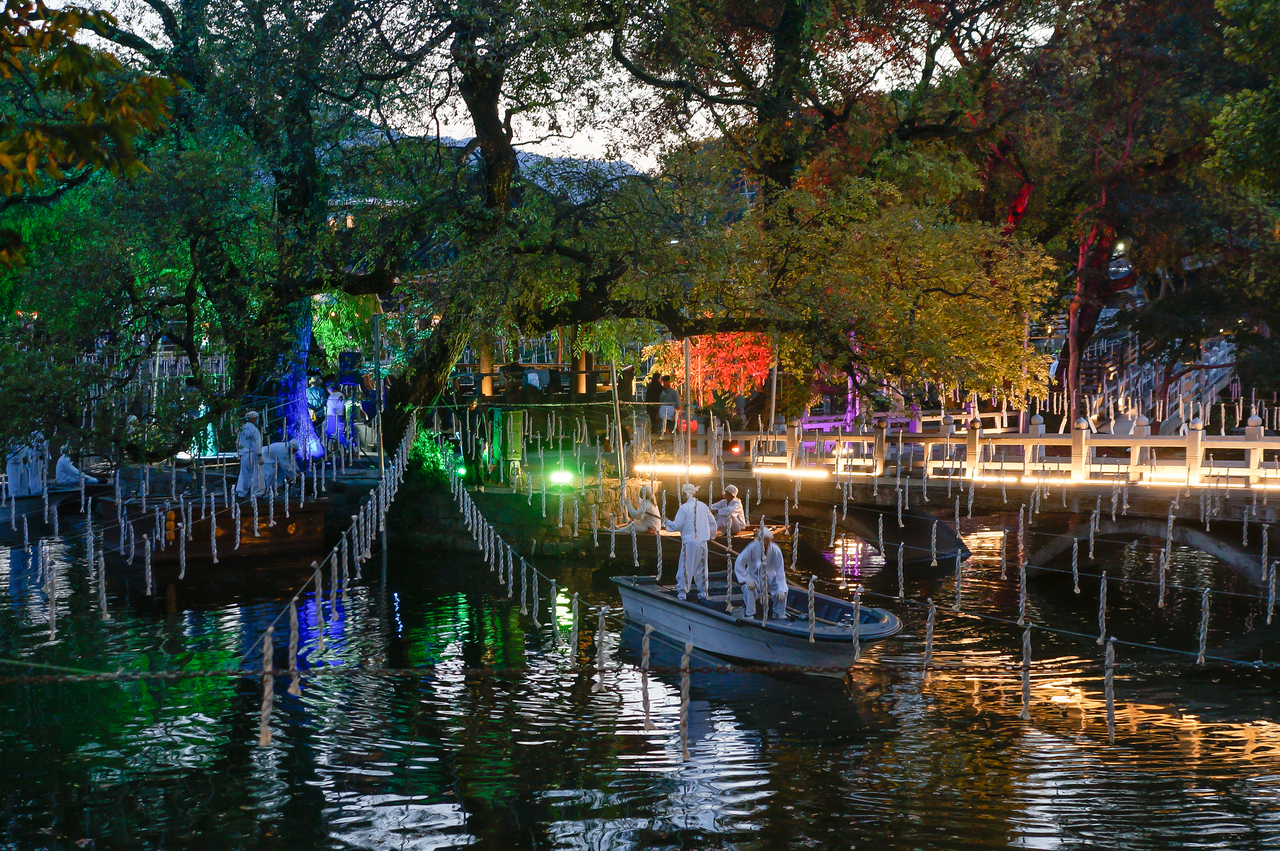
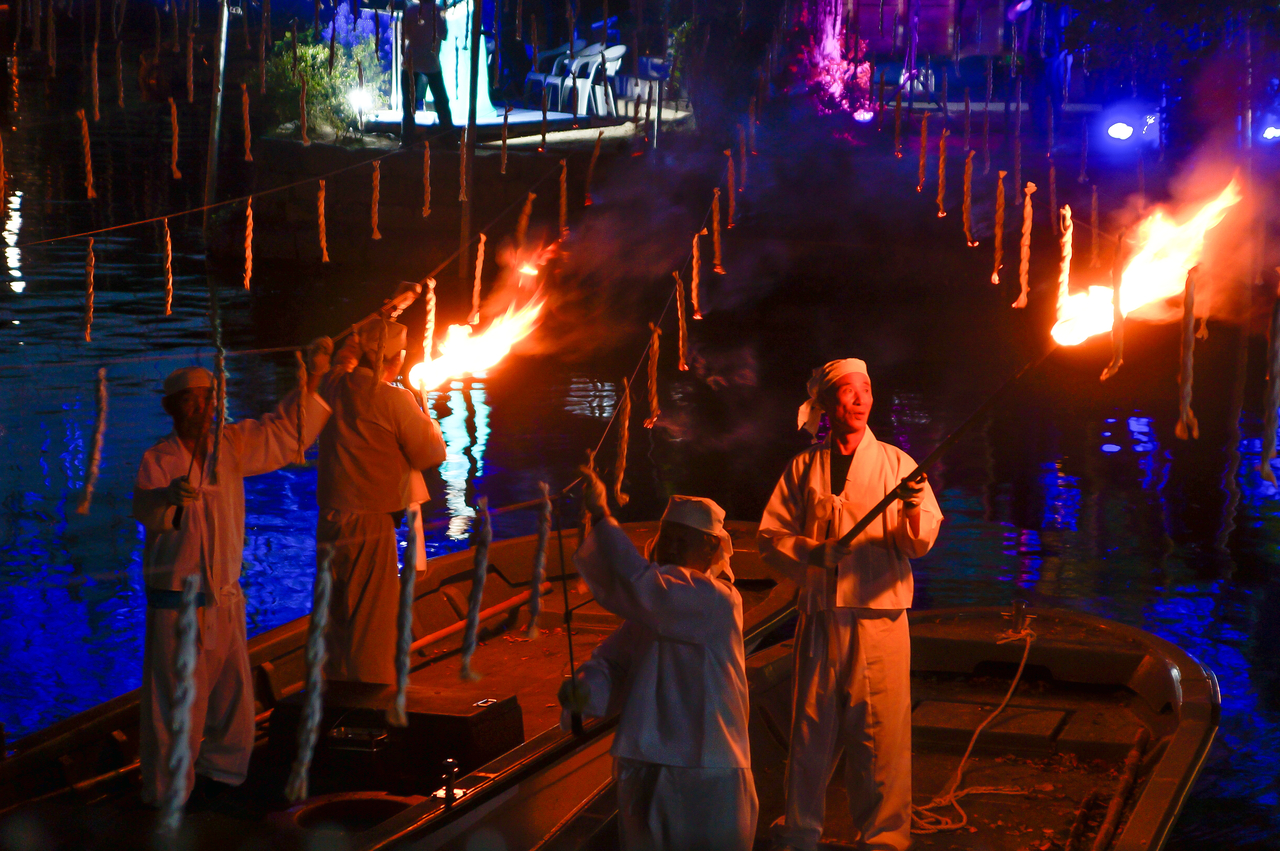
Before the festival began, boatmen dressed in white traditional attire launched wooden boats onto the pond. Pushing off with poles toward the center of the water, they raised torches and touched flame to the tips of the nakkhwa bong. As fire traveled along the ropes stretched across the pond, the wicks wrapped in hanji slowly absorbed the heat and began to glow red. One by one, sparks bloomed and drifted down onto the water. As darkness fell, thousands of red points of light were all that breathed in the night.
On the stage set up at Mujinjeong that evening, traditional Korean instruments filled the air. From melodies evoking the Korean spirit, such as "A Beautiful Country," to the soundtrack of the animated film "Howl's Moving Castle," the lyrical strains of the piri (a Korean oboe) and haegeum (a two-stringed fiddle) spread slowly across the water.
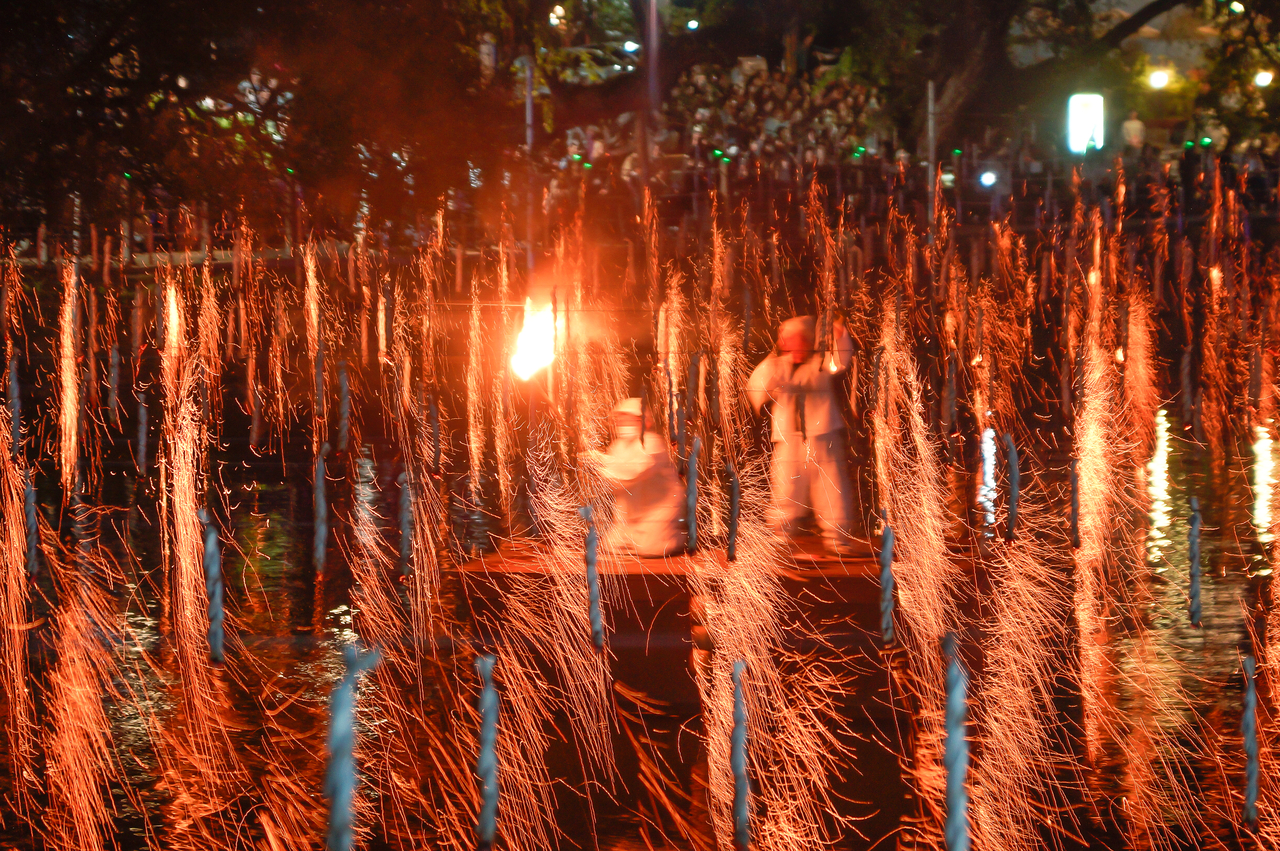
As the music played on, the reddened charcoal powder crackled and crumbled apart with a dry, popping sound. There was something beautiful, and at the same time quietly sorrowful, about watching the sticks burn themselves away to light the night. A Japanese tourist in her 60s said seeing a traditional Korean fire display in person would stay with her as a special memory. "When I get back to Japan, I want to recommend this event to everyone I know," she said.
The climax of the festival came with the jultchigi. When event staff struck the ropes holding the nakkhwa bong hard with long poles, the vibration sent a torrent of sparks cascading all at once. The embers that had been drifting down like flower petals moments before suddenly became a red waterfall pouring onto the pond. From the viewing area, a collective gasp rose from the crowd. It was a scene for which the word nakkhwa — falling fire — seemed the only fitting description.
Cold water, burning fire, dissolving into the dark
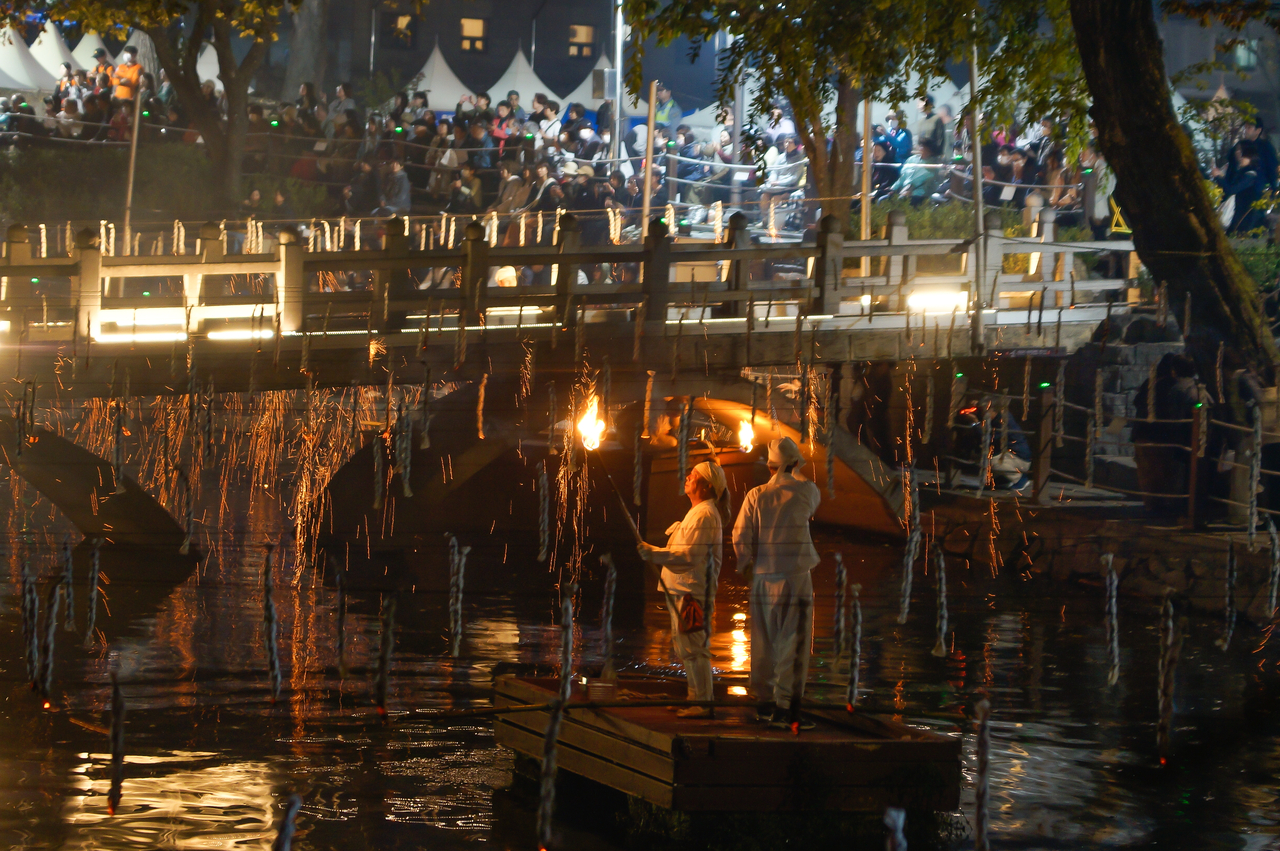
That evening, the pond at Mujinjeong became a mirror for the flames. The red arcs falling through the air were reflected whole on the surface, making it seem as though fire bloomed from within the water as well. The sight of hot fire meeting cold water felt less like a collision than a gradual merging — each element seeping into the other.
This quiet, contemplative aesthetic offers those who watch it a kind of emotional solace. Instead of a deafening boom or a blinding flash, a soft, steady glow woven into the darkness holds the eye. Rather than chasing the thrill of a single instant, the audience is invited to sit with the full arc of the flame — its rising and its fading. The flickering fire feels like a distillation of the Korean aesthetic of "yeobaek," the beauty found in what is left unsaid and unseen.
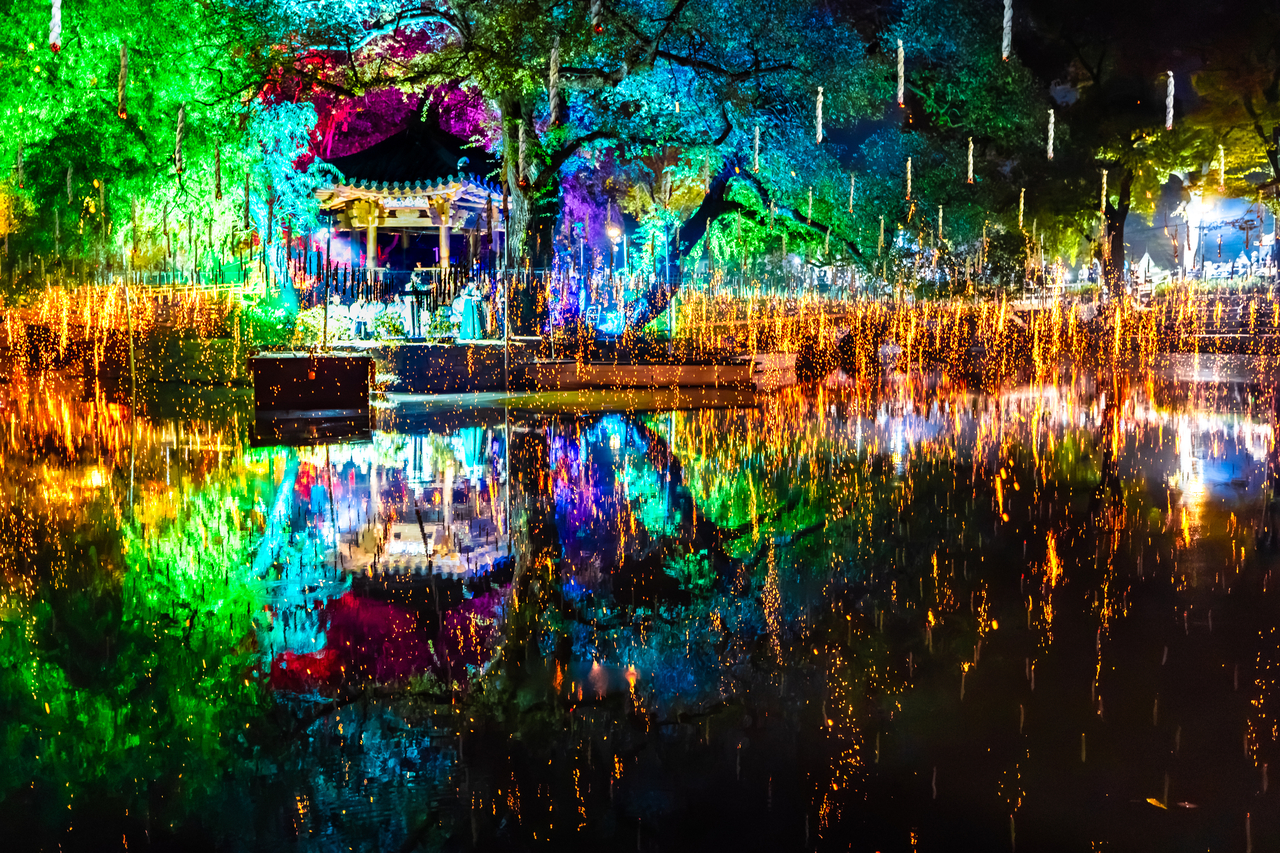
As the night deepened, the flames above the pond began to subside. The bright red trails grew thinner, and the surface of the water reclaimed its original dark stillness. Yet the faces of those rising from their seats still carried a flush of red. The rough-hewn charcoal sticks that had been hung for centuries in prayer for the peace and safety of one small village had left a deep impression in the hearts of visitors from across the sea — and then, quietly, as if urging autumn onward, they were gone.
terry@heraldcorp.com