Fruit Fly Trader (6): None of 13 fruit fly behaviors beat simply holding bitcoin
Since the complete wiring diagram of the fruit fly brain was made public, attempts to build "virtual fruit flies" on computers have been proliferating overseas — running games and simulations on them has become something of a trend. The Herald Business is publishing a series documenting the reporter's own experiment in which a virtual fruit fly brain, built from the published connectome, was put in charge of simulated bitcoin trading. All trades were conducted as paper trades; this is not intended as investment advice. [Editor's note]
![[AI-generated image]](https://wimg.heraldcorp.com/news/cms/2026/10/16/news-p.v1.20261016.5a6246753e714697bbcc0d62063ef652_P1.png)
Applying a fruit fly's instinct to flee from predators to bitcoin trading caused the virtual fly to sell at a 13 percent gain — just before the price went on to rise nearly 40 percent.
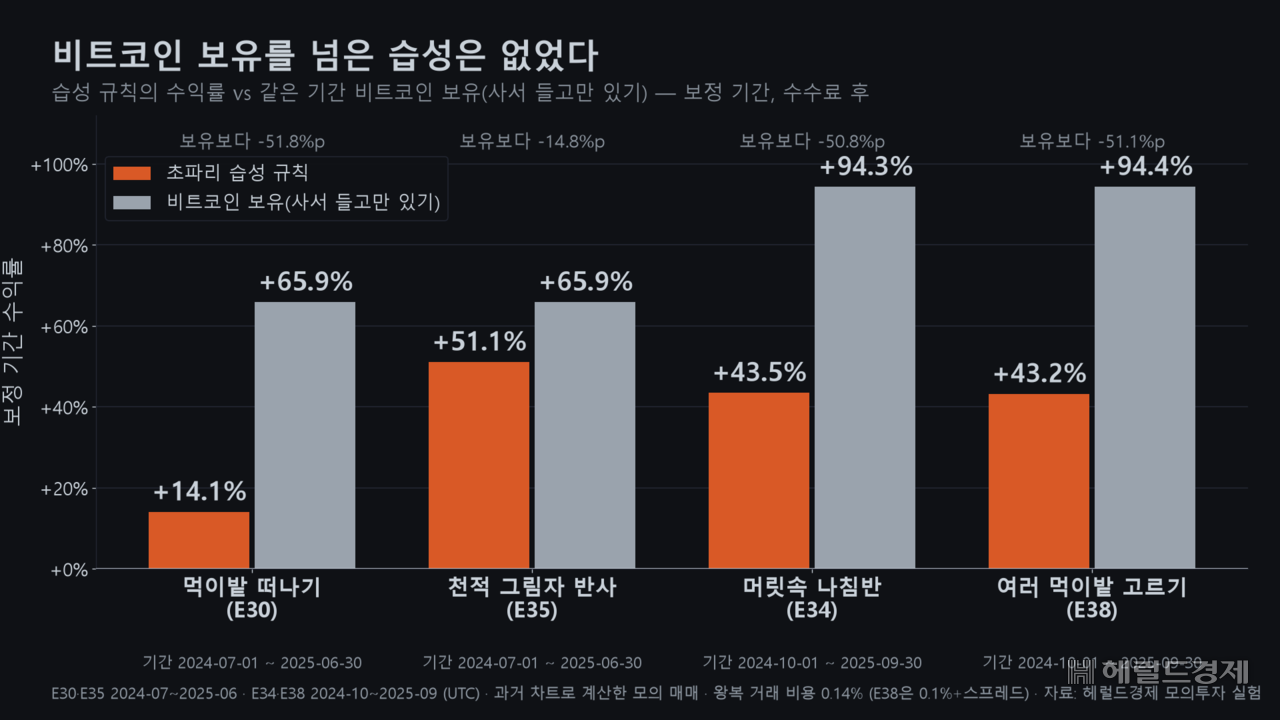
Thirteen fruit fly behaviors — fleeing predators, choosing mates, ramping up activity at dawn and dusk — were translated into trading strategies and back-tested against historical bitcoin charts. Not one outperformed simply buying bitcoin and holding it. Of all 13, only the scent-following foraging behavior survived into live paper trading.
The Herald Business has been running a simulated bitcoin trading experiment using a virtual fruit fly — a computer model built from the fruit fly brain connectome that scientists completed in 2024. The setup converts chart data into odor signals the virtual brain can process, then reads the brain's responses as buy or sell orders.
When that approach consistently failed to make money in the bitcoin market, the experiment expanded to include behaviors fruit flies actually exhibit in the wild.
![A fruit fly. [Getty Images Bank]](https://wimg.heraldcorp.com/news/cms/2026/10/16/news-p.v1.20260929.2f824c9c314a46c6b12d606feaf638a0_P1.png)
From the fly's brain to its actual behaviors
The AI running the experiment spent Sept. 25 combing through research papers on fruit fly behavior and drew up 13 trading strategy concepts. They included a larva's instinct for deciding when to leave a food patch, a fly's ability to use an internal compass to remember direction, its habit of tracking scent carried on the wind, a circadian clock that peaks at morning and evening, and its reflexive escape from approaching predators.
Each strategy was back-tested on historical bitcoin charts, with the assumption that combined fees and the bid-ask spread would cost 0.14 percent of the trade value per round trip.
![Unrelated to article content. A person catching insects. [Getty Images Bank]](https://wimg.heraldcorp.com/news/cms/2026/10/16/news-p.v1.20261016.695dc3fd611b4f03957dbd64351c34db_P1.jpg)
When a shadow grows and looms toward a fruit fly, the insect takes off and escapes in an instant.
In 2017, researchers at the Howard Hughes Medical Institute's Janelia Research Campus reported in the journal Nature that they had identified about 80 neurons in the fruit fly that respond exclusively to objects approaching head-on.
Those neurons do not fire for objects passing by to the side — only for objects that loom larger as they approach directly.
The predator-escape response was applied to stop-loss decisions in bitcoin trading. While the virtual fly held bitcoin, the magnitude of a price drop was mapped to the size of the approaching shadow and the speed of the drop to the rate at which the shadow grew; if both exceeded set thresholds, the position was sold immediately.
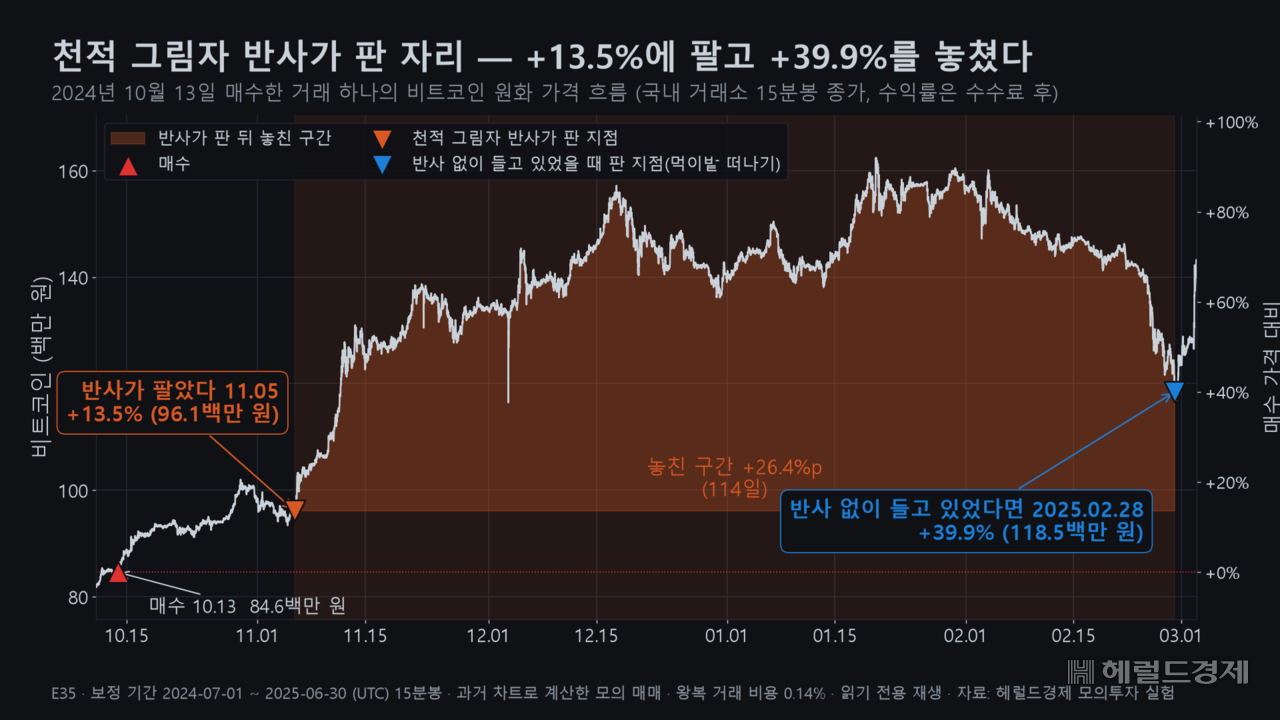
In a back-test trade entered on Oct. 13, 2024, the predator-escape response triggered a sale when the position was up 13.5 percent. Had the fly simply held on, the gain would have reached 39.9 percent.
When the sensitivity of the escape response was lowered, the strategy attempted to trade on even minor dips, with 26 to 49 percent of all trades ending in premature sells.
Acting like a fly — and losing money for it
Researchers at the University of Würzburg in Germany published a study in Nature Communications in 2024 using the fruit fly brain connectome to identify every neuron that makes up the fly's circadian clock.
The team found that the circadian clock is built from about 240 neurons — not the 150 previously thought. Morning activity and evening activity are known to be driven by distinct clusters within that network. Fruit flies are most active twice a day: at dawn and at dusk.
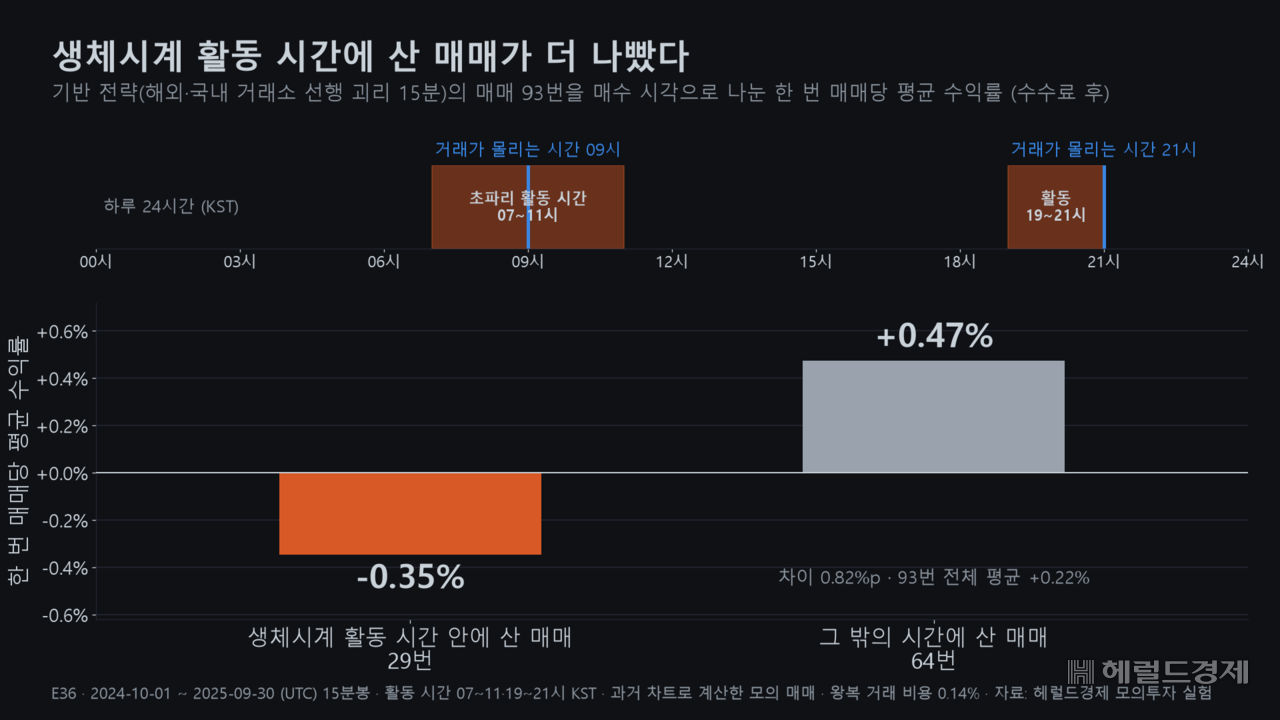
Mapping the fruit fly's circadian rhythm onto trading hours produced poor results. The 29 trades entered during the fly's active periods averaged a loss of 0.35 percent per trade, while the 64 trades entered at other times averaged a gain of 0.47 percent.
The fly's peak activity windows — morning and evening — overlapped with the busiest trading hours on domestic cryptocurrency exchanges, 9 a.m. and 9 p.m., but no meaningful edge emerged.
Fruit fly larvae move on to find new food when their current patch runs low. A study pre-published this year in the journal eLife proposed a computational model in which larvae accumulate small pieces of evidence that food is dwindling and leave once that evidence crosses a threshold.
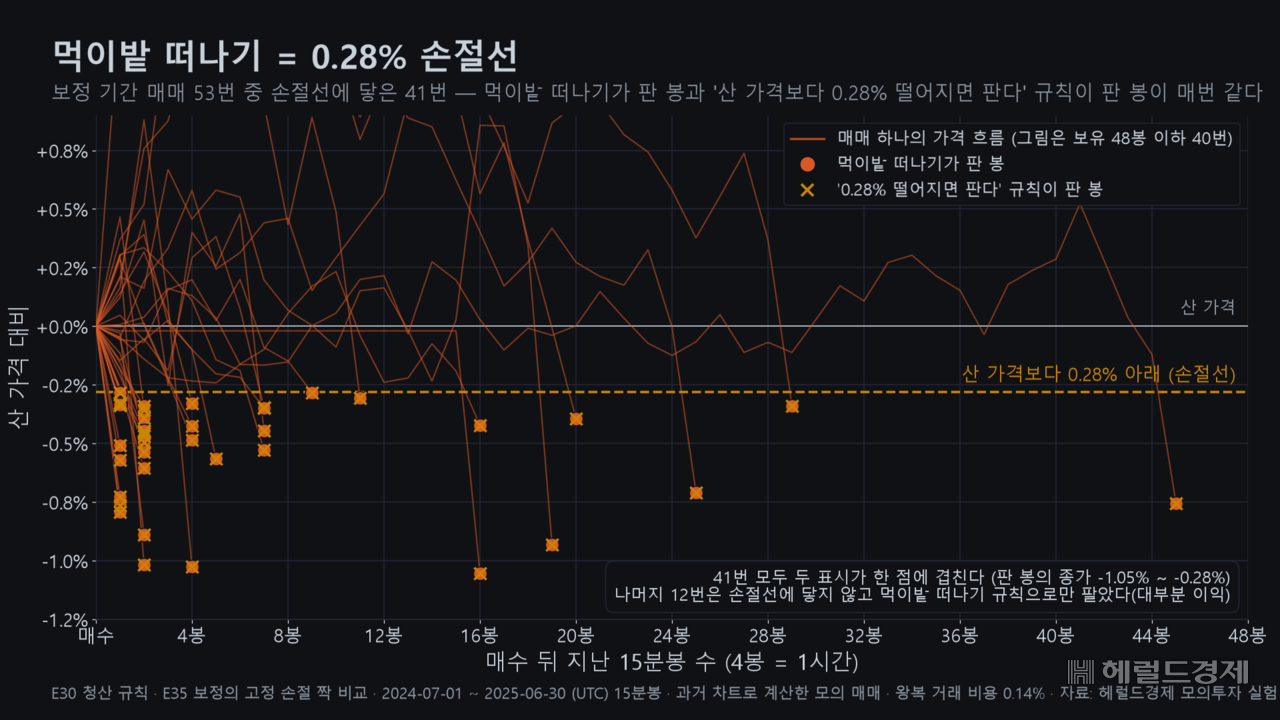
That behavior was applied to deciding when to sell bitcoin: the virtual fly would sell whenever its rate of return while holding had lagged the market average long enough for the accumulated evidence to cross a threshold. In testing, the model sold at exactly the same moment as a simple stop-loss rule — "sell if the price drops 0.28 percent from the purchase price" — on every single trade. The larva's food-patch model had been built in, but the system ended up behaving like a plain rule.
A strategy based on the fruit fly's direction-finding behavior executed 255 trades and returned 43.5 percent.
However, a simpler calculation that merely added the same signals together returned 64.0 percent, and simply holding bitcoin over the same period returned 94.3 percent. The fly's navigation instinct had actually dragged returns down.
One behavior was dropped before testing even began. A starving fruit fly becomes hypersensitive to smell and sweetness, eating things it would normally ignore.
In 2012, researchers at the California Institute of Technology published a study in the Proceedings of the National Academy of Sciences showing that specific neurons in the fruit fly brain suppress feeding behavior.
Translated into trading, that behavior becomes a rule of "bet bigger the longer you're losing" — doubling down after each loss to recover in a single trade, a strategy known as the martingale method. It was excluded from the experiment because, in paper trading rather than with real money, the outcome varies too much depending on the initial capital setting.
![Unrelated to article content. [Getty Images Bank]](https://wimg.heraldcorp.com/news/cms/2026/10/16/news-p.v1.20261001.0b40c990e4dc4f4b9497b4d023a01b88_P1.jpg)
The one behavior that made it to live paper trading
Of the 13 behaviors, only one advanced to live paper trading.
That was the fruit fly's scent-following foraging behavior, based on an experiment published in eLife in 2020 by researchers at Yale University.
The team built a custom wind tunnel, pumped irregular puffs of smoke through it, and filmed fruit flies walking inside. Scent carried on the wind reaches a fly in brief, intermittent bursts; depending on when it encounters the scent, the fly walks, stops, or turns to face into the wind.
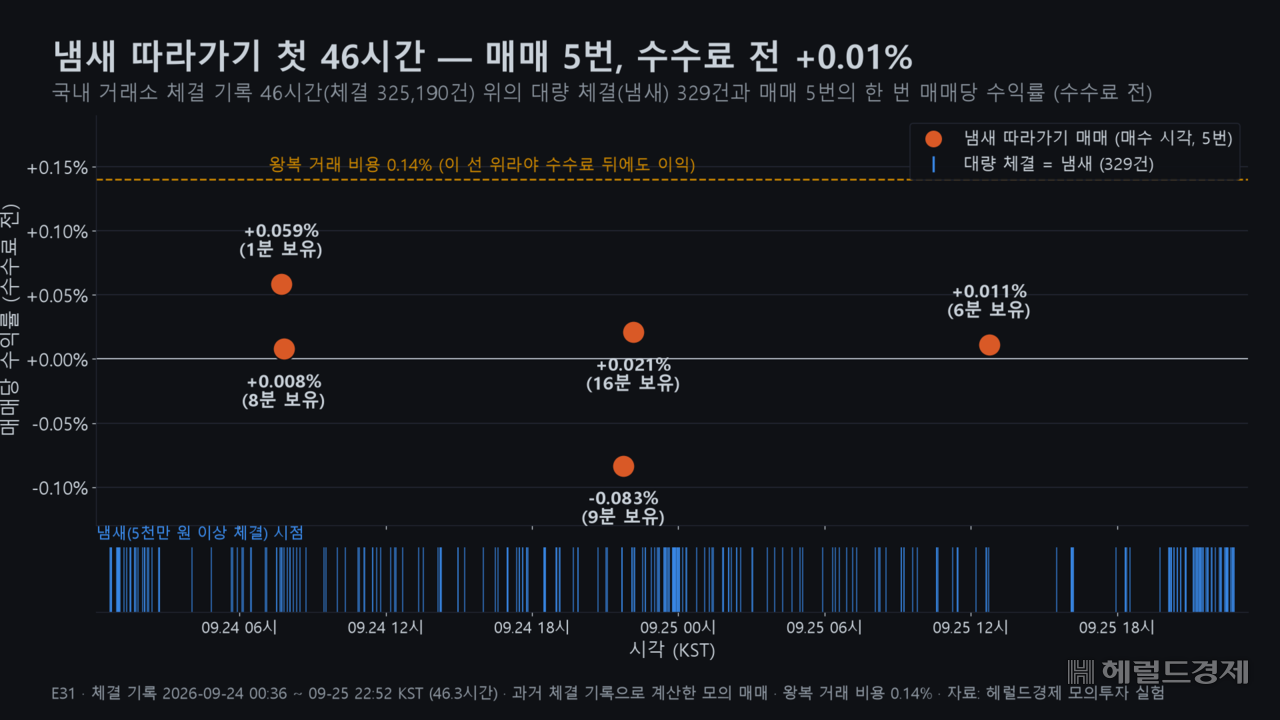
Using that framework, every large transaction in the cryptocurrency market was treated as a burst of scent reaching the fly, and the virtual fly reacted on a second-by-second basis. Over 46 hours, it made five trades, with a median return of 0.011 percent per trade.
All 13 strategies were back-tested on historical charts using simulated, not real, money. The scent-following behavior's first live run also covered only five trades over 46 hours, making it too early to draw conclusions about its effectiveness.
Meanwhile, a separate experiment has also been under way in which an AI reviews past market situations similar to the current one alongside its own trading history, then makes buy and sell decisions independently, much as a human trader would.
A four-week Saturday and Sunday series documenting an experiment in which a "virtual fruit fly," built from the published fruit fly connectome, is put in charge of real simulated cryptocurrency trading.
dbsdn1110@heraldcorp.com